News
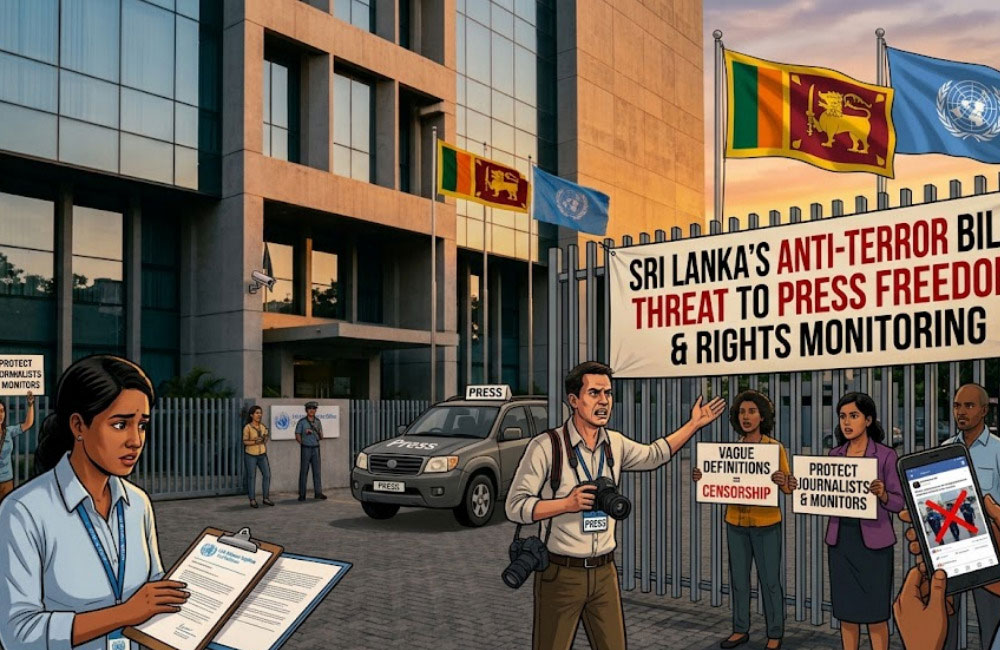
UN raises red flags over Sri Lanka anti-terror bill
The United Nations has issued a stern warning over Sri Lanka’s draft anti-terrorism legislation, saying that proposed restrictions on confidential information threaten press freedom and civil rights monitoring across the island.
The Geneva-based Office of the High Commissioner for Human Rights (OHCHR) expressed serious reservations regarding key speech-related provisions within the Prevention of State from Terrorism Bill published in Colombo.
UN officials pointed out that the government reintroduced controversial definitions in the latest draft despite previous international objections raised when the original text was presented in December 2025.
Under Section 74 of the proposed law, confidential information is defined to encompass details concerning the functions, movements, or locations of specified individuals, alongside codes, passwords, or encryption parameters tied to national security.
The rights body warned that extending the legal definition to cover any material likely to exert an adverse impact on national defence creates an overly broad and vague standard.
Human rights experts highlighted that routine reporting, social media updates on police raids, and field documentation of security operations could face criminal prosecution under these sweeping clauses.
Civil society advocates and media personnel monitoring militarised activities face heightened legal exposure under Sections 2, 8 through 11, 15, and 74 of the draft legislation.
The OHCHR stresses that maintaining such ambiguous statutory language risks criminalising legitimate journalistic work and fundamental human rights oversight throughout Sri Lanka.
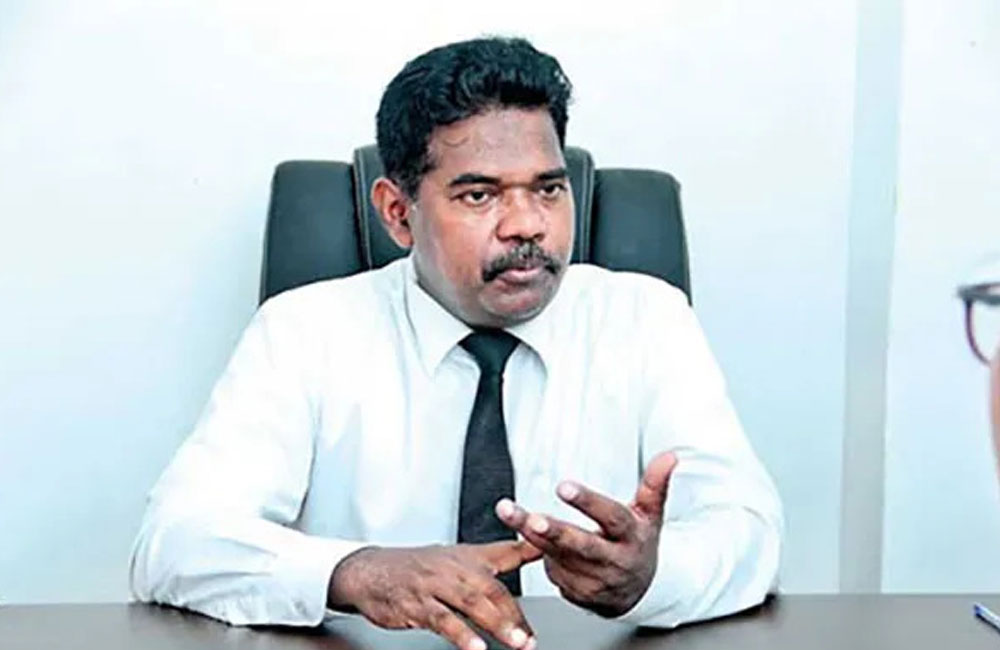
Families of deceased remand prisoners denied compensation, alleges rights group
Families of remand prisoners killed during the Negombo prison riot have not received any financial compensation, drawing sharp criticism from civil rights advocates over alleged discriminatory state policies.
The Committee for Protecting Rights of Prisoners (CPRP) highlighted the disparity in Colombo on Thursday, pointing out that while deceased prison officers received substantial payouts, families of the dead inmates remain uncompensated.
Attorney-at-Law Senaka Perera, speaking on behalf of the organization, noted that none of the deceased inmates were convicts, as the July clashes involved remand detainees and prison personnel.
The cabinet recently approved Rs. 5 million each for families of officers who lost their lives or suffered permanent disabilities during the July 5 and 6 violence.
Deceased prison officers also previously received two million rupees through the Agrahara insurance scheme, bringing their total compensation to seven million rupees.
Prison Spokesman Senaka Pallethenna said that families of dead officers have been paid while acknowledging that families of dead or wounded remand prisoners have received nothing.
The prisoners rights body has formally raised the grievance with the President Office and intends to discuss the matter further with Justice Minister Harshana Nanayakkara.
Legal observers noted that the state bears absolute responsibility for the safety of all individuals held in custody regardless of their legal status.

Anuradhapura sacred zone development: What official records actually reveal
A government urban planning project in Sri Lanka's historic Sacred City of Anuradhapura has sparked intense political debate following public concerns over structural risks to ancient monuments and new zoning regulations.
The controversy centers on recent infrastructure developments and a official gazette notification issued by authorities managing the ancient Buddhist heritage site in the North Central Province.
Allegations
Former lawmaker Udaya Gammanpila publicly warned that subterranean engineering works carried out under the modernization drive might undermine the structural integrity of ancient stupa foundations across the area.
He further claimed that the revised municipal framework could inadvertently absorb places of worship belonging to other religious denominations into the protected heritage boundary.
Following these statements, activist Upali Ratnayake filed an official complaint with the Criminal Investigation Department, accusing the politician of circulating unfounded claims capable of inciting communal discord.
Official clarification
Department of National Physical Planning Director General Ruchira Withana dismissed the political rhetoric, stating that the regulatory framework was a continuation of urban management strategies established in the nineteen-forties rather than a hasty administrative action.
He confirmed that social media reports regarding provisions for non-Buddhist altars or new kovils within the official boundaries were entirely false.
Officials also addressed public inquiries regarding a newly erected five-hundred-metre perimeter barrier around the Ruwanweli Stupa, explaining that the environmentally conscious structure was designed solely to keep out wandering wildlife without impeding worshipers.
Buddha Sasana Minister Dr. Hiniduma Sunil Senevi and District Secretary K.G.R. Wimalasuriya reassured the public that state actions strictly balance pilgrim convenience with heritage preservation.
Officials stressed that every project phase remains under the direct oversight of the Director General of Archaeology alongside certified physical planning experts.
Sustainable Preservation Strategy
The state reiterates that transparent urban management remains essential to securing the architectural legacy of Anuradhapura while safely accommodating millions of visiting devotees annually.

No officers will be shielded over unlawful conduct, assures Police Spokesman
Four police personnel attached to the Homagama Police Station have been interdicted following the death of a twenty-nine-year-old suspect while held in police custody.
Police said that the interdictions affect the Station Officer-in-Charge, the Crimes Division Officer-in-Charge, a Vice Officer-in-Charge from the Narcotics Division who participated in the raid, and a police constable.
The disciplinary action follows the death of the young man shortly after his arrest during a local raid.
Addressing a press briefing in Colombo, Police Spokesman Assistant Superintendent of Police F.U. Wootler stated that the police department will not shield any officer found guilty of unlawful acts, antisocial conduct, or illegal behavior.
He emphasized that a comprehensive inquiry into the incident is currently underway under the direct supervision of the Inspector General of Police.
A dedicated investigative team from the Western Province South Division has been deployed to conduct the inquiry under Section 125 of the Police Ordinance.
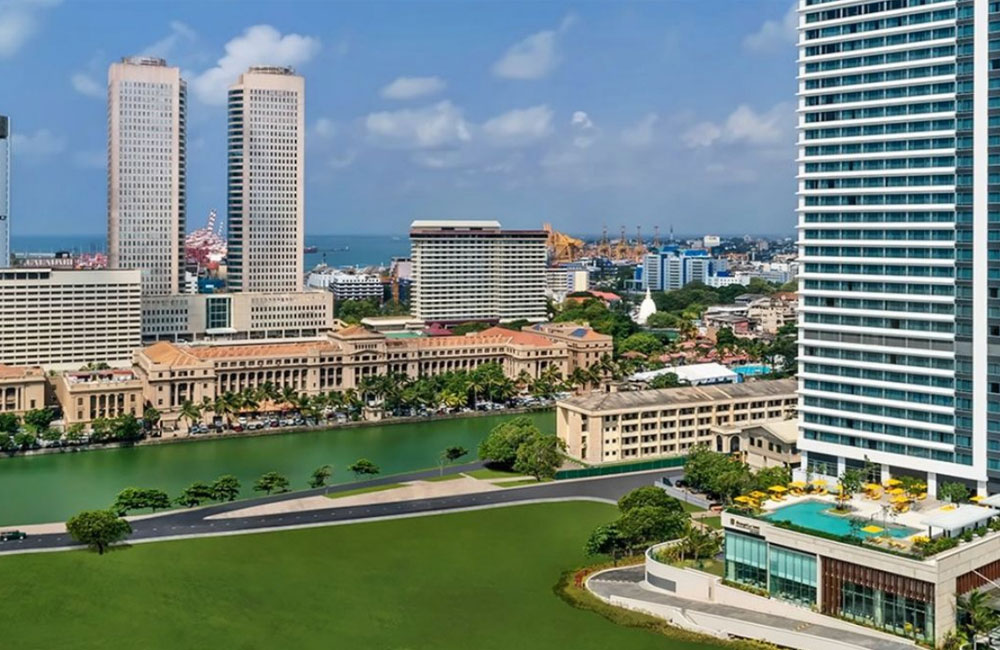
Anti-graft watchdog demands probe into Rajapaksa-era state land sale to private hotel firm
An anti-corruption watchdog in Sri Lanka has formally requested a state investigation into the multi-billion rupee sale of prime public land to a private hotel firm during the administration of former President Mahinda Rajapaksa.
The Citizens’ Power Against Bribery, Corruption and Waste submitted a complaint to the Commission to Investigate Allegations of Bribery or Corruption (CIABOC) on Thursday, demanding the recovery of the property alongside legal action against those involved.
According to the civil society group, the executive powers granted under the State Lands Ordinance were misused to transfer state assets to favoured parties without obtaining required approval from the Cabinet of Ministers.
The organization highlighted serious procedural irregularities in the deal, noting that the prime land was handed over to the private entity without conducting a public auction or initiating a competitive bidding process.
Concerns were also raised regarding the accuracy and validity of the valuation reports utilised to fix the final selling prices for the prime government property.
The watchdog pointed to an extraordinarily rapid timeline for the primary transaction, where the land survey was prepared on 27 December 2010, the legal deed was drafted the following day, and full registration was finalised on 29 December.
Legal documentation reveals that former Presidential Secretary Lalith Weeratunga signed the initial deed transferring a 2.4361-hectare plot to the hotel firm for 75 million US dollars, which equalled roughly 8,250 million rupees at the time.
Records further show that the purchasing company had been registered with the Registrar of Companies on 19 November 2010 under the directorship of Mohamed Sajad Mashoon, merely weeks before acquiring the state asset.
A secondary plot measuring 1.6108 hectares was subsequently sold to the same firm on 15 March 2011 for 5,499 million rupees under identical legal provisions.
In total, the two transactions encompassed approximately ten acres and eleven perches of public land sold for a combined value of 13,749 million rupees.
The formal petition was officially lodged and signed by Kamantha Thushara, the president of the anti-corruption organization.
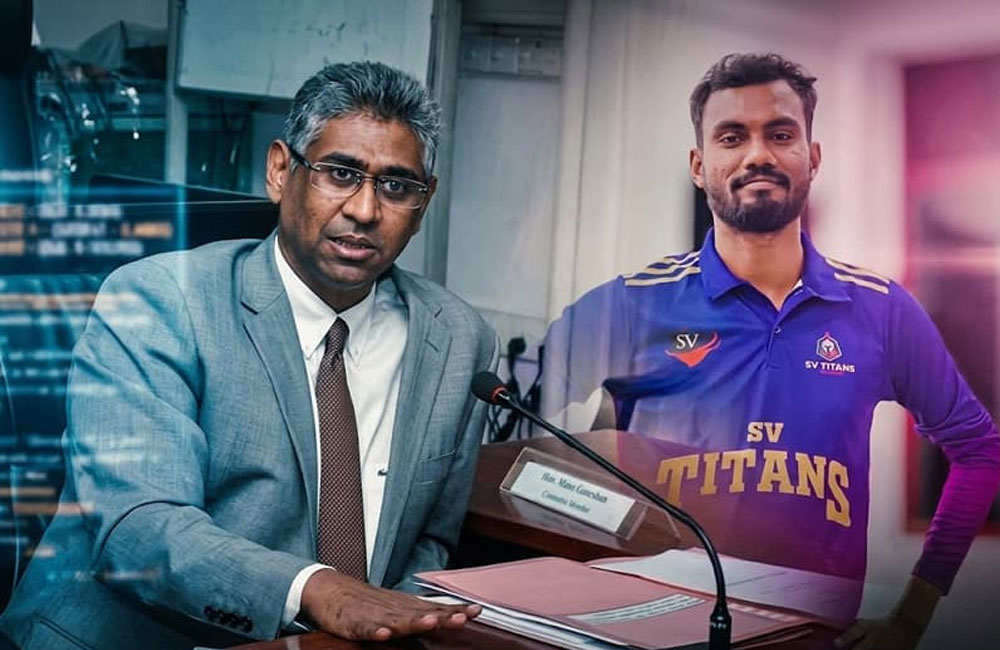
Faiszer explains cross-party legal strategy behind Saudi appeal
A rare joint legal and diplomatic intervention by the government and opposition lawmakers has successfully secured the overturning of a death sentence handed to a Sri Lankan youth in Saudi Arabia.
Speaking to The Daily News, Parliamentarian and President's Counsel Faiszer Musthapha said that the Saudi Supreme Court set aside the execution order against Anojan, a Sri Lankan youth originally convicted under cybercrime and religious offense laws.
The case has now been referred back to the Saudi High Court for re-hearing following a combined appeal funded and led by the Sri Lankan state alongside cross-party legal representatives.
Cross-party legal delegation
Highlighting the background of the intervention, Musthapha explained that Anojan had initially received a five-year prison sentence and a three million riyal fine for a cybercrime offense involving insults to religious figures.
Following an escalation to a capital sentence under Saudi legal frameworks, the youth's parents sought legal assistance, prompting Musthapha to partner directly with state authorities.
A three-member legal delegation comprising Musthapha, Upul Kumarapperuma, and Azad Navavi traveled to Saudi Arabia with the full authorization of the President and the Minister of Foreign Affairs.
The legal strategy navigated strict Saudi judicial categories, specifically distinguishing between pardonable offenses and divine law violations.
To ensure complete representation before the Saudi Supreme Court, the Sri Lankan state covered all associated judicial fees, retaining a specialized local defense team.
Musthapha noted that while the offense itself carried severe legal consequences, the primary objective was to spare the youth from execution and pursue sentence reductions or deportation through formal judicial channels.
National unity
Addressing political interpretations surrounding the joint mission, Musthapha rejected claims that the state intervention was driven by electoral motives regarding minority communities.
He emphasized that the delegation brought together a Muslim lawyer, a Sinhalese lawyer, and a Tamil youth under a unified national identity.
The opposition lawmaker commended the administration's willingness to finance the legal defense and entrust diplomatic responsibilities to opposition lawyers, describing the decision as an example of political maturity and national reconciliation.
Reflecting on future legislative and diplomatic engagements, Musthapha called for a broader shift in Sri Lanka's political culture regarding overseas citizen welfare.
He stated that national interests and the protection of citizens abroad must transcend party loyalties and ethnic divisions, urging both the government and opposition to maintain collaborative channels on matters of national importance.
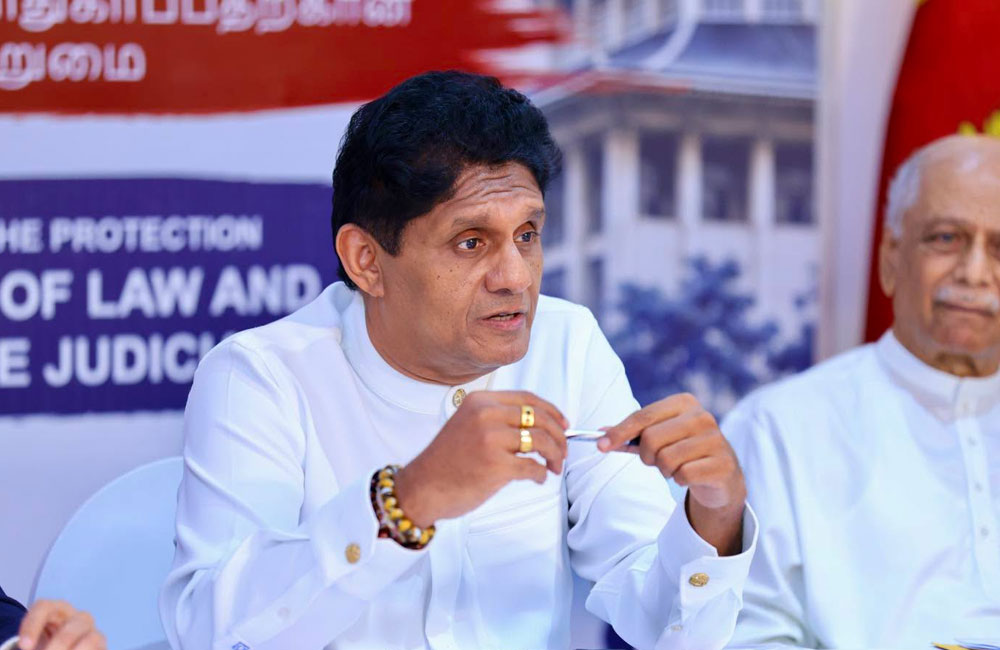
No solutions to human-elephant conflict despite Govt's two-year prosperity claims - Sajith
Despite claims that the past two years have brought prosperity, the government has failed to resolve the human-elephant conflict or secure fair prices for farmers, says Opposition Leader Sajith Premadasa.
He made these remarks during an inspection tour of the Wevagammana area in Lunugamwehera to evaluate the escalating human-elephant conflict.
He pointed out that the human-elephant conflict remains a severe crisis threatening both rural communities and forest resources, noting that farmers are forced to mortgage jewelry and property while borrowing at exorbitant interest rates to fund cultivation, only to face crop destruction, property damage, and loss of life.
Addressing the dual challenge of safeguarding human lives, agriculture, and elephant populations, he argued that achieving these goals simultaneously is entirely possible through community-based environmental conservation programmes that provide sustainable livelihoods for residents in affected regions.
The opposition leader stressed that electric fences must be properly maintained and national parks such as Lunugamwehera developed to attract local and international tourists, generating revenue that directly benefits local communities through people-centric wildlife development initiatives.
He asserted that the current administration must confront these challenges rather than evade them, ensuring that wildlife is protected while citizen livelihoods are simultaneously strengthened.
Broken Promises over the human-elephant conflict
Premadasa criticised the government for failing to deliver on electoral promises to resolve the crisis with the stroke of a pen, noting that governing party politicians and responsible officials are now evading the issue.
As a political party prioritising environmental conservation and human safety, he said the Samagi Jana Balawegaya advocates for a community-led environmental conservation model incorporating innovative solutions such as hanging electric fences.
Effective crop insurance scheme
He emphasised that an immediate solution to mitigate the animosity generated by the human-elephant conflict is the introduction of a formal, efficient, and productive crop insurance scheme.
Noting that the burden should not rest on farmers, he said that the government must sponsor a structured crop insurance program to provide financial relief when harvests are destroyed, criticising the current agricultural insurance framework as nominal rather than functional.
Pay attention to this crisis in 2027 Budget
Urging immediate action ahead of the upcoming 2027 budget proposals, he called for two urgent programs to protect wildlife, human lives, and agriculture.
He reiterated that despite claims of a prosperous two-year period, no tangible solutions have been delivered for the human-elephant conflict, and agricultural producers continue to struggle without fair prices for their yields.

Prolonged global oil price surge risks driving up Sri Lankan inflation - CBSL
Sri Lanka faces the threat of accelerated domestic inflation if international crude oil prices remain elevated over an extended period, Central Bank Governor Dr. Nandalal Weerasinghe said.
He made these remarks during a joint Colombo Stock Exchange and Securities and Exchange Commission institutional investor forum in Colombo this week.
The statement comes as headline consumer price inflation held at a 40-month high of 8.1 per cent in September, largely driven by surging energy costs.
Under state-owned Ceylon Petroleum Corporation adjustments following Middle East geopolitical conflicts, domestic retail fuel prices have surged by approximately 50 per cent.
Governor Weerasinghe said that monetary authorities had initially projected crude prices to stabilise around 90 dollars per barrel by late 2026, though actual market rates have consistently exceeded those estimates.
While the monetary authority maintains that inflation can be contained near current levels even if crude averages 100 dollars per barrel, a prolonged price shock will inevitably pass through supply chains to raise headline consumer figures.
Monetary policy, the Governor emphasised, targets demand-side pressures rather than external supply-side shocks.
Because Sri Lanka relies heavily on imported fossil fuels to drive thermal power generation, freight transport, and agriculture, rising crude import bills filter directly into production costs.
Under strict International Monetary Fund conditions attached to its USD 3 billion External Fund Facility, the state can no longer absorb these costs through subsidies, leaving businesses to pass higher freight and energy expenses onto household consumers.

Repeated US warship visits to Colombo Port intensify scrutiny over Sri Lanka's strategic neutrality
The repeated visits of United States Navy warships to Colombo Port have intensified scrutiny over Sri Lanka’s strategic neutrality in the Indian Ocean.
The littoral combat ship USS Canberra docked in Colombo on October 26 for replenishment, marking its second call to the island state this year following an earlier visit in June.
This docking came just weeks after another American warship, the USS Tulsa, completed a two-day replenishment stop in Colombo earlier in October before continuing its Indo-Pacific deployment.
While diplomatic representatives including US Ambassador Eric Meyer and Sri Lankan defence authorities frame these calls as routine engagements to foster bilateral naval ties, the frequency of American naval visits highlights the growing geopolitical significance of Colombo along vital international shipping routes.
Questions are now mounting over how the administration intends to maintain its non-aligned stance while managing expanding security ties with Washington alongside its formal bid to join the BRICS bloc.
Russian Ambassador Levan Dzhagaryan previously urged Colombo to take concrete steps towards BRICS accession, pointing out that broad consensus among member states remains essential alongside support from Beijing and Moscow.
Though foreign policy experts note that pursuing economic ties with BRICS while granting port access to the United States is not inherently contradictory, critics argue that the government must clearly articulate a transparent framework governing foreign military access to protect national sovereignty.
Defence cooperation yields tangible benefits in maritime security and humanitarian response, yet uncoordinated military engagements risk entangling the island nation in escalating major-power rivalries across the region.

Public interest must guide innovation - PM
Prime Minister Dr. Harini Amarasuriya emphasised that innovation must serve the public interest, research must inform national priorities, and the opportunities created by emerging technologies must be shared more equitably.
She made these remarks while addressing the inauguration of the University of Colombo International Conference 2026, held at the UCFM Tower Main Auditorium of the Medical Faculty.
The two-day academic forum, organised under the theme of advancing an inclusive future through artificial intelligence, sustainability, and innovation, brought together scholars and policymakers to address key national issues.
Addressing the assembly, the Prime Minister stated that higher education institutions hold a critical obligation to drive national progress by fostering rigorous critical thinking, advancing research, and formulating practical solutions to societal challenges.
She reaffirmed that providing equal access to high-quality education remains an essential state responsibility, adding that economic and social development must deliver fair outcomes across every community.
Turning to technological advancement, she observed that artificial intelligence offers major prospects for improving public administration, elevating educational standards, and unlocking new economic growth.
However, she warned that these advantages come with distinct risks, including digital divide disparities, data privacy vulnerabilities, algorithmic bias, and misinformation.
To manage these threats, she called for nationwide efforts to boost digital literacy and insisted that human oversight, ethical accountability, and public welfare must govern every technological application.

Bread and other bakery product prices to rise by Rs. 5
The price of a 450-gram loaf of bread and other bakery products will increase by Rs. 5 from midnight today (30), the All Ceylon Bakery Owners’ Association (ACBOA) has announced.
ACBOA President M.K. Jayawardena confirmed that the Association had decided to increase the prices of bakery products by Rs. 5, with the revised prices taking effect from midnight.
The price revision will apply to the standard 450-gram loaf of bread as well as other bakery products, according to the Association.
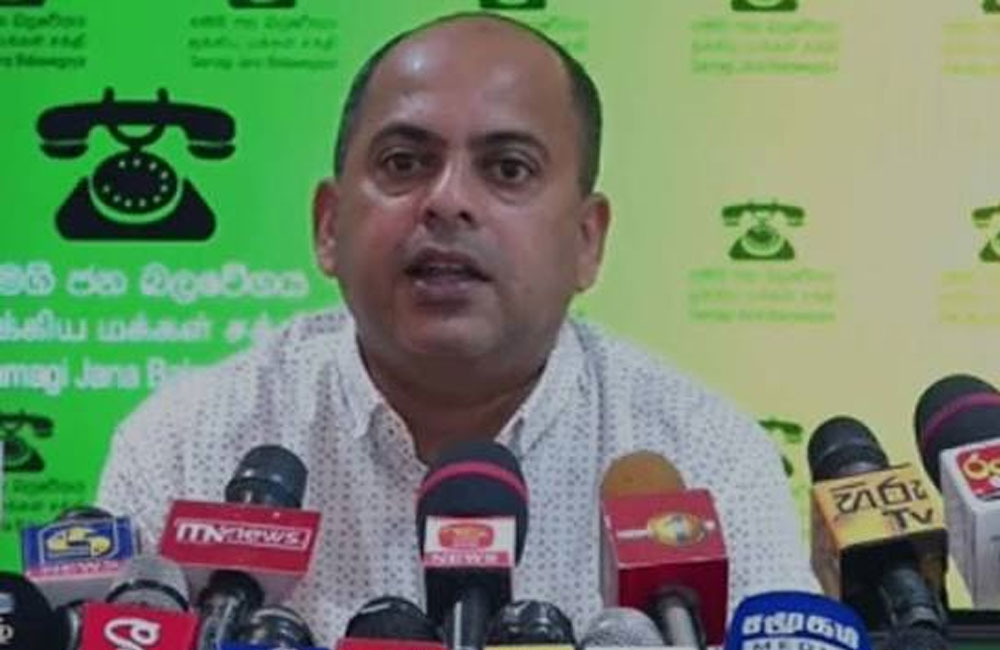
Rule of law concerns keep foreign investors away - Marikkar
Samagi Jana Balawegaya (SJB) Member of Parliament S.M. Marikkar says foreign investors remain reluctant to enter Sri Lanka due to lingering concerns surrounding democracy and the rule of law.
He noted that when capital is deployed overseas, international investors carefully evaluate a host country's democratic framework and judicial enforcement before committing funds.
Marikkar questioned official claims that two domestic firms have injected 500 million US dollars into the Port City project, while revealing that a separate 320 million US dollar Chinese port investment had been pulled out.
Pointing to mounting losses from coal imports, an unresolved controversy over 323 containers, capital flight, and the failure to secure new investments, he said that recent political developments have delivered destruction rather than progress.
Marikkar also urged media professionals to take responsibility for protecting the independence of their craft against legal overreach.
He concluded that journalists share a fundamental obligation to voice strong opposition against restrictive laws that threaten press freedom.
Page 1 of 794