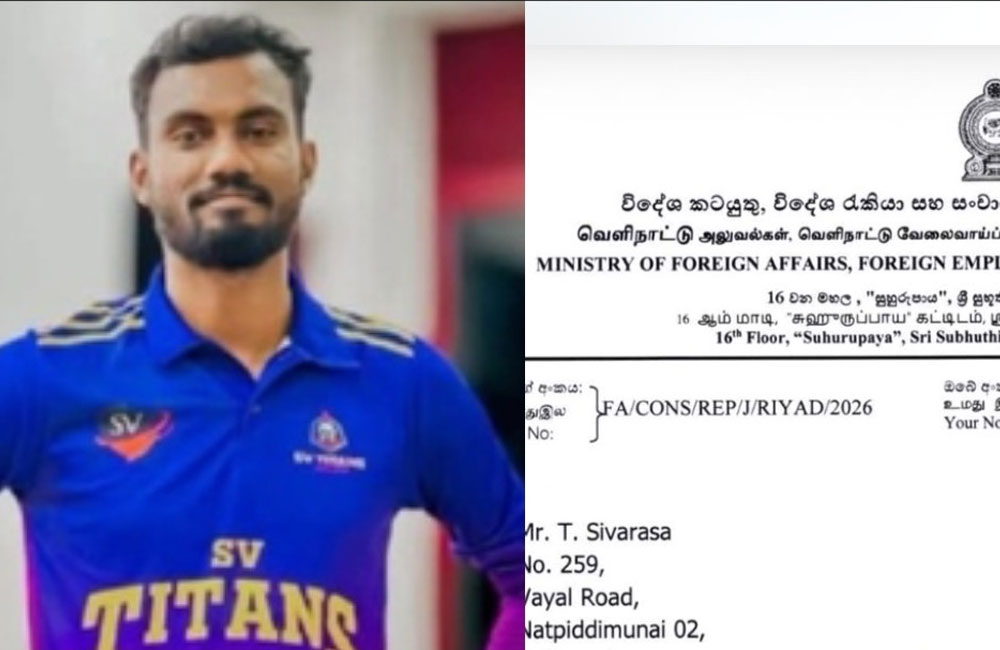
A mother in Narpittimunai is waiting for news that she prays will never come. Her son, Sivarasa Anojan, a Sri Lankan migrant worker in Saudi Arabia, was sentenced by a Saudi court on 15 July to five years’ imprisonment and a fine of SAR 3 million over a social media comment reportedly deemed insulting to Islam and the Prophet Muhammad. His family has subsequently been told that the punishment was increased to death following an appeal.
It is important to be precise about what is known and what remains unconfirmed. Sri Lanka’s Ministry of Foreign Affairs has not officially confirmed that a death sentence has been imposed. The Ministry said on 18 September that it was closely following Anojan’s case through our Embassy in Riyadh, coordinating with the Saudi Embassy in Colombo and engaging the relevant Saudi authorities through diplomatic channels.
Separately, Foreign Ministry sources have said that Anojan’s lawyer, who was present at the proceedings, verbally informed the Sri Lankan Embassy that the punishment had reportedly been enhanced to capital punishment. The Embassy is awaiting the formal written judgment from the Saudi judicial authorities. Until that judgment is received, we cannot know with certainty precisely what the court has decided or the legal reasoning upon which it rests.
There is nevertheless some important and encouraging news. The lawyer has reportedly advised the Embassy that the judgment may be appealed before the Supreme Court of Saudi Arabia within one month, and our Embassy, under the Ministry’s guidance and in consultation with Anojan’s family, is taking steps towards that appeal.
Those steps are welcome. They must now be pursued with the greatest urgency. When a human life may be at stake, there is simply no room for delay.
THE OFFENCE — AND THE CASE FOR MERCY
An insult to the Prophet Muhammad, peace be upon him, causes profound hurt to Muslims everywhere. Each country has its own laws governing such matters. The correctness or otherwise of those laws is not the issue I seek to address here. Saudi Arabia is a sovereign state with its own laws and judicial institutions, and those must be respected.
The issue before us is the life of one of our fellow Sri Lankans.
The facts reported thus far indicate that the case arose from a comment posted online during a debate concerning religious communities in Sri Lanka. The comment was reportedly removed within minutes, and Anojan subsequently issued a public video apology.
The reported comment was offensive and should not be defended. But its removal and the apology that followed provide powerful grounds upon which mercy may now be sought.
Repentance, forgiveness and compassion occupy an honoured place in Islam. It is in that spirit — and with full respect for the laws, courts and sovereignty of the Kingdom of Saudi Arabia — that I appeal to the Saudi authorities for clemency and ultimately for Anojan to be allowed to return to his family.
Sri Lanka and Saudi Arabia enjoy longstanding relations. Friendship between nations is demonstrated not merely in easy times but when one friend is able respectfully to ask another for compassion.
Sri Lanka itself retains the death penalty in law, although it has not carried out an execution since 1976. We therefore know the distinction between the existence of the ultimate punishment in law and the exercise of mercy in practice.
That is the spirit in which our appeal should be made.
THE LESSON OF RIZANA NAFEEK
We have been here before, and the outcome was unbearable.
Rizana Nafeek arrived in Saudi Arabia in May 2005 to work as a domestic helper in Dawadmi. Within weeks, on 22 May 2005, the four-month-old child of her employers died while in her care. Rizana said that the baby had choked while being fed. She was subsequently sentenced to death on 16 June 2007 and was executed on 9 January 2013, more than seven years after the child’s death.
The circumstances surrounding her case remain deeply troubling.
The available evidence indicated that Rizana was only 17 when the child died. A recruitment agency had falsified her passport so that she appeared to be 23, allowing her to travel overseas for domestic employment as an adult.
Human Rights Watch recorded that she had no access to a lawyer until after she had been sentenced to death and identified serious problems concerning interpretation during her interrogation. Rizana subsequently retracted her confession, stating in an affidavit that she had signed the document placed before her under duress.
International law prohibits the death penalty for offences committed by persons below the age of 18, and Saudi Arabia is a party to the Convention on the Rights of the Child.
The failures on the Sri Lankan side began before Rizana ever reached Saudi Arabia. A child was able to leave this country carrying a passport which falsely represented her age. The very systems of recruitment, documentation and departure control that existed to protect vulnerable workers had failed her.
The agents responsible were eventually sentenced by the High Court in Colombo to two years’ imprisonment.
During the later stages of Rizana’s case, considerable emphasis fell upon appeals for clemency, including personal appeals from the Sri Lankan President. Yet the fundamental question of her age — together with serious issues surrounding legal representation, interpretation and her disputed confession — should have remained central to every available legal avenue.
Clemency is an honourable and sometimes indispensable remedy. But it must accompany, rather than substitute for, the strongest possible legal defence.
Rizana’s execution was condemned internationally. Nothing said afterwards could bring her back.
What her case should have left Sri Lanka is one permanent rule: never again should one of our citizens reach the final stages of a capital case overseas without competent legal representation, proper interpretation, honest advice to the family and a Sri Lankan state fully engaged from the beginning.
QUESTIONS THAT CANNOT BE IGNORED
It is against that history that questions concerning the handling of Anojan’s appeal must be considered.
I stress that these are questions. They should not be confused with established findings of wrongdoing.
Many have been publicly raised by Batticaloa District MP Shanakiyan Rasamanickam and deserve answers.
According to Rasamanickam, Anojan’s family proceeded with the appeal after discussions with Deputy Foreign Minister Arun Hemachandra, despite an assessment attributed to the Sri Lankan Embassy that the prospects of success were “extremely low”.
Rasamanickam has further alleged that the family paid Rs. 1,890,766 in legal fees into an account identified with the Secretary to the Ministry of Foreign Affairs after being instructed to do so.
Documents referred to by him reportedly indicate that the appeal was filed in August, while the Ministry’s letter forwarding the appeal to the family was dated 16 September. Rasamanickam has also said that the appeal identified Attorney Adlan Abdullah Al-Subaie as counsel, while the family claims another lawyer appeared in court and that they had not been informed of that lawyer’s identity or contact details.
These allegations have not been established by an independent inquiry, and fairness requires that the Foreign Ministry be given the opportunity to answer each of them.
The Ministry, for its part, says it remains actively engaged through diplomatic and consular channels, is coordinating with the relevant Saudi authorities and is providing Anojan with all possible assistance. Those efforts should be acknowledged.
But the questions remain legitimate.
Who advised the family about the risks and benefits of the appeal? What precisely were they told? Who selected and instructed counsel? How were the legal fees disbursed? Why was there apparently confusion over the identity of the lawyer appearing in court? And were Anojan and his family fully informed at every stage?
If there are satisfactory answers, they should be given. If mistakes were made, they should eventually be identified and corrected.
But accountability must not consume the precious time now needed to protect Anojan’s life.
WHAT MUST BE DONE NOW
The first priority must be to obtain the formal written judgment from the Saudi authorities as quickly as possible. Every remaining legal option depends upon knowing precisely what the appellate court has decided and why.
Secondly, if an appeal to the Saudi Supreme Court remains available within the reported one-month period, there must be no possibility of that deadline being missed. Anojan requires experienced Saudi counsel of appropriate standing, with the lawyer’s identity, instructions and responsibilities clearly understood by his family. Our consular officers should remain in direct contact with Anojan and ensure that he understands his legal position through competent interpretation.
Thirdly, the legal process and the diplomatic process should proceed simultaneously.
Sri Lanka should respectfully make representations at the highest appropriate level seeking clemency or commutation. Such an appeal should be founded upon friendship between our countries, the circumstances surrounding the offence, Anojan’s apology and the humanitarian consequences for his family.
Every person capable of helping should do so.
Political and community leaders have already begun speaking about the case. This is not an issue belonging to the Muslim, Tamil, Sinhala or any other community. Nor should it become another argument between Government and Opposition.
A Sri Lankan citizen’s life may be at stake.
On that, Parliament should be capable of speaking with one voice.
Once Anojan’s immediate legal position has been secured, Parliament should examine the handling of the case carefully and fairly: who advised the appeal, what advice was given about its risks, who selected counsel, how the legal fees were handled and why there appears to have been difficulty obtaining documents.
That examination should not merely allocate blame. It should produce reform.
Sri Lanka sends hundreds of thousands of its citizens overseas to work. When one of them faces the most serious sanction imaginable, there should already be a system in place: a panel of properly vetted overseas lawyers, immediate access to competent interpretation, written legal-risk advice to families, transparent handling of legal fees and clear lines of responsibility between our missions and Colombo.
Workers travelling overseas must also understand something that social media has made dangerously easy to forget: what is typed on a telephone in another country is subject to the laws of that country. A comment made in seconds can have consequences lasting years — or worse.
BRINGING HIM HOME ALIVE
For the Sri Lankan Government, the coming days require a careful balance: respect for Saudi Arabia’s sovereignty and judicial process on the one hand, and the responsibility to use every lawful legal, diplomatic, consular and humanitarian avenue available to protect a Sri Lankan citizen on the other.
Those objectives need not conflict.
Sri Lanka can respect the Kingdom while asking for mercy. It can respect the Saudi courts while ensuring that Anojan receives the strongest legal representation available. And it can maintain a valued friendship while making clear how deeply concerned Sri Lanka is about the possibility that one of its citizens may face an irreversible punishment.
For Anojan’s mother in Narpittimunai, however, these distinctions will understandably seem very distant.
She simply wants her son home.
Rizana Nafeek’s family once waited for their daughter too. Their waiting ended in tragedy.
We cannot rewrite Rizana’s story. We can, however, demonstrate that we learned from it.
This time Sri Lanka must use every lawful avenue available, every diplomatic friendship it possesses and every opportunity for mercy that remains.
The objective is not complicated.
Bring Sivarasa Anojan home alive.
By Faiszer Mustapha PC MP
Leave your comments
Login to post a comment
Post comment as a guest