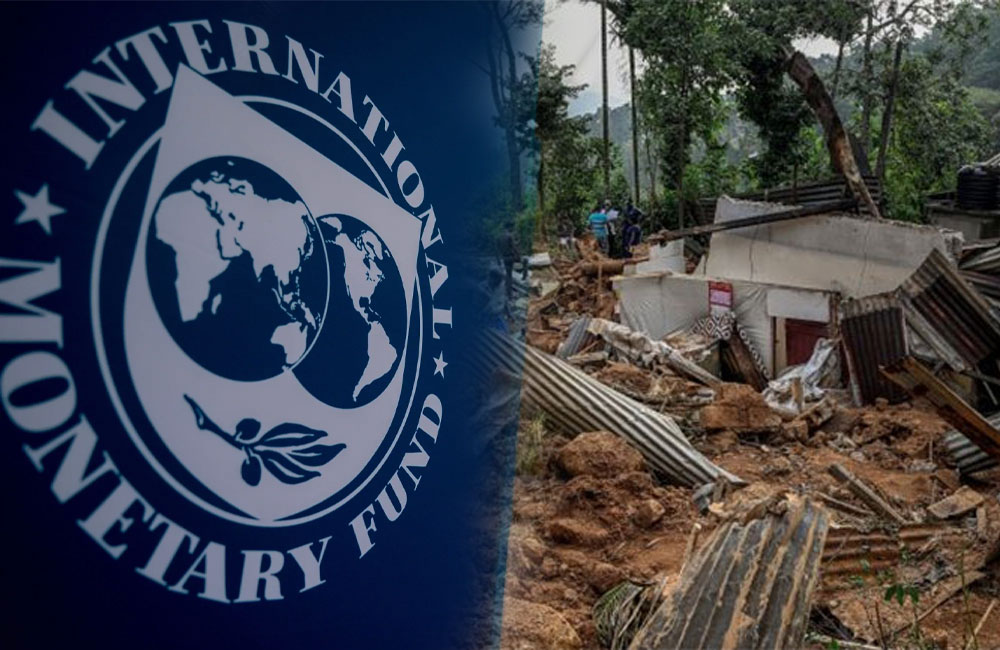
Sri Lanka has secured $206 million in emergency financing from the International Monetary Fund (IMF) through its Rapid Financing Instrument (RFI), as the country reels from the devastating impact of Cyclone Ditwah. The government has formally assured the IMF that it will preserve fiscal discipline and maintain an open trade and payments regime, even as economic shocks threaten to undermine a fragile recovery.
The cyclone has caused widespread destruction across the country. According to the World Bank, initial damages are estimated at $4.1 billion, while the International Labour Organisation (ILO) places the broader economic impact at $16 billion. The IMF has forecast that Sri Lanka’s balance of payments deficit will widen by around $700 million, highlighting the urgent need for liquidity support.
In a Letter of Intent (LOI) dated 10 December, co-signed by President and Finance Minister Anura Kumara Dissanayake and Central Bank Governor Dr. Nandalal Weerasinghe, the government detailed its immediate response, the scale of fiscal needs, and its commitments under the IMF’s Extended Fund Facility (EFF). The LOI emphasized fiscal prudence, stressing that recovery and reconstruction will be funded primarily through spending reprioritization, reallocation of budget allocations, and contingency funds. The government noted that a supplementary budget in 2026 would only be considered if absolutely necessary.
The LOI further pledged full compliance with the Public Finance Management Act and international transparency standards, ensuring emergency spending is accountable and legally sanctioned. On monetary policy, the Central Bank reaffirmed its commitment to avoid financing the deficit through money creation, in line with IMF-supported reforms, and requested an expedited update to the Safeguards Assessment.
The government also assured the IMF that it will maintain an open external payments system. It committed not to introduce new restrictions on international transactions, trade, or currency practices, in line with Article VIII of the IMF’s Articles of Agreement, a measure crucial to restoring investor confidence and stabilizing foreign reserves.
While the RFI provides immediate liquidity, analysts warn that Sri Lanka’s fiscal resilience will be severely tested. The combination of disaster recovery needs and existing economic vulnerabilities could strain the government’s ability to maintain reform momentum, safeguard price stability, and protect the banking sector.
The Fifth Review under the EFF is expected early next year. Despite the challenges, the government reaffirmed its commitment to structural reforms, debt sustainability, financial sector stability, governance improvements, and growth-oriented initiatives, signaling to international partners that long-term economic stabilization remains a priority even amidst crisis.
Leave your comments
Login to post a comment
Post comment as a guest