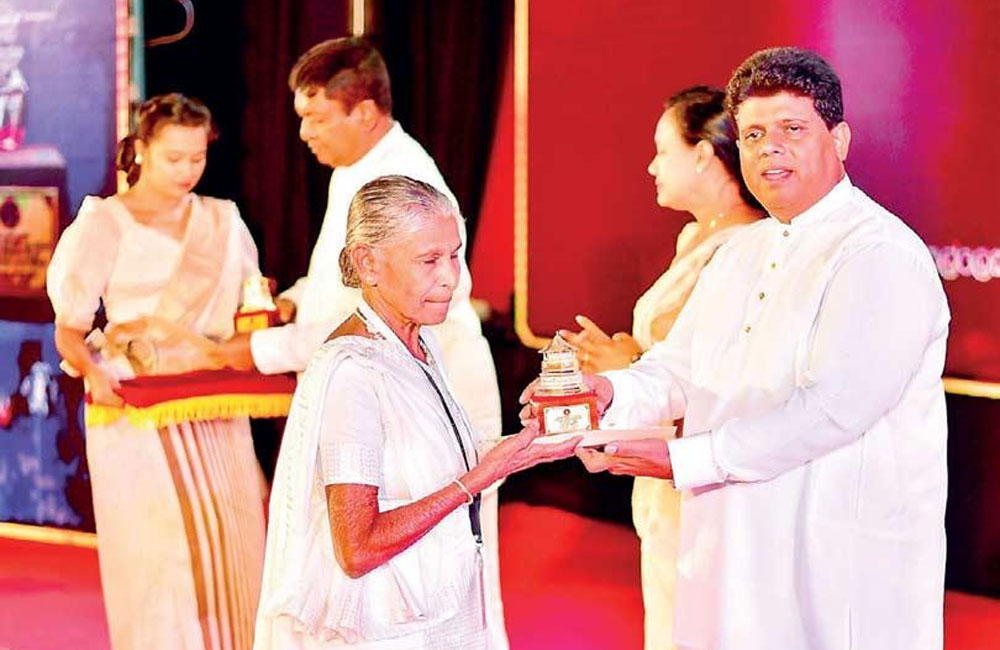
Among the 423 presentations awarded for the service extended to the Dalada Maligawa during the last 15 years, only one woman received the recognition. She was ‘Alathi Amma’.
‘Alathi Amma’, enters the inner shrine room and closes the door while the services monks exit the shrine. She, sometimes with another member from the same family, does the rituals on Wednesdays, where the Sacred Tooth Relic is bathed with perfumed water, specially during annual Esala Perahera and during the exposition of the Sacred Relic.
The ritual is simple but dignified and some tend to call her as the stepmother of Buddha. What she does inside the inner shrine without the service monks, is not questioned. But the service monks are aware of the ritual and they do not speak on this ritual.
The ritualistic duties have been passed on to them over the years from generation to generation. This family is not aware of the origins of these practices. It is believed that this ritual is inherited from two Ranaweera families and has been passed on to them by their ancestors.
There are no corresponding words to describe the ritual. One sees only that these two women enter the inner shrine with a wick dipped in pure coconut oil lighted and placed on a betel leaf. They do not speak about this ritual. But the service monks knows the ritual and they too does not speak about this ritual.
During the period of late Venerable Rambukwella Vipassi Thera, who was the Mahanayake of the Malwatta chapter, this scribe wished to know the origins of this ritual, and the status symbol of these two Alathi Ammas as when they move into the inner shrine with the service monks stepping out and the doors are closed. While waiting inside the inner shrine, I took the liberty to discuss with the office of ‘Alathi Amma’ and how it came into the Sri Dalada Maligawa. I was rechecking what was told by my uncle, who was a monk and had conducted service in the inner shrine around four times.
Venerable Vipassi Thera summoned one of the Alathi Ammas in service and asked her whether she knew how they had come into service. She told the Mahanayake that this was bestowed upon them. Her reply was that it has been passed to them from the previous generation when the elders pass away. But they were unable to trace the origins.
The Mahanayake thera, in his observation, said that this could be because kings at that time were Hindu or aligned to Hinduism although they performed Buddhist religious performances, this might have become a custom. Yet, he added that this needs to be verified. The thera also attributed to the fact that Hindu kings allowed women to perform rituals for blessings to ward off evil effects, when they return to the palace after attending official functions outside the palace. The Mahanayake thera further explained that this would be the same ritual now performed for Sacred Tooth Relic. He added that there is nothing wrong in these rituals as it wishes for wellbeing of everyone.
The ritual is to say “ Ayu Bo Wewa” thrice. It is a simple yet dignified process.
(Source:dailymirror.lk)
Leave your comments
Login to post a comment
Post comment as a guest