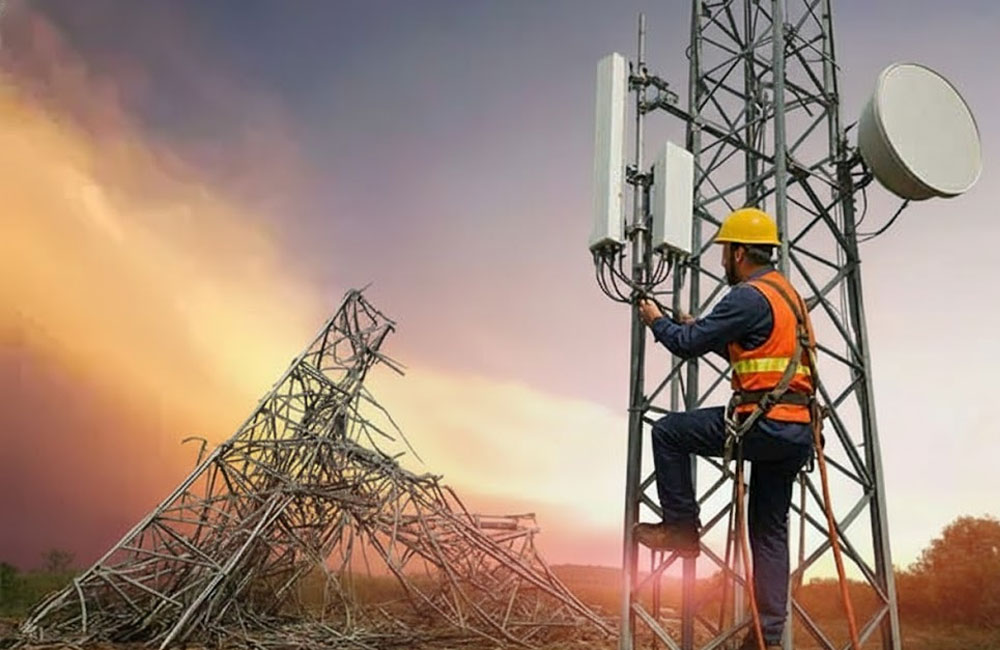
Sri Lanka’s telecommunications sector is undertaking one of its largest emergency restoration operations in years after Cyclone Ditwah ripped through the country, severing fibre backbones, disabling thousands of towers, and exposing structural vulnerabilities in the national connectivity grid.
Minister of Digital Infrastructure Eranga Weeraratne noted that the country’s fibre backbone had been cut in 11 locations, causing cascading failures across the network.
By Sunday evening, repair teams had restored most routes, leaving only two critical fibre lines still down, including the major link to Nuwara Eliya.
The fibre architecture, which channels all national traffic to Colombo before redistribution, collapsed in key segments, disrupting mobile broadband, enterprise lines, and emergency communications across multiple provinces.
The biggest blow came from the mobile-tower network. Out of Sri Lanka’s 16,000 communication towers, 4,000 went offline at the height of the crisis not due to structural collapse, but primarily because of power outages and fuel shortages for generators.
The minister said he could not yet confirm whether any towers were physically destroyed by the cyclone. Since then, operators have managed to restore approximately 2,500 towers, leaving around 1,500 still inactive or operating on temporary backup solutions.
The Telecommunications Regulatory Commission of Sri Lanka (TRCSL) convened emergency sessions with Dialog Axiata, SLT-Mobitel, and Hutch, directing them to synchronise generator deployment, battery rotation, and field team mobilisation with the Ceylon Electricity Board.
With power failures proving the dominant cause of tower shutdowns, restoration teams have focused heavily on stabilising electricity supply, relocating fuel stocks, and installing temporary power systems in districts such as Colombo, Gampaha, Kalutara, Kandy, and Ratnapura.
International partners have also become crucial to the national recovery effort. Huawei Technologies Lanka activated its Business Continuity Management mechanism, deploying more than 80 engineers to assist operators with fibre repairs, transmission module replacement, and on-site diagnostics in severely affected regions.
A rare and significant addition to the response has been the involvement of Starlink, which provided satellite broadband terminals to restore connectivity in blackout zones where fibre breaks and dead towers left entire communities cut off.
These satellite links have enabled coordination between local authorities, disaster-response teams, and health services while ground-based networks remain under repair.
Beyond the immediate crisis, experts point to the long-term implications. With climate-driven disasters intensifying, the telecom sector’s heavy dependence on the national grid, limited redundancy in fibre routes, and insufficient backup power capacity highlight structural vulnerabilities.
The Cyclone Ditwah disruption has revived calls for climate-resilient tower design, elevated switching centres, dual-path fibre routing, and mandatory disaster-preparedness standards for operators.
What is clear is that the disaster has become a watershed moment for Sri Lanka’s telecommunications strategy.
The rapid collaboration between government, operators, international partners, and satellite providers has kept the country connected in the worst conditions but it has also revealed how urgently the sector must evolve to withstand future shocks.
Leave your comments
Login to post a comment
Post comment as a guest