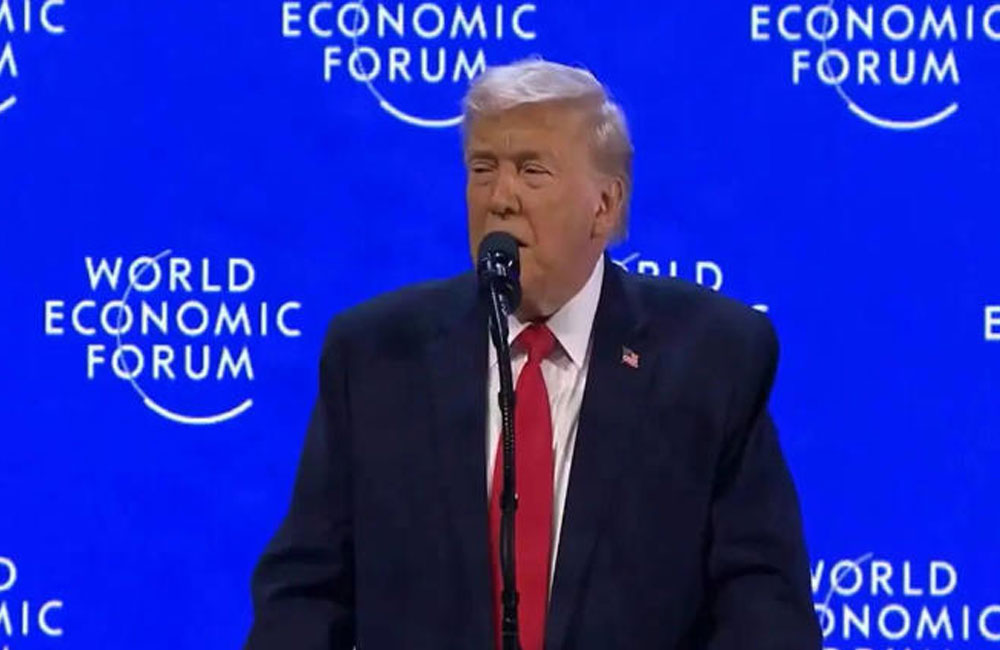
donald Trump arrived at the World Economic Forum this year not as a cautious participant in global dialogue, but as a man delivering a victory lap.
Marking one year since his return to the White House, the U.S. President used the Davos podium to proclaim what he called the “fastest and most dramatic economic turnaround in American history,” casting the United States as the undisputed engine of global growth and warning allies that the era of one-sided dependence on Washington is over.
“Growth is exploding. Productivity is surging. Investment is soaring. Incomes are rising. Inflation has been defeated,” Trump told the packed hall. “We were a dead country. Now we are the hottest country anywhere in the world.”
An Economic Boast, Delivered Without Apology
Trump’s core message was unmistakable: his economic model works, and the world should pay attention.
He pointed to 5.4 per cent projected fourth-quarter growth, core inflation at 1.6 per cent, and 52 stock market record highs since his election victory. According to Trump, those gains added $9 trillion in household wealth, while 1.2 million Americans moved off food assistance.
“Virtually no inflation and extraordinarily high economic growth,” he said. “Growth like our country has never seen before.”
The President repeatedly contrasted his record with that of the Biden administration, which he blamed for “stagflation, open borders and economic decline,” framing his return as a national rescue mission completed in record time.
Deregulation, Tariffs and a Smaller Government
At the heart of Trump’s argument was a rejection of what he called Western economic orthodoxy large government, green energy mandates and mass migration.
He highlighted the removal of 270,000 federal bureaucrats, a 27 per cent reduction in the budget deficit, and a regulatory rollback that he claimed eliminated 129 old rules for every new one introduced.
“Instead of empowering bureaucrats, we’re firing them,” Trump said. “They hated me at first. Now they love me they’re making more money in the private sector.”
Tariffs, often criticised by economists, were recast as a strategic weapon that Trump said cut the U.S. trade deficit by 77 per cent in one year, boosted steel production and triggered a surge in factory construction.
“Everyone said tariffs would cause inflation,” he told the audience. “We proved them wrong.”
Energy Nationalism and the Rejection of Green Orthodoxy
One of the speech’s sharpest departures from Davos consensus came on energy. Trump dismissed renewable-focused policies as economically destructive, arguing they hollowed out Western industry while enriching rivals.
“Instead of building ineffective, money-losing windmills, we’re opening power plants,” he said.
He cited record oil and gas output, falling fuel prices and a renewed embrace of nuclear energy as proof that cheap, reliable power not climate idealism drives prosperity.
“You’re supposed to make money with energy,” Trump said. “Not lose money.”
A Warning to Europe
While declaring affection for Europe, Trump issued an unmistakable warning: the continent is weakening itself through energy restrictions, high costs and what he called socially destabilising migration.
“Friends come back and say, ‘I don’t recognise it anymore,’” he said. “And not in a good way.”
He urged European leaders to prioritise growth, security and self-reliance, arguing that America could not indefinitely shoulder the burden of Western stability.
Greenland, NATO and American Power
The most controversial section of Trump’s address centred on Greenland, which he declared a “core national security interest” of the United States.
“No nation or group of nations is in any position to secure Greenland other than the United States,” he said, calling for immediate negotiations with Denmark over acquisition.
Trump framed the proposal as a defensive necessity, not expansionism, insisting it would strengthen NATO rather than weaken it.
“We want strong allies,” he said. “Not seriously weakened ones.”
Peace Through Strength
On global security, Trump presented himself as both a deal-maker and a deterrent, claiming progress in ending multiple international conflicts while rebuilding American military dominance.
“I don’t want to use force,” he said. “I don’t have to.”
His message to allies was blunt: American protection comes with expectations and patience is not unlimited.
A Speech That Redefined the Room
Trump’s Davos address was not an attempt to blend in. It was a challenge to economists, environmentalists, allies and adversaries alike.
In a forum built on consensus, Trump delivered confrontation. In a space devoted to multilateralism, he argued for national power first.
Whether embraced or resisted, his message was clear:
“When America booms, the entire world booms.”
(Source:lankanews.lk)
Leave your comments
Login to post a comment
Post comment as a guest