Economic

Business opportunities prevail between Qatar and Sri Lanka: Group CEO of Doha Bank
Sri Lanka has enjoyed close ties with Qatar, with over 120,000 Sri Lankans making up for close to 2.68mn population of Qatar. Diplomatic relations between Sri Lanka and Qatar persists since 1976. Sri Lanka has preferential and free trade agreements with India, Pakistan, Iran, Egypt, Singapore and Israel. Trade volume between Qatar and Sri Lanka stood only at $52.5mn in 2016.
In March 2015, His Highness Emir Sheikh Tamim bin Hamad al-Thani and Sri Lankan President Maithripala Sirisena witness the signing of an agreement in Colombo.
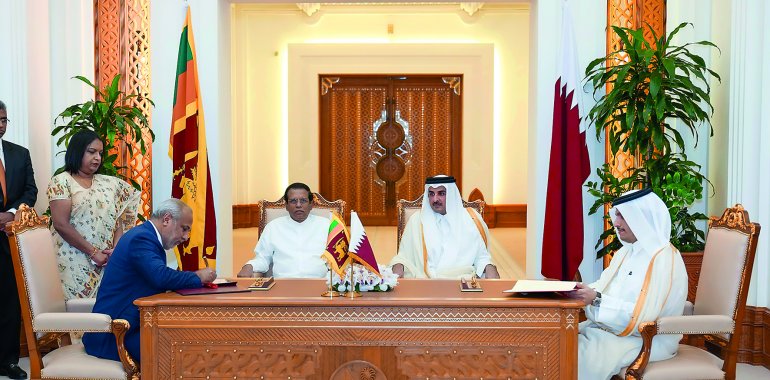
Emir H H Sheikh Tamim bin Hamad Al Thani held a session of official talks with President of the Democratic Socialist Republic of Sri Lanka, H E Maithripala Sirisena in March, 2017.
According to the Sri Lankan media, the two sides signed three agreements for co-operation in sports, youth affairs and media sectors. The memorandums of understanding (MoU) for strengthening co-operation in the field of sports will focus on the development of sports for handicapped persons and sports facilities.
His Highness the Emir has pledged financial assistance to resolve the drinking water problem of the people in the north and east. In October 2017, a high-level trade delegation led by Qatar’s Minister of Economy & Commerce Sheikh Ahmed bin Jassim bin Mohamed al-Thani participated in the second Qatar-Sri Lanka Joint Committee for Economic, Commercial and Technical Cooperation commenced in Colombo.
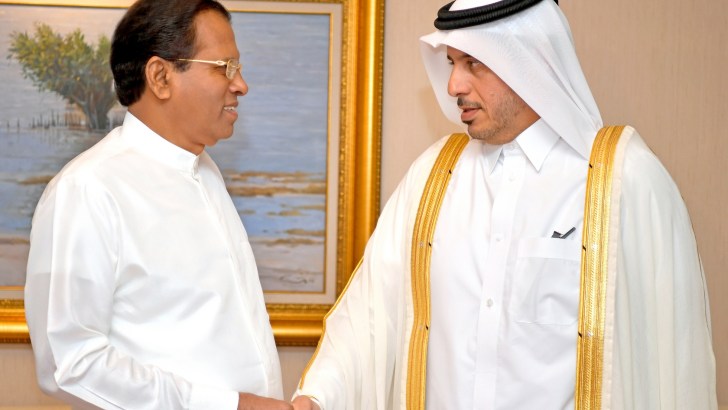
Bilateral meeting between President Maithripala Sirisena and the Prime Minister of Qatar Abdullah bin Nasser bin Khalifa Al Thani in October,2017.
In addition, there are 210 Lankan companies established in partnership with the Qatari side with a capital of $12.5mn in 2017. The Sri Lankan trade minister also said while there were only 1,700 Qataris who visited Sri Lanka in 2016, there are still potential opportunities in the tourism sector considering that there are 28 flights a week linking the two countries. In a speech, Sheikh Ahmed said the forum serves as a bridge that links Qatar and Sri Lanka’s private sectors and a platform that would promote the investments of Sri Lankan companies in Qatar.
Sri Lanka’s economy grew by 3.3% in the third quarter of 2017, 4% in the second quarter of 2017, and 3.8% in the first quarter of 2017. IMF expects Sri Lanka to report GDP growth of 4.8% and 4.9% during 2018 and respectively.
Agriculture sector of the economy has been affected badly from the unfavourable dry weather conditions during the last 18 months resulting in severe drought in some areas while many districts in the other parts experienced floods and landslides due to heavy rains.
In September 2017, Sri Lanka’s central bank has decided to maintain the Standing Deposit Facility Rate (SDFR) and Standing Lending Facility Rate (SLFR) at their current levels of 7.25% and 8.75%.
Loans and advances growth from till August 2017 (YOY basis) at 20.41%; and deposits growth till August 2017 (YOY basis) at 22.19%. Gross NPL ratio stood at 2.7% of total loans in the second quarter of 2017. The Capital Adequacy Ratio stood at close to 15% during the second quarter of 2017. The return ratios like RoE and RoA stand at 18.2% and 1.4% for the Sri Lankan banks during second quarter of 2017. S&P Global Ratings affirmed the “B+” Foreign Currency LT credit rating of Sri Lanka on November 20, 2017.
At the same time, the rating agency revised outlook to stable from negative. Moody’s however, has rated the Government of Sri Lanka as ‘B1 negative’.
Sri Lanka’s imports from Qatar have primarily been polymers of ethylene, 37% of Sri Lanka’s exports to Qatar were bananas followed by food preparations, tea, and vegetables. Sri Lanka can support Qatar in food.
Qatar can continue to support in polymers when it plans to expand hydrocarbon sector. Sri Lanka is keen on seeking Qatari investment in tourism, power and health sectors, says Rajitha Senaratne, Minister of Health and Indigenous Medicine, who was on a two-day visit to the country in October 2016.
Discussions also focused on the tax relaxations introduced by the Sri Lankan government for foreign investors. Qatar can invest in Sri Lanka’s major infrastructure projects via Public Private Partnership model. Qatar can invest in Sri Lanka’s aviation and navigation sector. Bilateral relationships can be explored such as fruits and vegetables, spices, cereals, rice, boat building, fabrics, construction services, garments and Information technology. There are business opportunities between Qatar and Sri Lanka.
Dr. R. Seetharaman is Group CEO of Doha Bank.
India biggest buyer for SL hand looms’
After nearly two decades of a continued battle for its survival, the handloom sector of Sri Lanka has finally turned around.
“The handloom sector of Sri Lanka faced a setback and declined. However, several government initiatives have successfully revived the sector.
Today, many Lankan handloom makers are reaping good profits” said the Minister of Industry and Commerce Rishad Bathiudeen addressing the inauguration of the annual handloom expo and awards event “Ran Salu”.
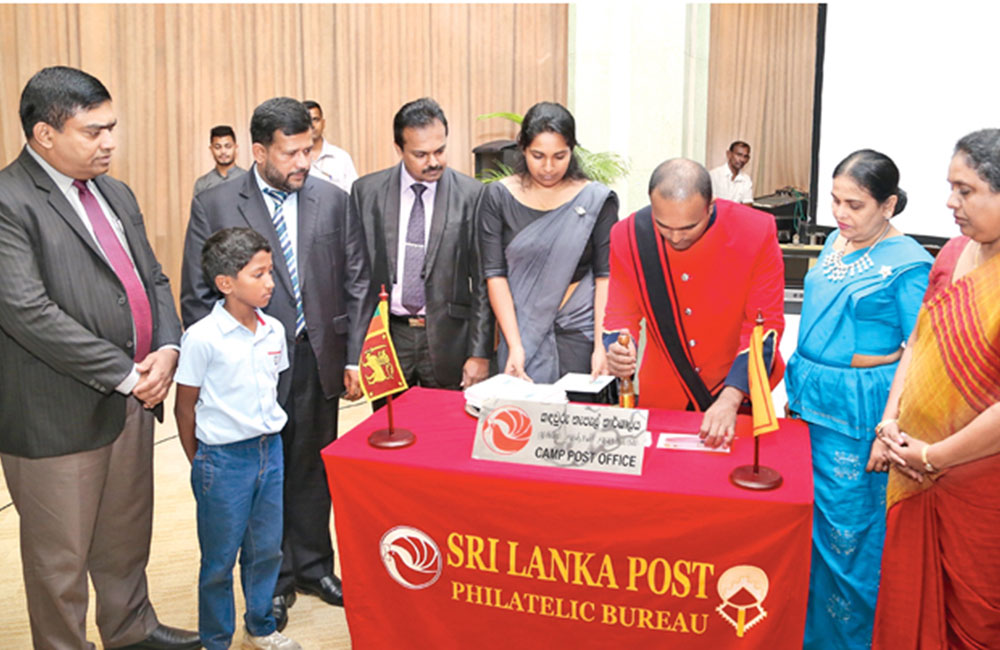
The event also witnessed the issuance of a postal stamp by the Postal Department of Sri Lanka commemorating celebrating the 105 year anniversary of the Handloom Textile Training Centre in Rajagiriya. The handloom sector of Sri Lanka faced a setback and declined, starting from the 1990s. However, several government initiatives have successfully revived the sector.
“Today many Lankan handloom makers are reaping good profits.
I am pleased to say that at present, all handloom products made in Sri Lanka are selling fast, and we are unable to meet the demand.
Most sales revenues are from the Sri Lankan buyers and the rest of revenues are from tourists” said Minister Bathiudeen.”
Sri Lankan handlooms are also being exported now-India being the largest buyer. Most Lankan handloom makers are in the East. Among the other leading provinces for handlooms are central and Southern.
“Over 70% of handloom makers are women and therefore strengthening this sector is a way to empower rural women. This sector is also a contributor to government self-employment creation plans.”
“We are working on establishing a handloom dye and colour centre in the North Central Province with the latest technology. Still, it is important for the sector to recognize excellence. After ten years, we have sent Sri Lankan handloom makers to overseas training.”
Minister Batiudeen also felicitated Ms Chandani Thenuwara-a veteran of Sri Lankan handlooms and who formerly served at the Department of Textiles.
“My biggest contribution to Lankan handlooms is the introduction of shaded colouring technology to the fabrics which was not possible in pre-1970s,” said a jubilant Ms Thenuwara.
Sri Lanka most popular destination on Eurasia review
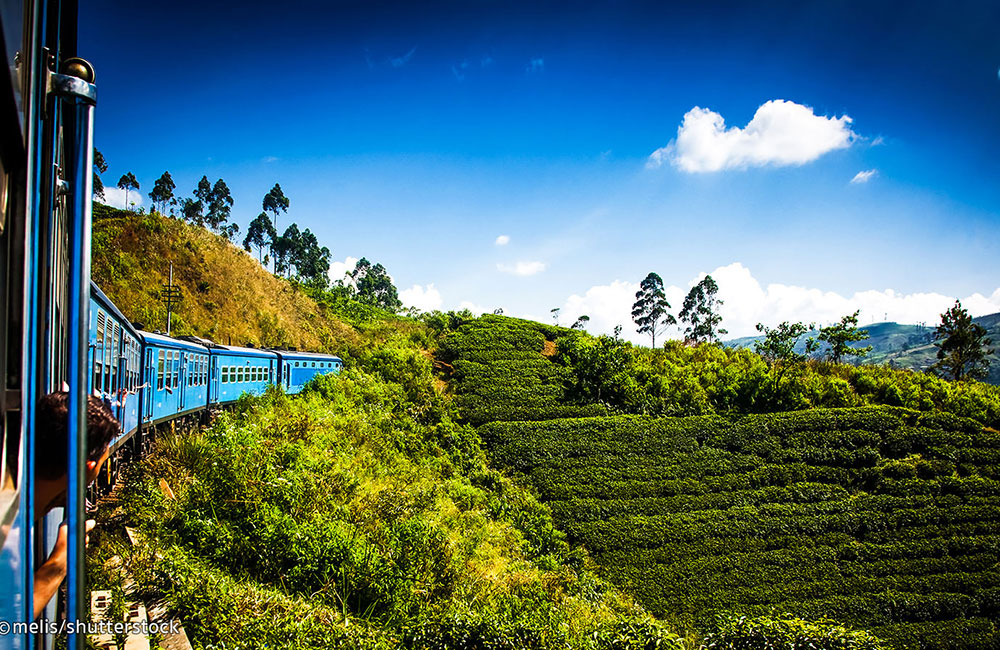
Sri Lanka is placing its name on the global map as a sought-after destination by various international news feature reviews, as Eurasia review mentioned Sri Lanka as the most sought-after destination in Asia with reference to the 2018 Virtuoso Luxe –Australian report.
According to the Virtuoso Report Sri Lanka is becoming one of the most popular global destinations and emerging destinations from the key findings of the 2018 Virtuoso Luxe – Australian edition report.
Sri Lanka Tourism has reaped the fruits of its effort to promote Sri Lanka across the globe by winning several awards as an upcoming  destination this year, as Asia’s leading adventure tourism destination, Asia’s leading destination at the World Travel Awards, becoming the best long-haul destination at the family traveler awards held in UK, and also was voted as finalist for culture and holiday destination category at the travel bulletin star awards which was held recently in London. These were a few of the endorsements which Sri Lanka won for its holiday friendly atmosphere on par with the ongoing peace process in the country, declaring the country as a safe country to travel. Sri Lanka also has been featured on the National Geographic channel, Lonely Planet and many other international channels and also on social media platforms.
Eurasia Review is a news and analysis journal which is widespread over several continents including South Asia, Europe and Latin America, Russia, and North Africa. It covers news, business, social, entertainment and environmental stories from across the globe. Being featured in international news journals gives Sri Lanka a global recognition as a traveller friendly destination which has so much to offer and explore and official from Sri Lanka Tourism said.
Source : Daily News
Material near-term improvements in Sri Lanka's fiscal strength unlikely: Moody's
Moody's Investors Service says that Sri Lanka's (B1 negative) high general government debt levels, very low debt affordability, and fragile external payments position continue to present the sovereign with material credit challenges.
In particular, persistently high government liquidity and external vulnerability risks will maintain pressure on the sovereign's credit profile, as large external payments come due in 2019-2022.
Looking ahead, continued advancement of reforms that support fiscal consolidation and reduce external vulnerabilities under Sri Lanka's current IMF program will be critical to mitigating macroeconomic risks and strengthening the sovereign's credit profile.
Moody's analysis is contained in its just-released report titled "Government of Sri Lanka: FAQ on fiscal reforms, and exposure to liquidity and external vulnerability risks".
The report provides Moody's view on the following three questions:
1) Have recent fiscal reforms improved Sri Lanka's sovereign credit profile?
2) What is your assessment of government liquidity and external vulnerability risks?
3) Will Sri Lanka's GDP growth contain credit risks?
On the issue of whether fiscal reforms in Sri Lanka have improved the sovereign's credit profile, Moody's says that material near-term improvements in the country's fiscal strength are unlikely. Moody's explains that beside the implementation of the Inland Revenue Act — aimed at broadening the tax base through a simplification of the tax system — more sustained fiscal consolidation will be challenging.
Moreover, contingent liability risks related to state-owned enterprises will persist.
Moody's also points out that Sri Lanka's low tax efficiency and tax collection methods provide significant scope to broaden the tax base, increase tax revenue and eventually lower its elevated debt burden, which was equivalent to just under 80% of GDP in 2017. Ongoing revenue reforms under the IMF program, particularly in tax policy and administration, will support a gradual decline in the debt burden over the medium term.
Moreover, particularly large external maturities are due in 2019-2022. With significant market access required to refinance maturing debt — including a sizeable portion denominated in foreign currency — government liquidity and external vulnerability risks will remain elevated.
Moody's points out that an ongoing accumulation of reserves and implementation of an effective, predictable and transparent liability management strategy would support the sovereign credit profile, by reducing uncertainty around the cost of future refinancing.
With the question of whether Sri Lanka's GDP growth contains credit risks, Moody's says that the country's growth potential and relatively large economy and high income levels when compared with similarly rated sovereigns provide the economy with some shock absorption capacity and will help limit some of the risks from its high debt burden.
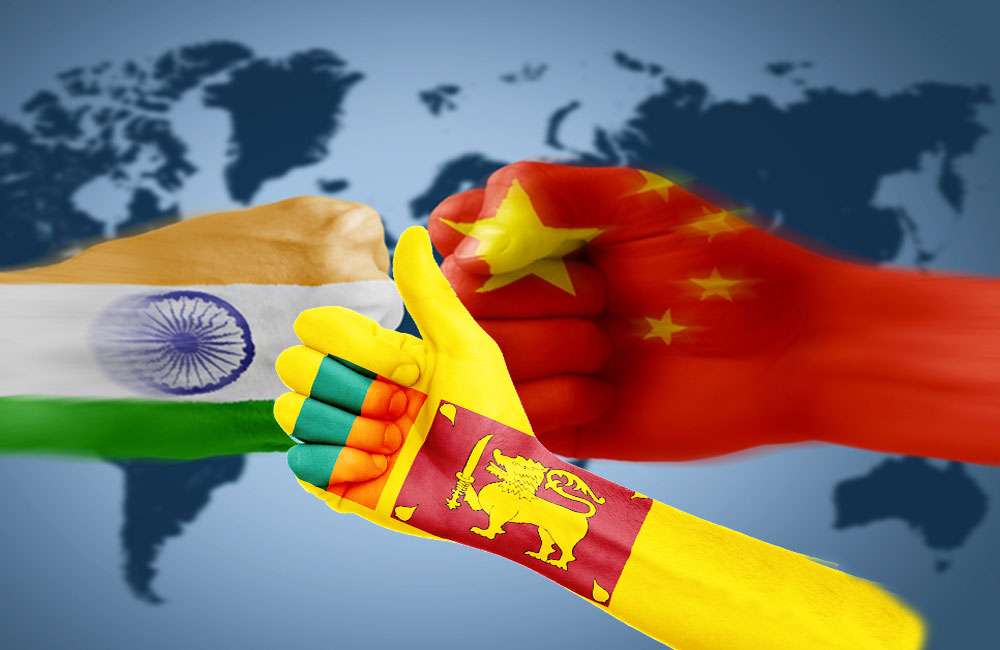
India-Sri Lanka ties improved in 2017 despite port lease to China
Though issues over a proposed economic and technology pact, poaching by fishermen in each other's territorial waters and China's influence in the island nation remained, President Maithripala Sirisena and Prime Minister Ranil Wickremesinghe have kept the relationship warm by persisting with top-level engagements.
India and Sri Lanka managed to keep their relationship warm in 2017 with high-level exchanges and signing of pacts despite New Delhi's concerns over China's forays in the island nation, including its acquisition of the strategic port of Hambantota.
Though issues over a proposed economic and technology pact, poaching by fishermen in each other's territorial waters and China's influence in the island nation remained, President Maithripala Sirisena and Prime Minister Ranil Wickremesinghe have kept the relationship warm by persisting with top-level engagements.
Historically, India-Sri Lanka ties have witnessed ups and downs. In the 1980s, the Tamil question dominated relations and more recently differences have sometimes erupted over poaching by fishermen and Sri Lanka's increasing dependence on China for investment.
But the ties have showed signs of maturity, breaking away from the past towards an era of synergy and understanding.
"We have had another good year of excellent relations (with India)," a foreign ministry official here told PTI.
One of the key moments in bilateral ties this year came when Sri Lanka turned down China's request to dock one of its submarines at the Colombo port.
Under the previous dispensation of then president Mahinda Rajapaksa, Sri Lanka had allowed a Chinese submarine to dock at the Colombo port, drawing protests from India.
The year began with Sri Lanka vowing to immediately release 51 Indian fishermen from its custody following a high- level meeting between the two countries on the vexed issue.
Both sides also agreed to a set up Standard Operating Procedures (SOPs) to expedite the release and handing over of fishermen in each other's custody on completion of respective legal and procedural formalities.
Coast Guards of the two countries decided to set up a hotline for better coordination between the two maritime security forces.
In April, Indian Railways secured its largest export order from Sri Lanka Railways for the supply of 10 broad gauge diesel locomotives and six DMU (diesel multiple units) train sets worth Rs 680 crore.
India and Sri Lanka signed an MoU for "Cooperation in Economic Projects", to boost economic ties after wide-ranging talks between Prime Minister Narendra Modi and his Sri Lankan counterpart Ranil Wickremsinghe in New Delhi.
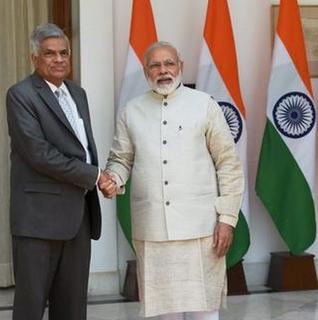
Prime Minister Narendra Modi with his Sri Lankan counterpart Ranil Wickremesinghe at Hyderabad House in New Delhi.
The Indian leadership expressed the hope that the island nation will complete its reconciliation process within the two-year deadline.
Both the sides also agreed to set up a Joint Working Group (JWG) to discuss the development of a port, petroleum and other industries in the Lankan city of Trincomalee.
Modi visited Sri Lanka in May on his second visit to the country in two years. His visit was mainly aimed at reinforcing the traditional connect between India and Sri Lanka at a time when China was seeking to make inroads in the island nation.
He participated in the Vesak Day celebrations, the biggest festival of Buddhists, and assured India's support to Sri Lanka for the island's nation-building endeavours.
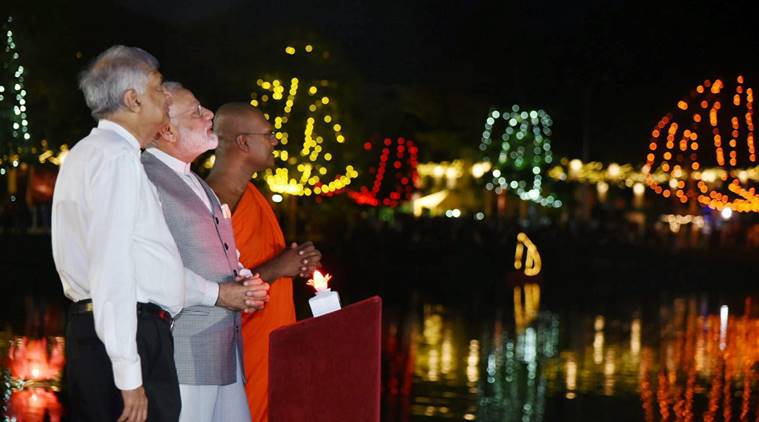 Prime Ministers Modi and Wickremesinghe observing Vesak celebrations in Colombo
He said that the Sinhala and the Tamil communities in Sri Lanka should strengthen unity and harmony as he assured India's full support to the steps taken by Colombo to improve the living conditions of minority Tamils in the country.
The Indian Navy carried out a joint hydrographic survey of Sri Lanka's Weligama Bay and southern coast, in a reflection of the growing cooperation between navies of the two countries.
Sri Lanka, while sealing its debt-equity partnership with China on the strategic southern port of Hambantota, has not upset India which was curious to know if the Sino-Lanka relationship would hamper India's regional interests.
Cash-rich China has invested millions of dollars in Sri Lanka's infrastructure since the end of a brutal civil war in 2009.
Sri Lanka owed China USD 8 billion, then Finance Minister Ravi Karunanayake had said last year. The Sri Lankan government had signed a USD 1.1 billion deal in July to sell a 70 per cent stake in the Hambantota port to China.
Sri Lanka received USD 300 million as the initial payment under the 99-year lease agreement.
The opposition and trade unions in Sri Lanka have dubbed the port deal as a sell out of the country's national assets to China.
"India would be more likely to pressure Sri Lanka on issues that concern its own national security," said Dr Jehan Perera, a noted political commentator.
"Sri Lanka has consciously sought to follow a foreign policy that considers India to be an ally and assuages India's concern over its closeness to China, which could have geo- political consequences, which are adverse to India," he said.
Modi's engagements have been the cornerstone of the flourishing relationship. His trip to the island nation in May underscored his commitment to enhancing the relationship.
Modi was the chief guest at the event marking the Vesak Day, which commemorates Buddha's birth, enlightenment and the death.
"Buddhism and its various strands are deep seated in our governance, culture and philosophy," Modi had said, touching the heartstrings of the majority Buddhists.
Modi became the first Indian prime minister to reach out to 30,000 Indian Tamils in the central tea plantations.
Foreign Secretary S Jaishanker had said India "will henceforth" give "special consideration" to Indian Tamils in view of their special needs and their willingness to join the island's political mainstream.
The Indian government was quick to assist Sri Lanka when floods hit the country, killing more than 200 people in May.
The Indian Navy deployed three ships and over 300 personnel to assist Sri Lanka in its rescue and relief efforts for over 500,000 people.
Some observers even said that Modi was deliberately enhancing India's engagement with Sri Lanka at a time of China's growing influence in the island nation.
Despite Wickremesinghe's presence at the inauguration of China's ambitious Belt and Road Initiative (BRI), which India skipped, both India and Sri Lanka showed that the relationship could move on while understanding each other's concerns.
Showing India's long-standing interest on the issues of Tamils, Jaishankar met with the members of the Tamil National Alliance (TNA) and the Tamil Progressive Alliance (TPA).
Perera said: "Like the rest of the international community, they (India) would be oriented to give more time to the Sri Lankan government to resolve the outstanding Tamil issues.
Sri Lanka's option of moving closer to China has meant that India has stopped pressuring Sri Lanka with regard to its ethnic conflict despite Sri Lanka's failure to implement transitional justice measures".
Most observers believe that despite Sri Lanka's courtship with China, India's importance to Sri Lanka can never be discounted.
India, which is Sri Lanka's largest trading partner, has provided development assistance worth over USD 2.5 billion.
Over 70 per cent of the cargo handled at the Colombo port is transshipment cargo to and from India.
Sri Lanka is keen on the new trade pact, the Economic and Technology Cooperation Agreement (ETCA), which would enhance commercial ties with India's fast-growing southern states.
The Sri Lankan government may find some serious political opposition to ETCA as opposition parties have never missed opportunity to provoke anti-India sentiments to achieve domestic political gains.
(PTI)
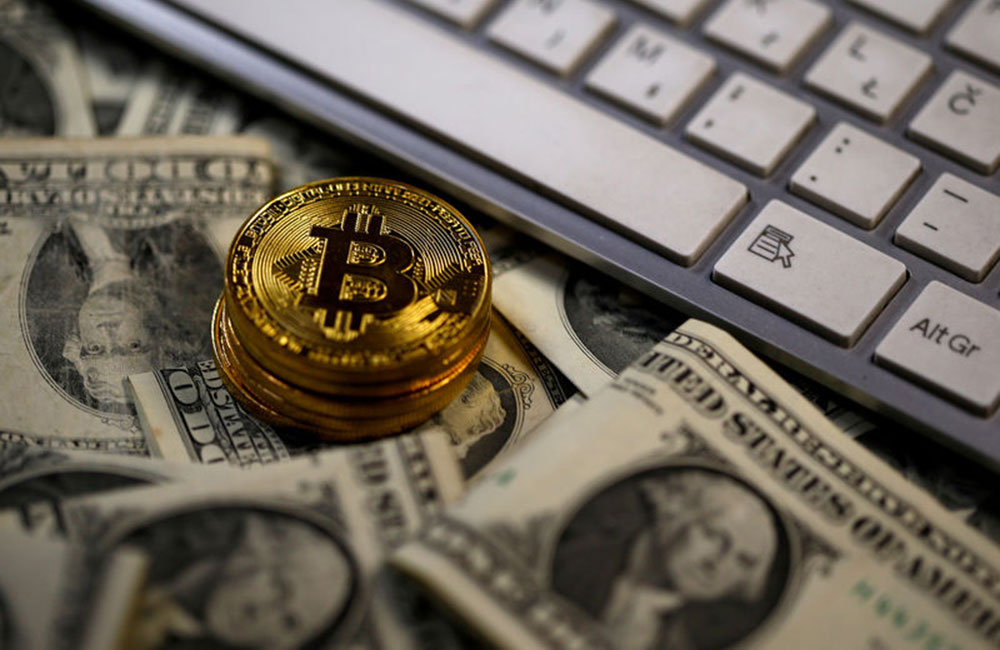
Bitcoin hits new record high as warnings grow louder
Bitcoin blasted to another all-time high of almost $18,000 on the Bitstamp exchange on Friday, up 9 percent on the day, as warnings grew over the risks of investing in the highly volatile and speculative instrument.
The cryptocurrency’s staggering recent price rises -- more than 1,700 percent since the start of the year -- have driven worries that the market is a bubble that could burst in spectacular fashion.
Bitcoin has climbed almost 80 percent so far in December alone, putting it on track for its best month in percentage terms since December 2013.
On Friday it reached as high as $17,900 BTC=BTSP on the Luxembourg-based Bitstamp exchange.
While bitcoin has added another fifth to its value since Monday, trading has been slightly calmer than the wild price swings the market has seen in recent weeks, with volatility lower since the launch of bitcoin futures from Cboe Global Markets on Sunday.
Market-watchers said bitcoin’s price was being lifted by the launch of rival CME Group’s bitcoin futures contracts on Sunday.
“The hope (is) that futures signal the unlocking of institutional money into the digital arena and (that there will be) a rapid demand increase and ratification of the technology and its principles,” said Charles Hayter, founder of industry website Cryptocompare.
But outside of the crypto market, worries continue to grow about the amount of money piling into the space.
A study by Anglia Ruskin University, Trinity College Dublin and Dublin City University released on Friday said bitcoin could pose a threat to the financial stability of traditional currencies and markets.
“Our evidence finds that the price of Bitcoin has been artificially inflated by speculative investment, putting it in a bubble,” said Larisa Yarovaya, one of the report’s authors and a lecturer at Anglia Ruskin University.
“Although bitcoin is not regulated by governments, it could still have a knock-on effect on traditional markets due to the interconnectedness of cryptocurrency markets with other financial assets.”
Source : Reuters
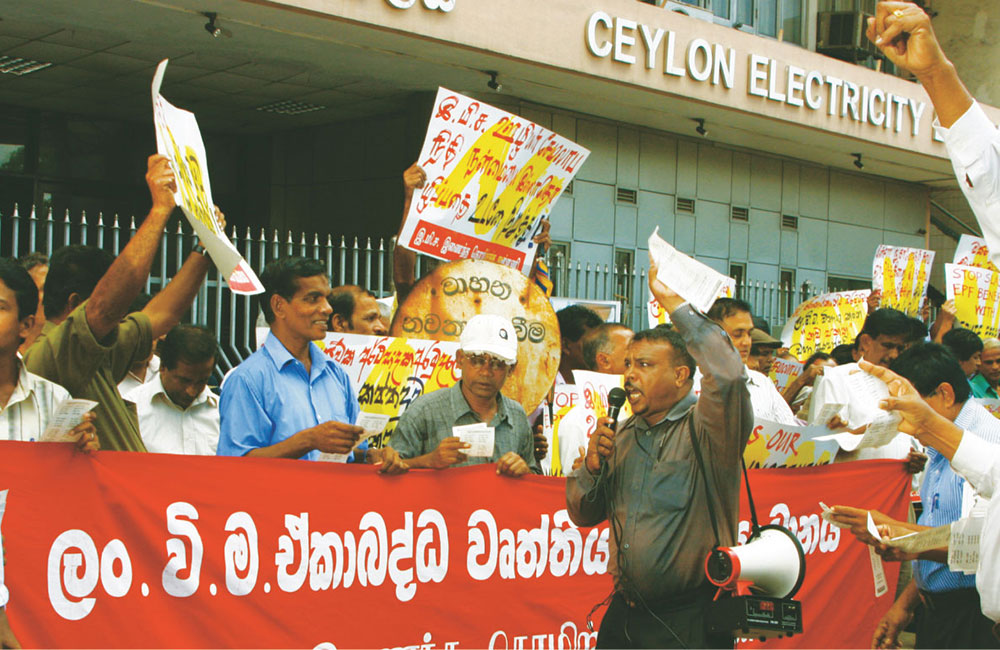
Bonuses for government employees
The cabinet has approved the payment of bonus to the staff of public corporations and state-owned enterprises for 2017.
Accordingly, the maximum bonus has been set at Rs 15,000 with the minimum set at Rs. 3000.
The bonuses will be given to employees in the categories mentioned below.
Employees of organizations that avoided a loss last year and gained a profit during this year Rs.15 000 as an incentive.
2. Employees of organizations that have turned around a loss-making venture to a profit making company this year Rs. 13, 500 as an incentive.
3. Employees of organizations that recorded a loss last year but reduced that loss amount this year Rs. 5000 up from the Rs. 3000 given before.
4. Employees of organizations that recorded a loss this year which continued on to this year Rs. 3000.
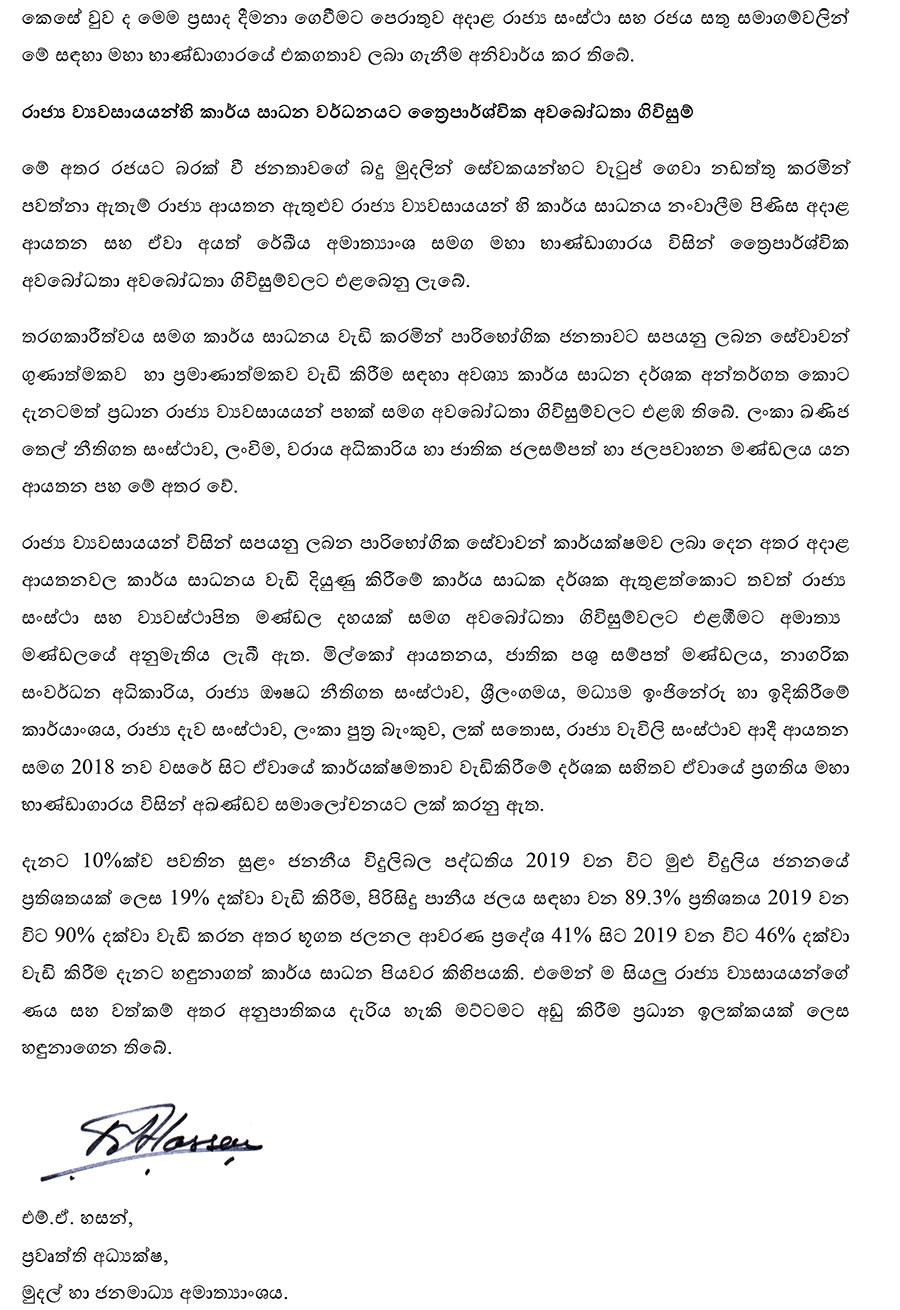
Russia restricts tea supplies from Sri Lanka after finding beetle
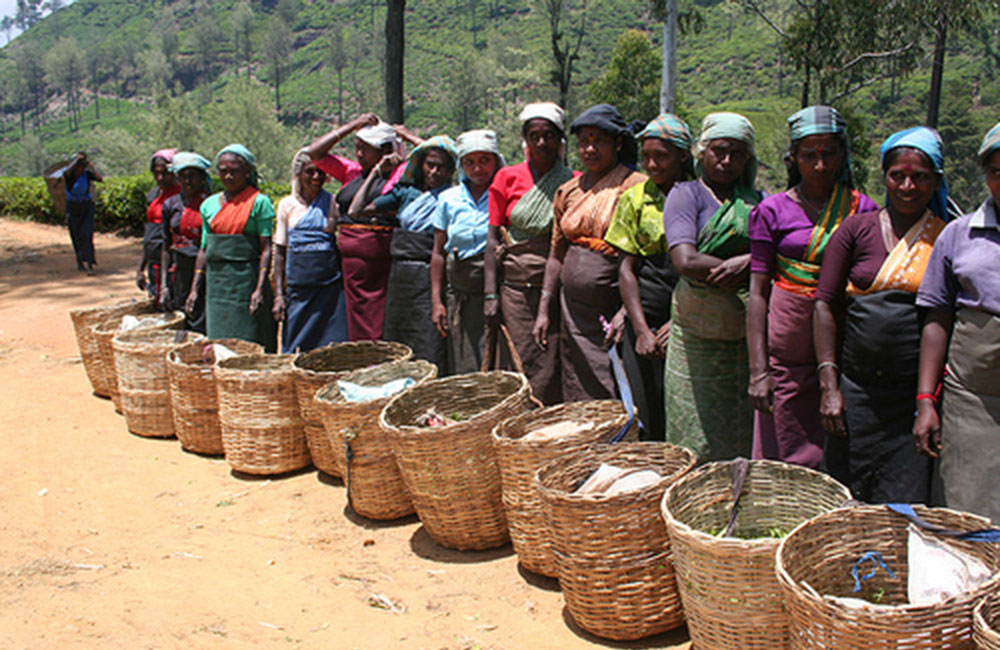
Russia will place temporary restrictions on imports of all agricultural products from Sri Lanka, including tea, from Dec. 18, the Russian agricultural safety watchdog Rosselkhoznadzor said on Thursday.
The watchdog said it had taken the decision to impose restrictions after it found an insect, known as the Khapra beetle, in the packaging of one consignment of tea from Sri Lanka.
Tea from Sri Lanka accounts for 23 percent of Russia’s tea market, with other supplies come from India, Kenya, China and Vietnam, Ramaz Chanturiya, the head of the Rusteacoffee association, was quoted as saying by RIA news agency.
Members of Rusteacoffee, an association of Russian tea producers, will ask Rosselkhoznadzor to resume tea imports from Sri Lanka but with tougher controls, he added.
Russia imported 141,300 tonnes of tea worth $436 million in the first 10 months of 2017, according to customs data.
Source: Reuters
Sri Lanka offers wide investment opportunities: Malaysian PM
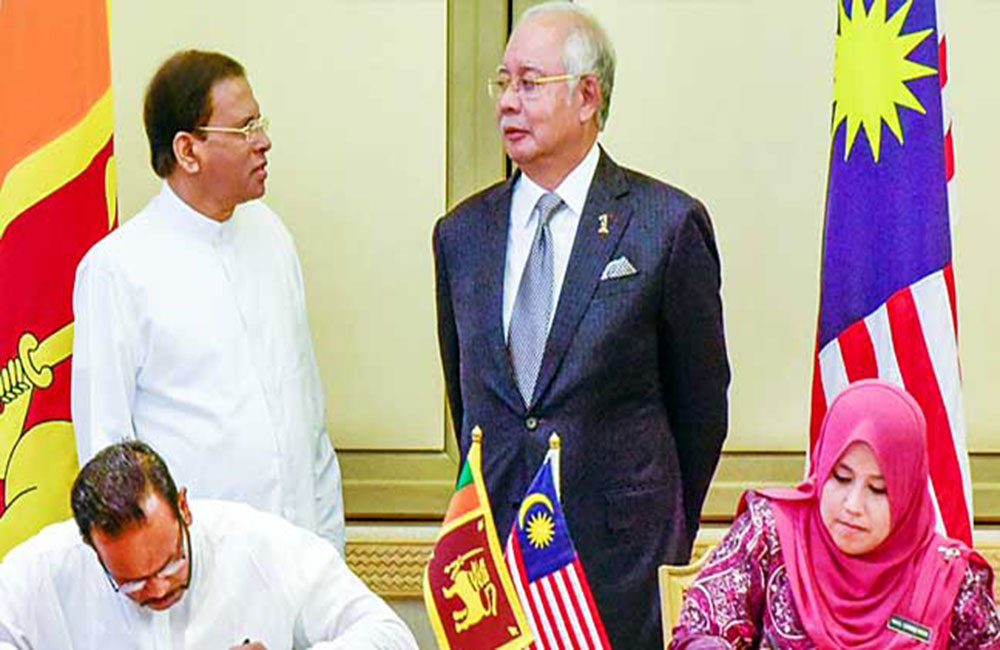
Malaysian Prime Minister Najib Razak describes his official visit to Sri Lanka as very successful in opening investment opportunities to Malaysia as that country is now on the eve of economic recovery.
He said that during his meeting with Sri Lankan President Maithripala Sirisena on Monday, several consensus had been reached including the efforts to realise the International Free Trade Agreement (FTA).
I see Sri Lanka as a nation that has many similarities with us and they are now on the eve of economic recovery (after the civil war), this is the right time for us to grab the opportunity, when a nation is about to take off, this is the time we can gain opportunities,” he told Malaysian journalists when commenting on his three-day official visit to this country, today.
The prime minister said the FTA between Malaysia and Sri Lanka is expected to be finalised at the end of next year or in early 2019 at the latest.
He said the latest development was achieved during his meeting with his counterpart, Ranil Wickremesinghe today.
“The meeting (with Wickremesinghe) focused on several follow-up actions and in detail on what we can do.
“These include the continued commitment to take follow-up action to finalise the FTA. Hopefully, at the end of 2018 or early 2019 it can be finalised. Sri Lanka must resolve the FTA with Singapore first before focusing on Malaysia,” he said.
He said Sri Lanka perceived Malaysia to be a very suitable trading partner because Malaysia was not a large nation but was also not a small nation and did not threaten (the economy of) that country.
The prime minister said, as an example, the Malaysian telecommunication company that is successful in Sri Lanka, Dialog Axiata not only succeeded in making lucrative profits and creating employment opportunities for more than 350,000 people of that country, but it also implemented its corporate social responsibility programmes including assisting smart schools, providing technical information data for farmers and so on.
Malaysian Tamils cooperation needed to help Jaffna region
Najib said he had also received a courtesy call from the Chief Minister of Sri Lanka’s Northern Region, Vigneswaran Canagasabapathy who provided the latest information on the situation in the region which is under pressure after the civil war.
He said, Jaffna was under pressure after being affected by the civil war and 45,000 women had become single mothers without any source of income while 11,000 former soldiers were now without any job.
Najib said Malaysia would try to help the region with the cooperation of non-governmental organisations to send a special mission and to see what aid could be given based on the country’s capability.
The prime minister said Malaysia had more than 200,000 people of Sri Lankan descent and many of them were successful and could possibly cooperate with the government to send an aid mission.
Replying to another question on the suggestion by certain quarters that all Muslim countries open up their respective embassies in Palestine, Najib said the matter must be studied and discussed at the Cabinet level before hand.
“We also need the opinion from Palestine and so far, we have not received any opinion from the Palestinian authorities.
Malaysia has so far set up the Egyptian and Palestinian embassy in Egypt.
Najib said Malaysia remained committed to champion the rights of the Palestinians and opposed the move by the United States in recognising Jerusalem as the capital of Israel.
“This means that our stand is firm on this matter,”he added.
PIC: FMT News
Sri Lanka's Industrial production increased by 3.7%
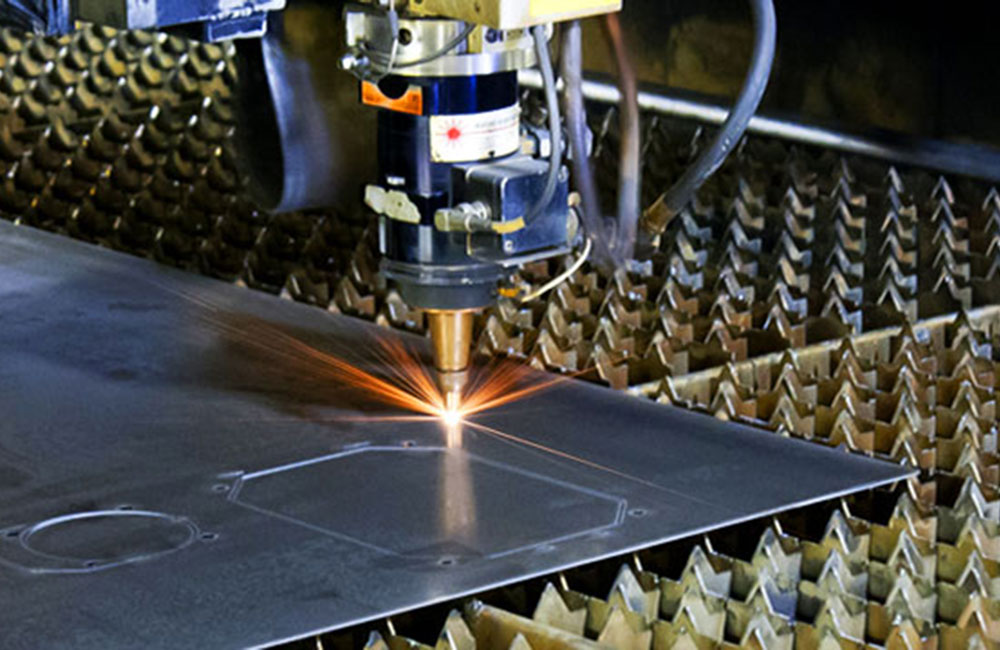
The volume of industrial production has increased by 3.7% in the month of October according to the Director-General of the Department of Census and Statistics, A.J Satharasinghe. According to Satharasinghe, the increase is when compared to the same month in 2016. The Index of Industrial Productions (IPP) for the months of October 2017 and 2016 were 108.6 and 104.7 respectively.
IIP conveys the status of production in the industrial sector of an economy in a given period of time in comparison with a fixed reference point in the past. It reveals short-term changes in the industrial sector.
The manufacturing industries; ‘Fabricated Metal Products’. ‘Machinery and Equipment’ and ‘Basic metal products’ have shown remarkable increases of 26.2%, 14.2% and 8.7% respectively compared to October 2016.
Pic Source: innvativefab.com
World Bank ups forecast for China growth in 2017 to 6.8 pct
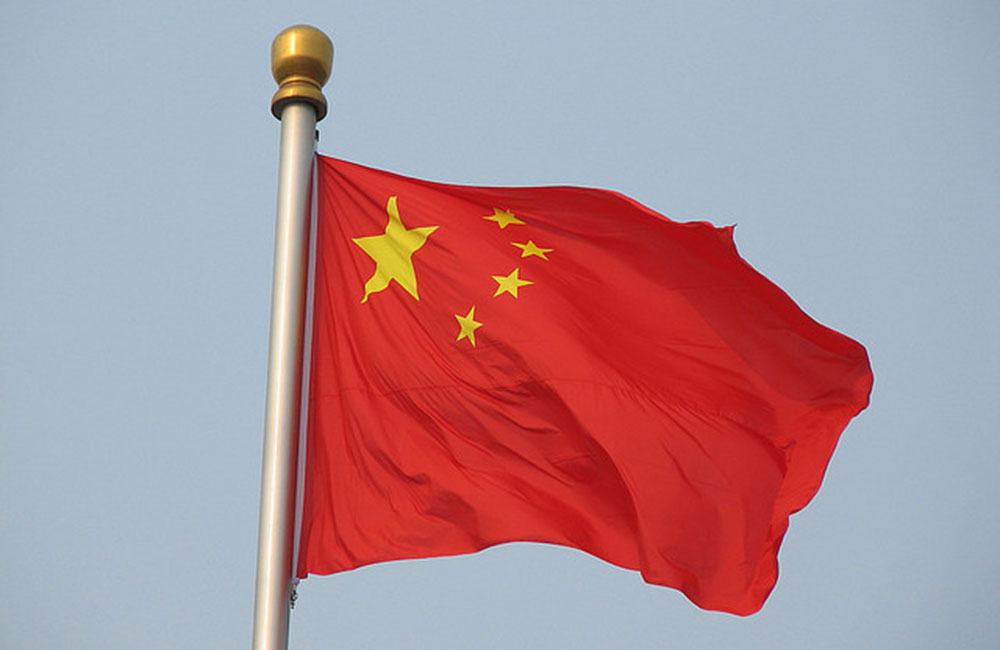
The World Bank has raised China's growth forecast for this year from 6.7 percent to 6.8 percent, based on rising household income and improving external demand, according to its latest report Tuesday.
It was the bank's second upward revision for China, after it revised up the projection from 6.5 percent to 6.7 percent in April.
"China has maintained growth resilience and gained reform momentum as the authorities have undertaken a host of measures aimed at reducing macroeconomic imbalances and limiting financial risks without notable impact on growth," said John Litwack, World Bank lead economist for China. "As a result, economic rebalancing received a boost. The growth of household incomes and consumption accelerated relative to investment."
He underlined the fact that net exports had returned to positive contribution to growth, business confidence improved, job creation remained buoyant, capital outflows stabilized and the renminbi appreciated against the U.S. dollar.
The bank estimated China's GDP growth to decelerate to 6.4 percent in 2018 and 6.3 percent in 2019, mainly due to domestic policy tightening.
"Prudent monetary policy, stricter financial sector regulation, and the government's continuing efforts to restructure the economy and to reign in the pace of leveraging are expected to contribute to the growth moderation," according to the report.
"Favorable economic conditions make this a particularly opportune time to further reduce macroeconomic vulnerabilities and pursue reforms that target better quality, more efficient, fairer, and more sustainable development," said Elitza Mileva, World Bank senior economist and co-author of the report.
The report pointed out that the successful implementation of reforms of government budget and China's pension system were critical to the country's macroeconomic stability, economic rebalancing, and social transformation in the coming years.
The major downside risk to the forecast is the still rising leverage of the non-financial sector.
"Despite the recent slowdown, credit continues to grow considerably faster than GDP. Outstanding bank loans reached 150 percent of GDP in November 2017, up from 103 percent at the end of 2007," the report said.
China's GDP expanded 6.9 percent year-on-year in the first three quarters, above the government's target of around 6.5 percent for this year.
Backed by better-than-expected growth, the International Monetary Fund (IMF) has revised up its China forecast for the fourth time this year, to 6.8 percent in 2017 and 6.5 percent the year after.
Source : Xinhua
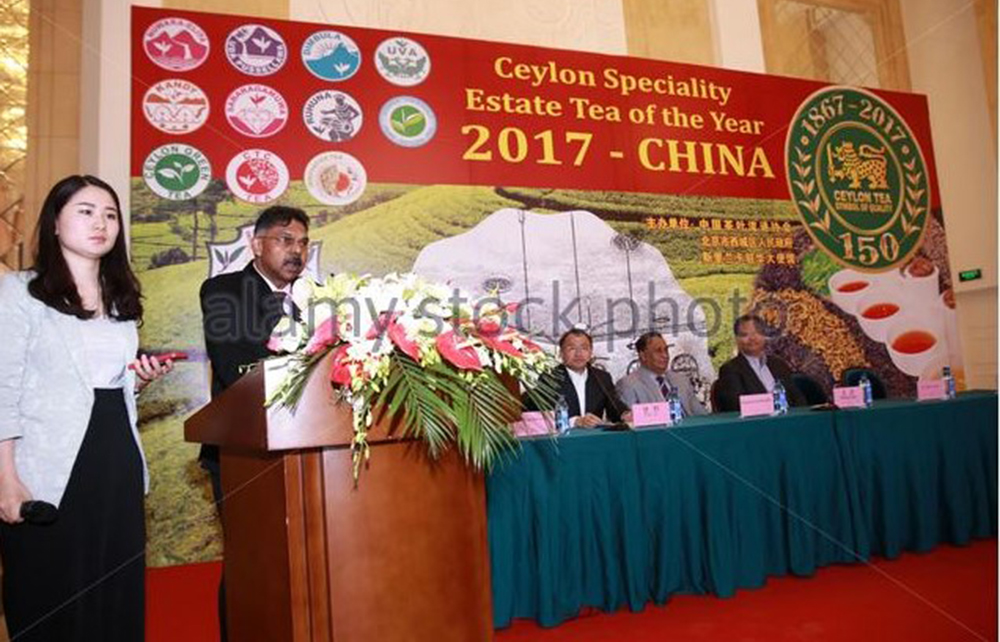
Sri Lanka to hold tea auctions in China
The Sri Lankan government is to promote black tea consumption in China and also hold tea auctions there, a government spokesman said.
The move is in response to growing consumption of black tea in China, which hitherto had been a green tea drinking nation, Gayantha Karunathilaka, Minister of Land and Parliamentary Reforms said.
The proposal by Plantations Industries Minister Navin Dissanayake had been approved by the Cabinet of ministers this week, he told a news conference.
Sri Lanka is to enter into agreements with Chinese government entities to promote black tea and hold tea auctions.
Economy Next
13 December 2017
Page 22 of 23