
Nearly one in four Sri Lankan workers could find their jobs reshaped or threatened by the rapid advance of Generative Artificial Intelligence (GenAI), according to a new labour market analysis that paints a sobering picture of the country’s digital readiness.
Drawing on International Labour Organisation (ILO) benchmarks and Sri Lanka’s Labour Force Survey 2023, the study estimates that around 1.83 million workers, or 22.8% of total employment, are in occupations exposed to GenAI. While this is slightly below the global average, analysts warn that the real danger lies not in the technology itself, but in Sri Lanka’s limited capacity to adapt to it.
At the sharpest edge of risk is a smaller but highly vulnerable group: over 187,000 workers in occupations with the highest exposure to GenAI, dominated by clerks and clerical support staff. These roles rely heavily on routine, information-processing tasks precisely the kind of work GenAI systems are increasingly able to perform faster, cheaper and around the clock.
“The threat is not dramatic mass layoffs overnight,” the report suggests, “but a gradual erosion of demand for certain roles.” As AI tools become more capable of drafting reports, processing documents and generating content, traditional white-collar jobs once seen as secure may quietly shrink.
Even professionals and technical workers are not immune. Nearly 142,000 workers fall into roles with rising exposure, signalling that GenAI’s reach extends beyond low- and mid-skill occupations. Meanwhile, millions employed in agriculture, crafts and elementary jobs remain largely shielded for now due to the manual and context-specific nature of their work.
Yet the most striking finding is not who is exposed, but who is ready. Of the 1.83 million potentially affected workers, only about 480,000 are digitally literate and employed in workplaces with basic digital infrastructure. This means the majority are theoretically replaceable by AI, but practically unable to benefit from it.
This digital gap creates a paradox. On one hand, low readiness may slow AI-driven job losses. On the other, it risks leaving Sri Lanka behind as global competitors harness GenAI to boost productivity and cut costs. Firms that fail to adopt may struggle to survive, indirectly threatening jobs across entire industries.
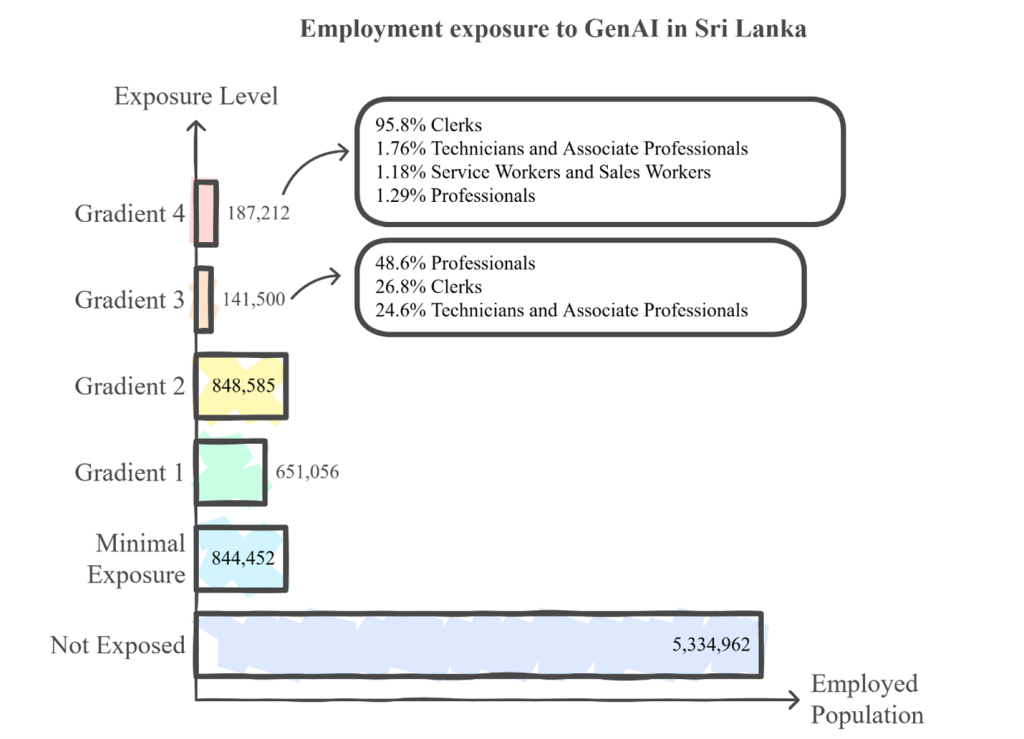 Source: Authors’ calculations based on LFS 2023 and occupation exposure categories identified by Gmyrek et al., 2025
The warning is clear: GenAI will not arrive as a sudden shock, but as a slow, structural threat. Without urgent investment in digital skills, workplace technology and reskilling pathways, Sri Lanka risks a future where jobs disappear not because AI is too powerful, but because the workforce is unprepared.
As the report concludes, the country stands at a crossroads. GenAI could either deepen employment insecurity especially for clerical and professional workers or become a tool for transformation. The outcome will depend on how quickly Sri Lanka acts, and whether its workers are equipped to work with AI rather than be replaced by it.
( Source : lankanews.lk)
Leave your comments
Login to post a comment
Post comment as a guest