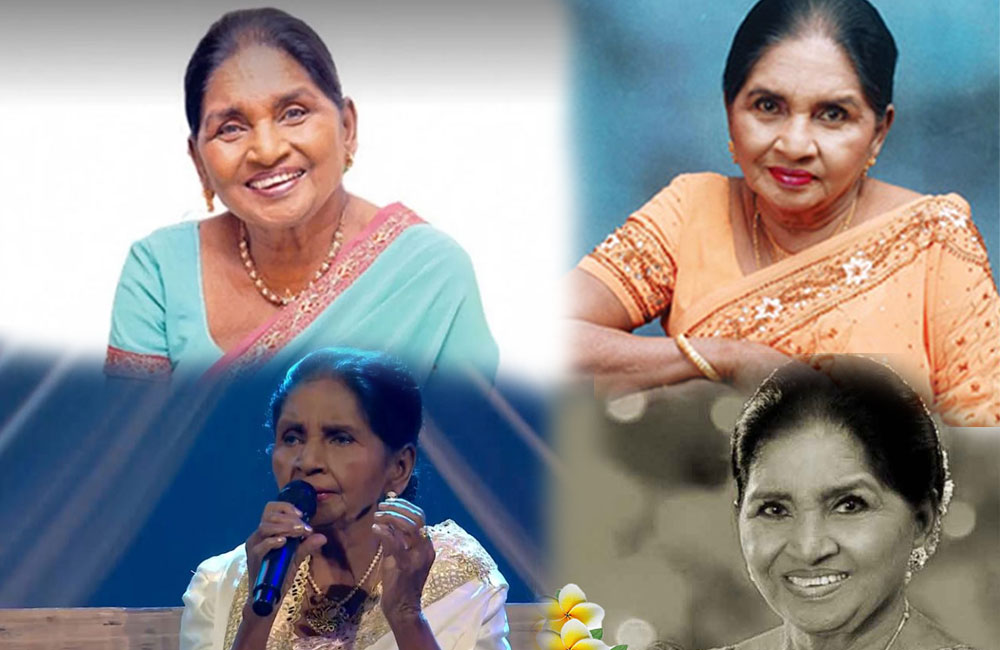
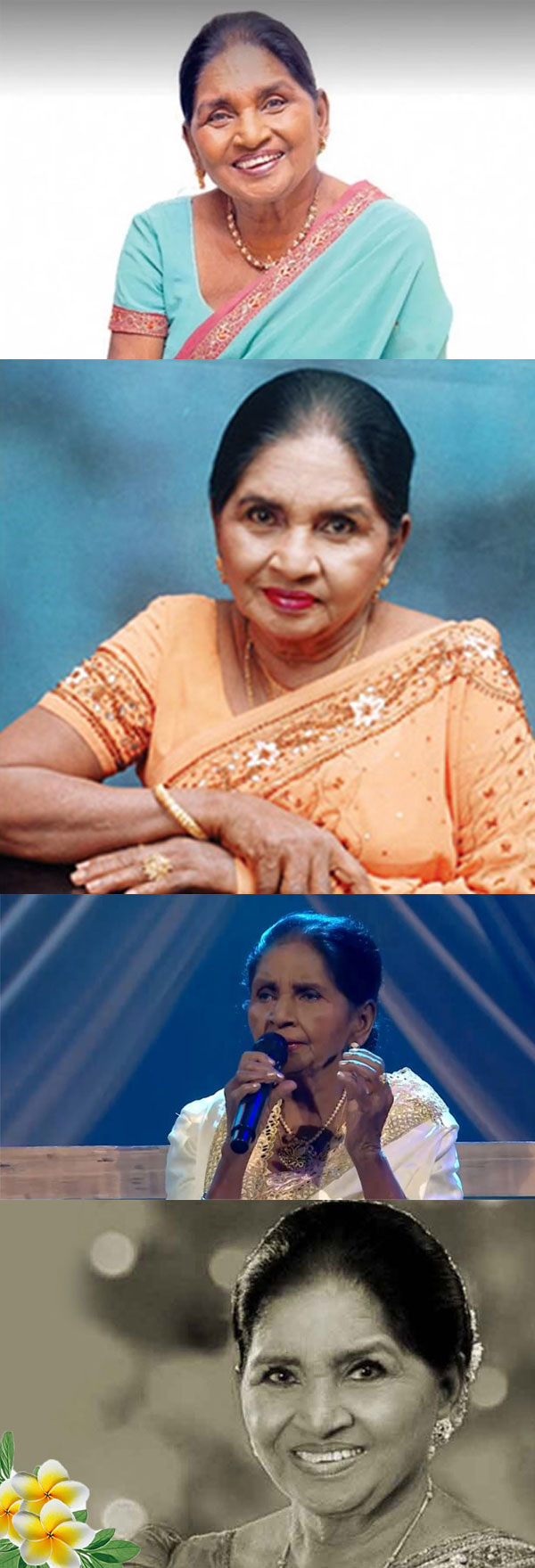
The passing away of veteran singer Mrs Latha Walpola, "The Queen of Songs of Lanka", has created an unfillable void in the Lankan music world. The boundless body of creations she gifted to Sri Lankan singing culture will remain as a cultural heritage of ours. Her melodious voice and her singing ability, which won hearts for generations, set a benchmark in Sri Lankan music.
We sang many of her songs on numerous occasions while enjoying ourselves. Her immortal songs like සැළලිහිණි කොවුල් හඬ රැව් දෙන්නා, මල් බර හිමිදිරියේ, සහ ලෝ අඩ නින්දේ still remain fresh in our memories. The songs of the era she sang, especially with her life partner, veteran singer Dharmadasa Walpola, continue to hold a prominent place among the most popular song collections in Sri Lanka even today.
The last time we sang those songs was when the 55th anniversary of our group, students of the Faculty of Engineering, University of Peradeniya, from 1965-69, was held in Sri Lanka last year. In addition to noting my enjoyment of her songs, I would like to take this opportunity to write about several occasions when some of her life events had an impact on my social life.
One was during the 1981-82 period, when the Walpola family was beset by political harassment. Facing the threat of eviction from their home due to pressure from political authorities, they sought the support of the Janatha Vimukthi Peramuna. Mrs Walpola had sent one of her sons to the then JVP Head office, which was located at Weerasinghe Saw Mills, in Armour Street, Colombo, to inform us about their situation. I brought to the notice of the relevant authorities, the harassment they were enduring, but it did not yield any success. History bears witness to the manner the then-President and certain political powers thought about professionals engaged in the sphere of arts.
Chitra and I had the opportunity to meet Mrs Walpola in person at one of her singing concerts held in Canberra, Australia in the 1990s. The concert, organised by the Australia Sri Lankan Association Inc., ACT (ASLA) in collaboration with other organisations, was a great success. Our very cordial meetings also gave us the opportunity to reflect on our past.
The ‘Sri Lanka Day’ organised in Canberra in 1998 to commemorate the half-century since Sri Lanka gained independence is a historic event that deserves special mention. The fact that February 4th coincided with the annual Australian National Multicultural Festival held in Canberra further enhanced the significance of the event. Under the leadership of ASLA, of which I was the president, with the support of other Sri Lankan organisations, and under the guidance of the Sri Lankan High Commissioner to Australia, late Mr. Elmo Perera, and the High Commission, the event was to be held on a grand scale.
The event featured a series of exhibitions on Sri Lankan arts and crafts, heritage and photography, a Sri Lankan cricket exhibition, a Sri Lankan documentary film exhibition, a Sri Lankan cooking demonstration, and several Sri Lankan food, tea and tourism stalls. To conclude the one-day event on a grand note, preparations were also being made to hold a dance and songs recital at the Llewellyn Hall of the Australian National University. The dance program was organised by the Canberra School of Sri Lankan Dance and its principal, late Mrs Vijitha Lokusooriya. The singing program was organised by the School of Eastern and Western Music of Canberra (සංගීත් මංජරී) and its principal, Sangeetha Visharada Ranjith Madurapperuma.
The final item of this dance and singing program was proposed to be a group sing-along of the song "පෙරදිග මුතු ඇටයයි මේ - ලෝකේ සිරි බර සිරි ලංකා", a song full of national pride, sung by the nightingale, Mrs Latha Walpola. It was also proposed to involve Sri Lankan as well as Indian, Pakistani, Bangladeshi, Fijian and Australian students who were associated with the Sri Lankan School of Eastern and Western Music, in singing the finale. It highlighted Sri Lanka’s cultural diversity and multi-ethnic harmony, using a blend of South Asian and Australian cultures.
However, a strong campaign of various kinds had been launched against both these proposals. One of the main allegations levelled was that the song "පෙරදිග මුතු ඇටයයි මේ" was a liberation song of the Janatha Vimukthi Peramuna and that it could not be allowed to be sung at all. The other allegation was that the song should only be sung by Sinhalese students and that non-Sinhalese students should not be allowed to sing it. Although both of these allegations were based on absurd facts, it should be specially noted that those were disseminated throughout Australia by certain Sinhala supremacists.
It can be assumed that the basis for these absurd allegations may have been the anti-Christian sentiments among those supremacists. Mrs Latha Walpola was born as Rita Genevieve Fernando. She was raised in a Catholic family. She was educated in a Catholic convent. Her singing career began in church choirs. Her religious beliefs and the background in which she was raised may have influenced her early musical path. However, her singing abilities were considered very similar to those of Latha Mangeshkar, who was considered India's greatest and most powerful singer. Although Lata Mangeshkar's singing style was noted as a benchmark in Indian playback singing, the religious bias of some appeared to have become an obstacle for Mrs Latha Walpola.
The Organising Committee met for the last time at the Sri Lankan High Commissioner's residence to make final decisions on the 50th Independence Day program. As the president of the committee, I included the proposals that had been debated and the allegations that had been made against them on the agenda of that meeting. The representatives of the Sinhala Cultural Association in Canberra spoke in support of those allegations. When the High Commissioner asked for my views, I denied both allegations and presented the necessary facts to negate them.
First, I confirmed that the song "පෙරදිග මුතු ඇටයයි මේ" is not a liberation song of the JVP. I explained that the song was a very popular song that evoked Sri Lankan pride and national sentiment, that the lyrics were written by Karunaratne Abeysekara, and that the song was sung around 1956, long before the Janatha Vimukthi Peramuna came into being. Accordingly, it was confirmed that the allegation was completely false and fabricated.
Second, I emphasized that rather than limiting the singing of such a song filled with national pride to Sinhalese, we should be proud that citizens of South Asia, or the Indian subcontinent, or any other country in the world, should come together and sing "This is the pearl of the East". I also explained that this is a very important occasion that proclaims Sri Lanka’s multicultural diversity and international friendship. All the non-supremacists unanimously approved the ideas I presented. The supremacists remained silent. At the end, having taken all those facts into consideration, the High Commissioner agreed that the program should be organised as proposed.
The result of that decision was the successful conclusion of the 50th Independence Day celebrations, Sri Lanka Day, on 4 February 1998, under the patronage of the Chief Minister of the Australian Capital Territory, Mrs. Kate Carnell. A highlight of the event was the singing of the song "පෙරදිග මුතු ඇටයයි මේ - ලෝකේ සිරි බර සිරි ලංකා" by students of various nationalities together. This was a wonderful occasion of expressing national harmony and cultural diversity.
Discussing these events reminds us that Mrs Latha Walpola leaves behind an unfillable void in the universe of Sri Lankan cultural creativity. Born Rita Genevieve Fernando, she transformed her musical journey, which began with church choirs, into an immortal chapter in the history of Sri Lankan music. Her contribution to Sri Lankan music was also a means of promoting national harmony, cultural diversity and human equity. Her contribution to the art of Sri Lankan singing was immeasurable, and her melodious voice will remain in the hearts of many generations. Her melodious voice will resonate in our hearts forever, and her musical legacy will represent a high point in Sri Lankan culture.
We pay tribute to Mrs. Latha Walpola for her immeasurable contribution to the art of Sri Lankan singing. We express our deepest condolences to all of her family, friends and countless followers.
Lionel Bopage
31 December 2025
Leave your comments
Login to post a comment
Post comment as a guest