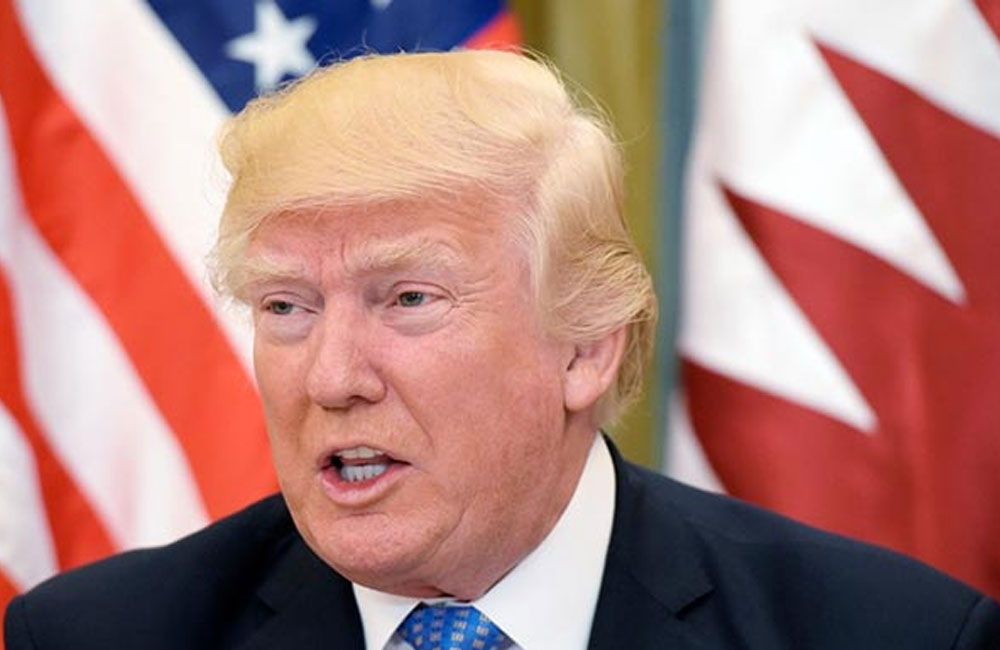
U.S. President Donald Trump said on Monday the United States could support another major strike on Iran were it to resume rebuilding its ballistic missile or nuclear weapons programs and warned Hamas of severe consequences if it does not disarm.
Speaking beside Israeli Prime Minister Benjamin Netanyahu following a meeting at his Mar-a-Lago estate in Florida, Trump suggested Tehran may be working to restore its weapons programs after a massive U.S. strike in June.
“I’ve been reading that they’re building up weapons and other things, and if they are, they’re not using the sites we obliterated, but possibly different sites,” Trump told reporters during a press conference.
“We know exactly where they’re going, what they’re doing, and I hope they’re not doing it because we don’t want to waste fuel on a B-2,” he added, referring to the bomber used in the earlier strike. “It’s a 37-hour trip both ways. I don’t want to waste a lot of fuel.”
Trump, who has broached a potential nuclear deal with Tehran in recent months, said his talks with Netanyahu focused on advancing the fragile Gaza peace deal he brokered and addressing Israeli concerns over Iran and over Hezbollah in Lebanon.
Iran, which fought a 12-day war with Israel in June, said last week that it had conducted missile exercises for the second time this month.
Netanyahu said last week that Israel was not seeking a confrontation with Iran, but was aware of the reports, and said he would raise Tehran’s activities with Trump.
A SECOND PHASE IN GAZA?
Trump said he wanted to move to the second phase of the ceasefire deal between Israel and the Palestinian militant group Hamas reached in October after two years of fighting in Gaza, a progression that entails international peacekeeping forces deployed in the Palestinian enclave.
Israel and Hamas accuse each other of major breaches of the deal and look no closer to accepting the much more difficult steps envisaged for the next phase. Hamas, which has refused to disarm, has been reasserting its control as Israeli troops remain entrenched in about half the territory.
Israel has indicated that if Hamas is not disarmed peacefully, it will resume military action to make it do so.
During his Monday comments, Trump heaped the blame on the militant group for not disarming more promptly, arguing that Israel had lived up to its side of the deal and warning that Hamas was inviting grave consequences.
“There will be hell to pay,” Trump warned when asked what he will do if Hamas does not lay down its arms. He has made similar statements at previous intervals during the fighting.
Netanyahu said this month that Trump had invited him for the talks, as Washington pushes to establish transitional governance for the Palestinian enclave amid Israeli reluctance to move forward.
The deployment of the international security force was mandated by a November 17 U.N. Security Council resolution.
While Washington has brokered three ceasefires involving its longtime ally - between Israel and Hamas, Israel and Iran, and Israel and Lebanon - Netanyahu is wary of Israel’s foes rebuilding their forces after they were considerably weakened in multiple wars.
Overall, Trump’s comments suggested he remains firmly in Netanyahu’s camp, even as some aides have privately questioned the Israeli leader’s commitment to the Gaza ceasefire. His comments also suggested he is willing to risk additional hostilities related to Gaza and Iran, even as Trump has taken credit for resolving Israel’s wars in both places.
Trump struck a warm tone as he greeted Netanyahu before their meeting, going so far as to say that Israeli President Isaac Herzog had told him he planned to pardon Netanyahu of corruption-related charges - a conversation Herzog’s office immediately denied took place.
Netanyahu reciprocated, telling reporters after the meeting that he was gifting Trump the country’s Israel Prize, which he said has historically been reserved for Israelis.
NEXT STEPS IN GAZA CEASEFIRE PLAN
Trump’s plan to end the Gaza war ultimately calls for Israel to withdraw from the Palestinian territory and Hamas to give up its weapons and forgo a governing role.
The first phase of the ceasefire included a partial Israeli withdrawal, an increase in aid and the exchange of hostages for Palestinian detainees and prisoners.
An Israeli official in Netanyahu’s circle said that the prime minister would demand that the first phase of the ceasefire be completed by Hamas returning the remains of the last Israeli hostage left in Gaza, before moving ahead to the next stages. The family of the deceased hostage, Ran Gvili, joined the prime minister’s visiting entourage.
Israel has yet to open the Rafah crossing between Gaza and Egypt, also a condition of Trump’s plan, saying it will only do so once Gvili’s remains are returned.
Trump said that he and Netanyahu did not agree fully on the issue of the Israeli-occupied West Bank but the Republican leader did not lay out what the disagreement was.
TURKEY, SYRIA ALSO DISCUSSED
Before the meeting, Trump told reporters he would talk to Netanyahu about the possibility of stationing Turkish peacekeepers in Gaza. That is a fraught subject - while Trump has frequently praised Turkish President Tayyip Erdogan, Israel and Turkey have a much more circumspect relationship.
While the fighting in Gaza has abated, it has not stopped entirely. Although the ceasefire officially began in October, Israeli strikes have killed more than 400 Palestinians — most of them civilians, according to Gaza health officials — and Palestinian militants have killed three Israeli soldiers.
Netanyahu said on Monday that Israel was keen to ensure a peaceful border with Syria, and Trump said he was sure Israel would get along with President Ahmed al-Sharaa, who took power after longtime strongman Bashar al-Assad was deposed last year.
But Israel has been suspicious of the new leader, who was once a member of al-Qaeda, going so far as to bomb government buildings in Damascus this July.
(Source:adaderana.lk)
Leave your comments
Login to post a comment
Post comment as a guest