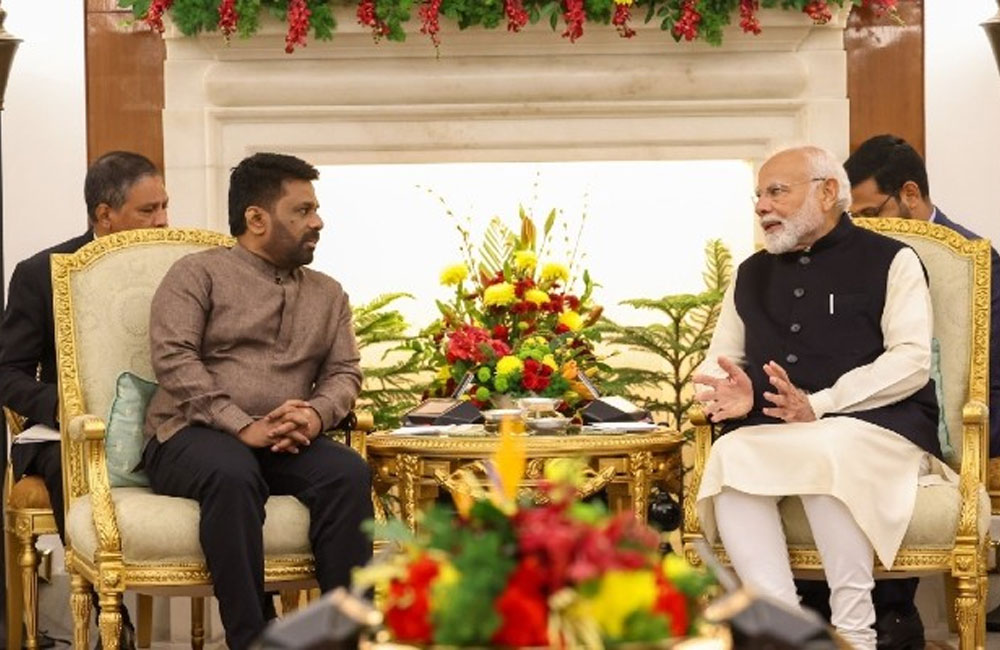
Recent newspaper reports have drawn attention to a proposed joint official committee involving Sri Lankan and Indian officials that is reportedly intended to oversee India’s US$450 million post-disaster reconstruction assistance to Sri Lanka. While these reports have generated significant public interest, the precise details and official confirmation of such a mechanism have yet to be formally disclosed to Parliament or communicated to the public.
According to print media accounts citing senior government sources, the reported joint committee would be responsible for determining reconstruction priorities, managing procurement under Indian concessional credit lines, and coordinating the deployment of Indian technical manpower.
The assistance package is said to cover key sectors including road and railway infrastructure, housing, health, education, agriculture, and the possible establishment of an Immediate Disaster Response Team.
However, at the time of writing, no official statement has been issued outlining the committee’s mandate, composition, legal basis, or reporting structure. Nor has Parliament been formally briefed on the operational framework under which such a committee would function, raising questions about transparency and oversight should the reported arrangement materialise.
The reported aid package comprises US$350 million in concessional lines of credit and US$100 million in grants. Its announcement was conveyed during a recent visit by India’s External Affairs Minister S. Jaishankar, who arrived in Sri Lanka as a special envoy of Indian Prime Minister Narendra Modi and met with President Anura Kumara Dissanayake and other political leaders. While the assistance itself has been publicly acknowledged, the governance mechanisms for administering it remain unclear.
Media reports further suggest that the Indian High Commission would play a coordinating role in facilitating meetings and monitoring project progress, with Indian technical teams potentially assisting in sectors such as housing, railways, healthcare, and education. These claims, however, remain unverified through official channels.
The absence of confirmed information is notable, particularly given India’s own emphasis on parliamentary oversight in managing domestic and overseas credit lines. In India, sectoral oversight committees routinely review infrastructure projects, financial schemes, and public sector undertakings to ensure accountability and efficiency. Observers note that similar clarity would be essential in Sri Lanka if a joint mechanism is indeed established.
Until formal confirmation is provided, the reported joint committee remains a matter of public speculation rather than established policy. Nonetheless, the issue underscores the importance of timely disclosure, parliamentary engagement, and public communication when large-scale foreign-funded reconstruction initiatives are contemplated. In the absence of such transparency, even well-intentioned assistance risks becoming a subject of uncertainty and debate.
Leave your comments
Login to post a comment
Post comment as a guest