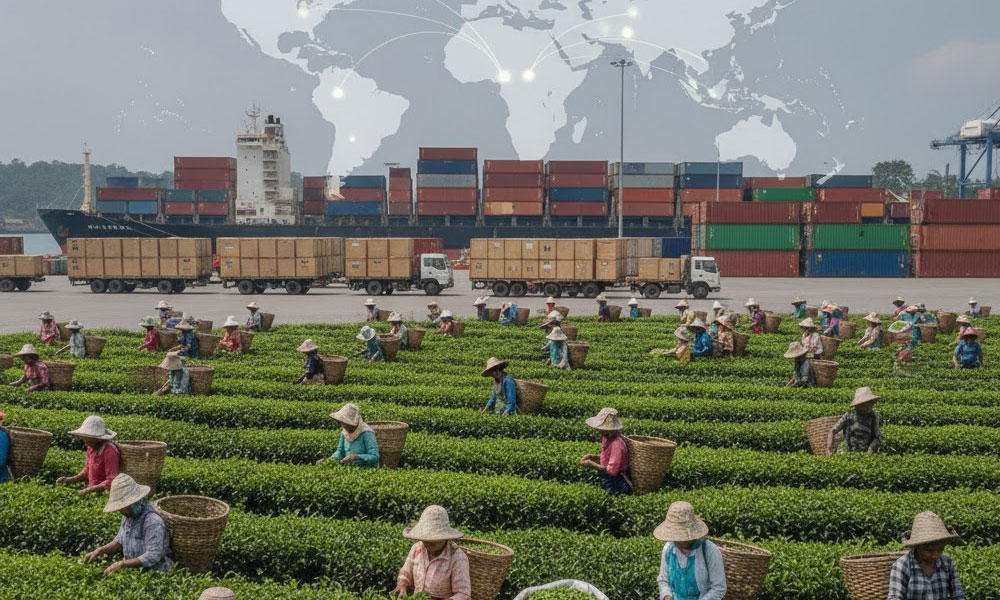
Sri Lanka’s tea industry demonstrated resilience in 2025, with higher export volumes cushioning the impact of fluctuating global prices and exchange rate movements. Data compiled by Forbes & Walker Research, based on Sri Lanka Customs statistics, show that tea export earnings reached an estimated $1.4 billion in the first 11 months to November, marking a solid year-on-year improvement.
While international tea prices remained under pressure in several key markets, Sri Lanka managed to expand its shipment volumes significantly. Total exports rose to 239.57 million kilograms, compared to 223.22 million kilograms during the same period in 2024. With the exception of Bulk Tea, all major product categories recorded positive volume growth, highlighting a gradual shift towards higher-value and specialty segments.
Monthly performance in November reflected some short-term softness, with exports declining by 0.71 million kilograms year-on-year. The contraction was mainly driven by lower shipments of bulk and packeted tea, even as Instant Tea and Green Tea continued to gain traction among buyers seeking convenience and health-oriented products.
Price movements were mixed across currencies. The average FOB value in rupees strengthened during November, supported partly by domestic cost adjustments and currency factors. In contrast, dollar-denominated prices edged lower, underscoring the challenges faced by exporters competing in price-sensitive global markets.
Despite these pressures, the cumulative dollar FOB average for the January–November period remained broadly stable at $5.85 per kilogram, allowing earnings to grow in line with higher volumes. Analysts note that this performance reflects strong demand from traditional Middle Eastern and Eurasian markets, alongside renewed buying from North Africa.
Iraq continued to dominate as the largest destination, accounting for more than 36 million kilograms of imports. Türkiye and Libya emerged as key growth markets, while shipments to Russia softened amid economic and logistical constraints.
However, industry stakeholders caution that reliance on volume-led growth alone may not be sustainable. Rising production costs, labour constraints, and climate-related disruptions pose ongoing risks to margins. They argue that increasing value addition, strengthening branding, and expanding premium offerings will be essential to protect earnings in the medium term.
As global competition intensifies, Sri Lanka’s tea sector faces a strategic choice: continue defending market share through volume, or pivot more decisively toward differentiated, higher-margin products that can withstand pricing volatility.
Leave your comments
Login to post a comment
Post comment as a guest