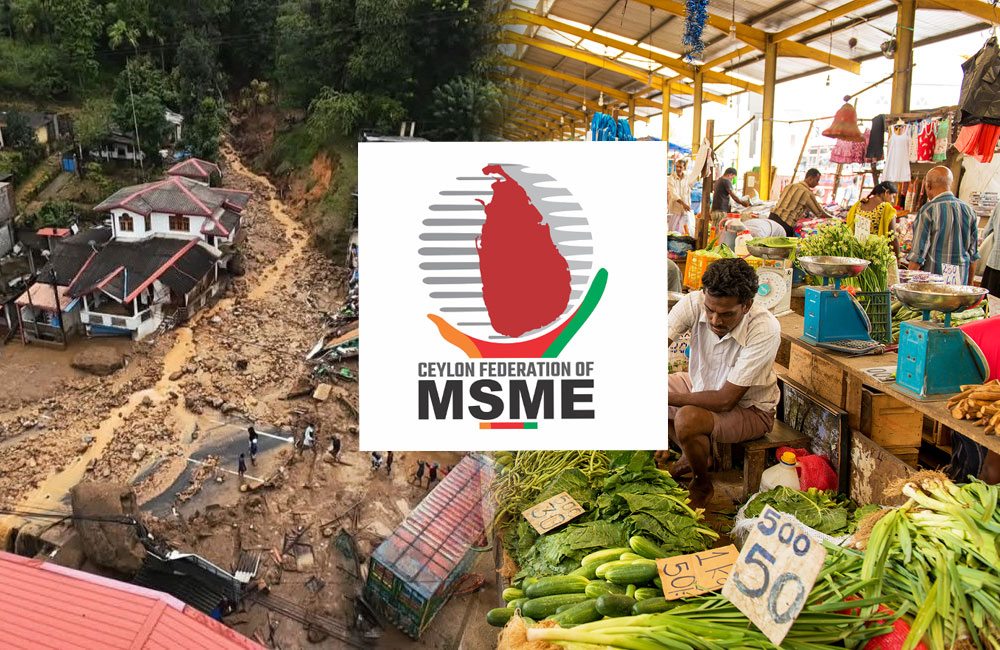
Sri Lanka’s Micro, Small and Medium-sized Enterprise (MSME) sector contributing over 52 percent of GDP and accounting for nearly three-quarters of the country’s entrepreneurial base has once again emerged as both the backbone and the most fragile pillar of the national economy.
Already weakened by years of macroeconomic instability, punitive interest rates, and shrinking credit access, the sector is now grappling with the devastating fallout from Cyclone Ditwah and the subsequent floods, which industry leaders say have inflicted damage exceeding even the 2004 tsunami in certain regions.
According to Ceylon Federation of MSMEs (CFMSME) President Mahendra Perera, the impact on businesses located in low-lying flood-prone areas has been severe and widespread. Initial assessments conducted by a special support centre under the Ministry of Industries reveal that 13,698 enterprises have been directly affected. This includes 5,639 micro enterprises, 4,636 small businesses, 2,986 medium-scale firms, and 437 large-scale enterprises, highlighting the depth and breadth of the disruption across the production and services economy.
The cyclone struck at a time when the MSME sector was already on the brink. Recent data shows that more than 60 percent of MSMEs are now classified as Non-Performing Loan (NPL) holders, largely due to prolonged exposure to double-digit borrowing costs during the economic crisis. Forced shutdowns lasting days and, in some cases, weeks have further crippled cash flows, pushing many enterprises from financial distress into outright default.
Compounding the crisis is the fact that a large proportion of MSMEs operate without adequate insurance coverage, while many lack digital backups of financial and operational records, intensifying post-disaster losses and delaying recovery. CFMSME estimates place direct economic losses to MSMEs between Rs. 50 billion and Rs. 85 billion, while the overall economic damage could extend to nearly Rs. 200 billion, when supply-chain disruptions and secondary impacts are included.
A comprehensive impact report prepared by CFMSME has already been submitted to the relevant authorities, calling for urgent, targeted intervention. The Government has responded by announcing immediate relief measures, including Rs. 200,000 in financial assistance for all disaster-affected industries and compensation of up to Rs. 5 million for physical and building damage.
However, industry leaders caution that speed, transparency, and accessibility will ultimately determine whether these measures translate into real recovery. Past experience suggests that delays in fund disbursement and procedural bottlenecks often blunt the effectiveness of well-intentioned relief packages.
Beyond immediate relief, Mahendra Perera outlined a series of policy interventions aimed at stabilising and rebuilding the MSME sector. These include rapid grant disbursement, concessional low-interest recovery loans, extended loan moratoriums of up to 12 months, suspension of parate execution, and flexible debt restructuring frameworks. Crucially, CFMSME has also called for access to fresh credit regardless of temporary adverse CRIB records, recognising that many defaults stemmed from systemic shocks rather than business mismanagement.
Additional proposals focus on asset replacement, disaster-resilient rebuilding, subsidised insurance schemes, wage support for affected workers, and restoration of disrupted supply chains, with tailored assistance for manufacturing, agriculture, tourism, and export-oriented MSMEs.
At a structural level, business leaders are advocating the establishment of a dedicated MSME Disaster Recovery Task Force and the integration of climate resilience into national MSME policy, aligned with the Climate Finance Strategy 2025–2030. Without such reforms, Cyclone Ditvah may be remembered not merely as a natural disaster, but as a stark warning of unresolved systemic fragility within Sri Lanka’s economic architecture.
Leave your comments
Login to post a comment
Post comment as a guest