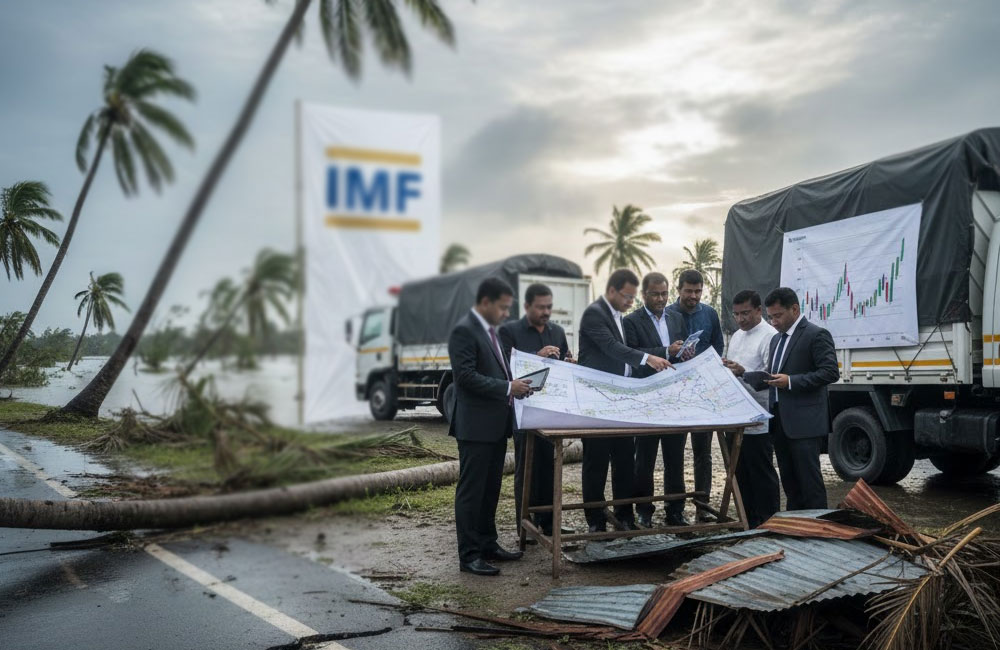
Sri Lanka’s decision to tap the International Monetary Fund’s Rapid Financing Instrument (RFI) following the devastation caused by Cyclone Ditwah has been presented by the Government as a timely and low-cost lifeline. Finance and Planning Deputy Minister Dr. Anil Jayantha Fernando has argued that the IMF’s approval of approximately US$206 million offers emergency balance-of-payments relief at an exceptionally low and transparent interest rate. However, a closer examination of the facility raises important questions about cost, sustainability, and longer-term fiscal implications.
Cyclone Ditwah struck the island on November 28, inflicting widespread human and economic damage. With over 600 lives lost, tens of thousands displaced, and critical infrastructure destroyed, the immediate humanitarian and reconstruction needs are undeniable. In this context, the IMF’s rapid financing appears to provide short-term breathing space for an economy still emerging from its worst crisis in decades.
Yet, while Dr. Fernando has emphasised the RFI’s headline interest rate of around 3.27%, linked to the IMF’s Special Drawing Rights (SDR) framework, this figure does not fully capture the effective cost over time. IMF lending terms are not static. Interest rates fluctuate weekly, and additional surcharges can apply depending on the size and duration of borrowing relative to Sri Lanka’s IMF quota. These surcharges potentially rising by up to 200 basis points may not be immediate, but they are neither hypothetical nor rare.
Moreover, the RFI is designed as a short-term emergency instrument with a repayment window of three to five years. While suitable for shock absorption, it also adds to Sri Lanka’s already strained external debt obligations at a time when fiscal buffers remain thin. Emergency funding may ease immediate balance-of-payments stress, but it does not generate foreign exchange earnings or address structural weaknesses in revenue, productivity, or disaster resilience.
Dr. Fernando has also framed the RFI as a confidence-building tool, warning against “misinformation” undermining recovery momentum. However, transparency requires acknowledging both benefits and risks. IMF emergency financing, even when fast-disbursing and lightly conditioned, still reinforces reliance on external borrowing rather than domestic resource mobilisation or risk-pooling mechanisms such as disaster insurance.
Alongside IMF support, the Government has announced temporary domestic relief measures, including three- to six-month loan repayment extensions for affected businesses and the introduction of concessional credit facilities through licensed banks. While these measures may ease short-term cash flow constraints, their effectiveness will depend on consistent implementation and the banking sector’s willingness to absorb risk without transferring costs back to borrowers later.
In sum, while the IMF’s RFI provides urgently needed liquidity after Cyclone Ditwah, portraying it as unequivocally “low-cost” risks oversimplifying a complex financial reality. Emergency relief is necessaryand it is not free, and it is not a substitute for long-term economic resilience.
Leave your comments
Login to post a comment
Post comment as a guest