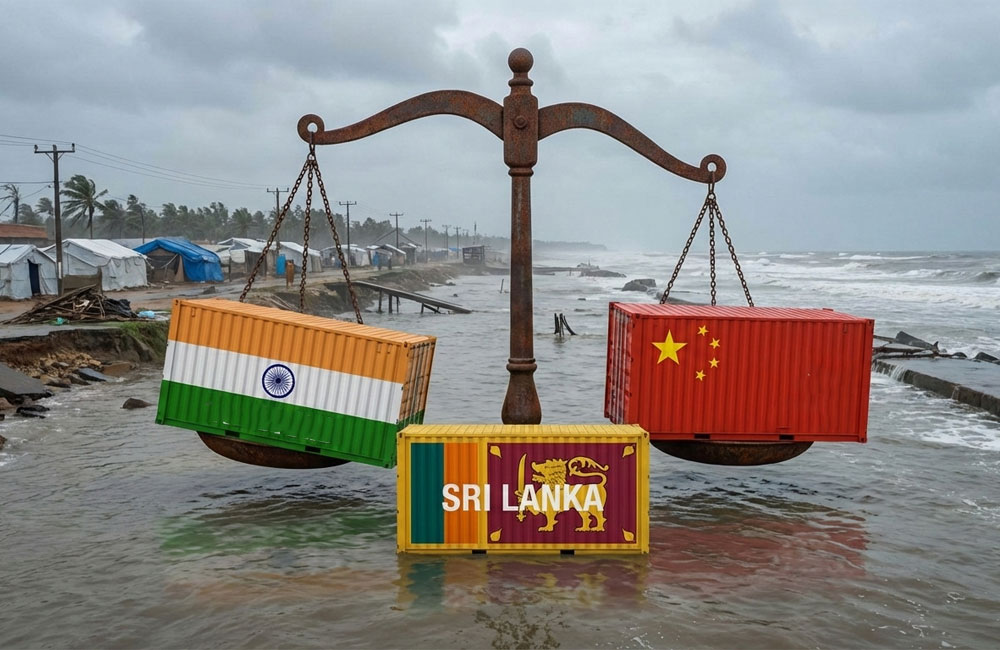
India’s USD 450 million reconstruction package for cyclone-hit Sri Lanka arrives at a critical geopolitical moment, raising questions about whether disaster assistance is also becoming a strategic signal in the intensifying competition for influence in the Indian Ocean.
While the humanitarian dimension of India’s response to Cyclone Ditvah is undeniable—marked by rapid deployment of naval vessels, air assets, medical teams, and relief supplies the scale, speed, and political framing of the package indicate broader strategic intent. Dr. S. Jaishankar’s role as Special Envoy of Prime Minister Narendra Modi and the formal transmission of a letter to President Anura Kumara Dissanayake elevate the assistance from routine aid to high-level diplomatic engagement.
The package, comprising USD 350 million in concessional credit and USD 100 million in grants, is designed to rebuild infrastructure, housing, health and education systems, agriculture, and disaster preparedness. These sectors are not only socially vital but strategically sensitive, shaping long-term connectivity and economic resilience.
India’s swift intervention under Operation Sagar Bandhu contrasts with Sri Lanka’s earlier experience of slower, project-driven assistance from other partners. Over 1,100 tons of relief supplies, emergency medical units, and bridge construction efforts underscore India’s operational readiness in the region.
However, the geopolitical subtext is difficult to ignore. Sri Lanka remains a focal point of competition between India and China, particularly following years of heavy Chinese lending for ports, highways, and energy projects. As Colombo undergoes debt restructuring and recalibrates its external relationships, disaster assistance has become another arena for influence.
India’s emphasis on grants, concessional credit, and rapid execution positions its aid as less financially burdensome than traditional large-scale infrastructure loans. This approach implicitly contrasts with criticism surrounding debt sustainability linked to some past Chinese-funded projects, even as Beijing continues to explore ways to reassert its presence through alternative financing and development support.
Politically, New Delhi’s message is clear: India intends to be Sri Lanka’s most dependable partner during crises, not only in economic recovery but also in safeguarding regional security. The deployment of major naval assets reinforces India’s maritime reach and its vision of the Indian Ocean as a shared security space.
For Sri Lanka, the challenge lies in leveraging Indian assistance without becoming overly dependent or entangled in great-power rivalry. Colombo must balance immediate reconstruction needs with long-term strategic autonomy, ensuring that humanitarian aid does not translate into geopolitical pressure.
Ultimately, India’s cyclone assistance reflects both solidarity and strategy. As climate-related disasters intensify across the region, relief diplomacy is likely to become an increasingly prominent and contested tool in shaping the future balance of power in the Indian Ocean.
Leave your comments
Login to post a comment
Post comment as a guest