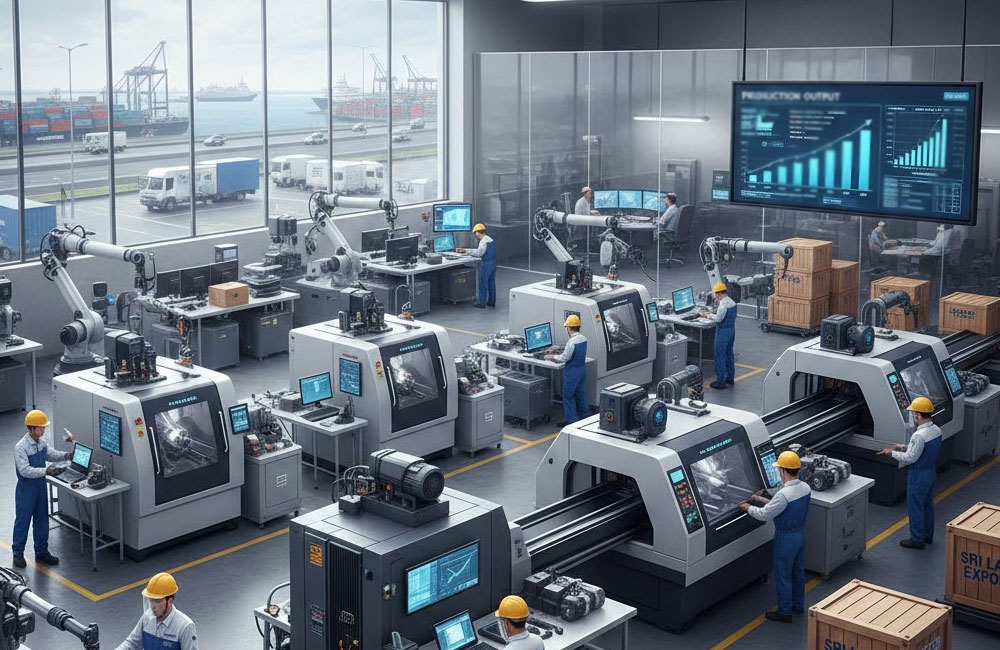
The launch of Shield Restraint Systems’ advanced manufacturing facility in Wathupitiwala presents both an opportunity and a test for Sri Lanka’s industrial strategy. While the USD 8.5 million investment signals renewed investor confidence, it also exposes structural weaknesses that could limit the country’s ability to scale similar projects.
Unlike traditional export industries, Shield’s operation focuses on safety-critical components used across global transportation, construction, and leisure industries. This places Sri Lanka on a higher rung of the manufacturing value chain, demanding precision engineering, rigorous quality control, and regulatory compliance aligned with US and European safety standards.
From an economic standpoint, the projected USD 50 million in annual export revenue is significant, particularly given Sri Lanka’s ongoing foreign exchange constraints. The potential creation of 500 direct jobs also suggests downstream benefits, including skills transfer, supplier development, and exposure to global best practices. If replicated, such investments could diversify exports away from price-sensitive sectors.
But risks remain. The facility is opening at only 10% capacity, reflecting a cautious rollout amid uncertain global demand and domestic policy conditions. Industry analysts note that scaling to full capacity will depend heavily on regulatory stability, consistent labour policies, and efficient customs and logistics operations.
Administrative inefficiencies continue to be a recurring concern among foreign investors. Despite repeated commitments to streamline approvals, Sri Lanka’s investment facilitation processes remain fragmented across agencies. Shield’s management has openly called for a genuinely empowered one-stop service—an issue that has stalled or discouraged similar investments in the past.
There is also geopolitical risk. While shifting global supply chains away from over-concentration in East Asia creates openings for countries like Sri Lanka, competition from Vietnam, India, and Indonesia remains intense. These markets offer faster approvals, larger domestic supplier bases, and clearer industrial roadmaps.
Furthermore, the long-term sustainability of such projects depends on policy consistency beyond electoral cycles. Sudden tax changes, labour law uncertainty, or delays in infrastructure upgrades could undermine investor confidence and restrict expansion plans.
Nevertheless, Shield’s expressed intention to explore an additional USD 17 million in investments suggests cautious optimism. If Sri Lanka can address procedural inefficiencies while maintaining macroeconomic stability, this project could serve as a blueprint for attracting niche, high-value manufacturers seeking alternatives in South Asia.
The real economic impact, therefore, will not be measured by the opening ceremony but by whether Sri Lanka can convert this single investment into a broader industrial transformation
Leave your comments
Login to post a comment
Post comment as a guest