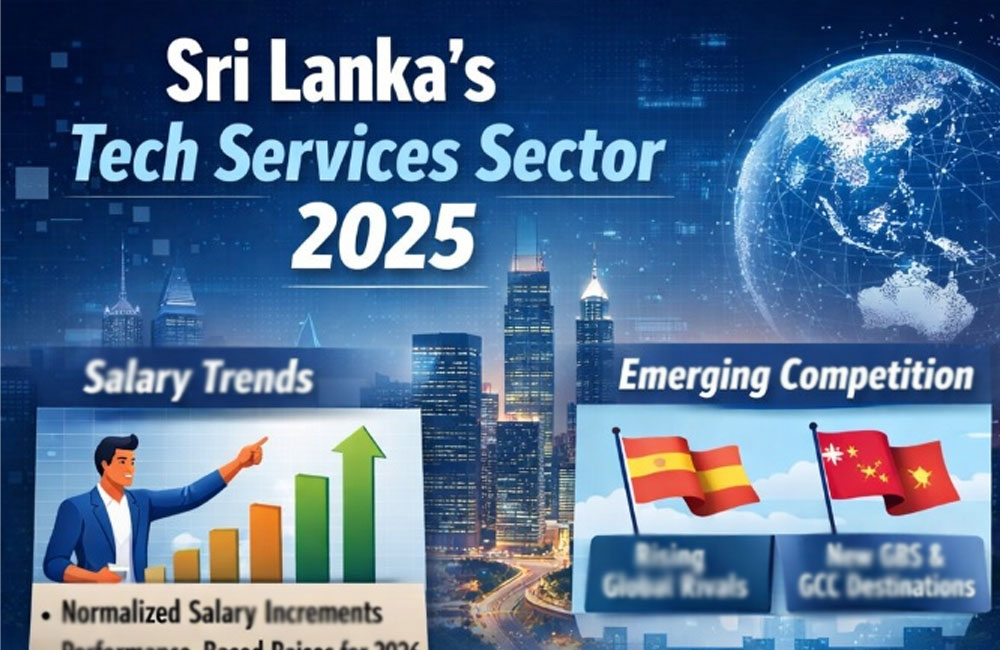
Sri Lanka’s technology services industry is entering a phase of recalibration, as companies adjust compensation and talent strategies to align with a more competitive and evolving global environment, according to the latest Compensation and Benefits Survey released by SLASSCOM.
The study recorded a strong participation rate, with 72% of organisations from the 2024 survey returning this year, reflecting both continuity and growing confidence in the survey as a benchmark for industry decision-making. The findings point to a sector that is moving beyond crisis-driven responses and towards more structured, performance-oriented reward frameworks.
One of the most notable trends is the stabilisation of salary increments. During the height of Sri Lanka’s economic crisis, IT and BPM companies implemented unusually high salary increases to support employees facing inflationary pressures and currency volatility. In 2025, however, increment budgets have normalised, indicating a shift towards sustainability rather than short-term relief.
Looking ahead to 2026, IT companies are planning differentiated salary adjustments, with higher increases targeted at top performers compared to regular performers. BPM companies, meanwhile, are projecting relatively higher overall increments. This reflects a broader transition toward performance-linked compensation and a growing emphasis on measurable contribution rather than uniform pay hikes.
The survey also highlights a gradual transformation in organisational structures. Skill-based models are gaining traction, allowing companies to align rewards more closely with critical capabilities rather than traditional job titles. Alongside this, organisations are expanding their focus beyond basic pay to include career development opportunities, continuous learning, and skills enhancement as key components of total rewards.
Despite the growing availability of flexible and non-monetary benefits, total cash compensation remains the most important factor for employees. However, companies are increasingly offering personalised benefit options to cater to a multi-generational workforce with varying expectations around work-life balance and career progression.
Employee migration, while still a concern, has declined in urgency, dropping from the top issue in 2024 to second place in 2025. Nonetheless, outward mobility continues, particularly among skilled professionals pursuing higher education and international exposure.
From a global perspective, the report underscores intensifying competition among outsourcing and Global Capability Centre (GCC) destinations. While Sri Lanka remains a key player, two new countries have emerged in 2025 as attractive alternatives for GBS operations and GCC expansion. This development highlights the need for Sri Lanka to strengthen both talent quality and cost competitiveness to protect its position.
The survey also reveals that 52% of participating organisations operate as GCCs, reinforcing the sector’s importance to Sri Lanka’s export services economy. SLASSCOM Chairperson Shehani Seneviratne noted that the report provides critical insights to help organisations make forward-looking decisions and sustain Sri Lanka’s role as an innovative technology hub.
Leave your comments
Login to post a comment
Post comment as a guest