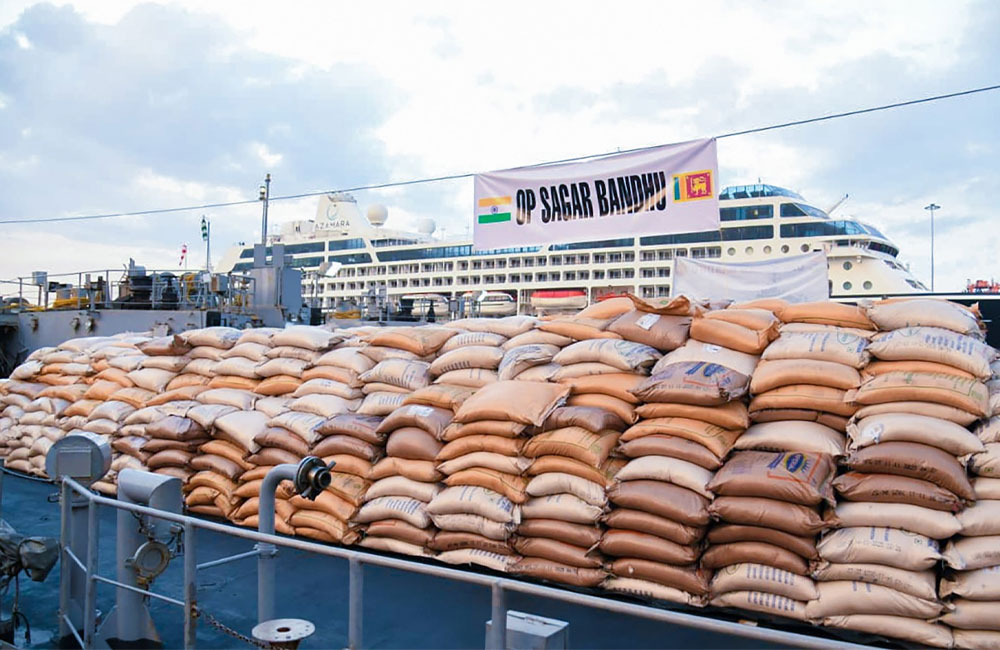
India’s response to Sri Lanka’s devastation caused by Cyclone Ditwah has marked an unprecedented chapter in regional humanitarian assistance, combining scale, speed, and strategic intent. Under Operation Sagar Bandhu, New Delhi deployed the largest foreign field hospital ever sent to Sri Lanka, underscoring not only humanitarian solidarity but also India’s evolving neighbourhood-first geopolitical strategy.
On December 2, 2025, a fully equipped Para Field Hospital staffed by a 78-member Integrated Task Force from the Indian Army’s Shatrujeet Brigade was airlifted to Sri Lanka. The mobile hospital was rapidly established in Mahiyanganaya, a severely affected area near Kandy, where local health infrastructure had been overwhelmed. According to the Indian High Commission, the deployment was designed to deliver immediate, high-impact medical relief while complementing Sri Lanka’s strained public health system.
The hospital provided trauma care, emergency surgeries, maternal services, and general treatment, attending to 1,000–1,200 patients daily. Over its 12-day mission, the facility treated 7,176 patients, conducted 513 minor procedures, and performed 14 major surgeries, offering lifesaving intervention in a region cut off by floods and infrastructure damage. Visiting the site on December 12, Indian High Commissioner Santosh Jha reaffirmed India’s commitment to stand “shoulder to shoulder” with Sri Lanka during crises, a message echoed by Uva Province Governor Kapila Jayasekara.
Beyond healthcare, India’s assistance extended into critical infrastructure restoration. On December 10, at the request of Sri Lanka Telecom, Indian Army signallers repaired a damaged optical fibre cable, restoring communications after a cyclone-triggered blackout. Working in difficult terrain and adverse weather, the team completed precision OFC splicing near a base transceiver station close to the field hospital, enabling the resumption of normal network operations.
As the mission concluded, an Indian Air Force C-17 Globemaster returned the medical team to India on December 14, while simultaneously delivering 10 tonnes of essential medicines and 15 tonnes of dry rations to Sri Lanka. Health Minister Dr. Nalinda Jayatissa, present at the airport, described the deployment as the largest and most comprehensive field hospital ever provided by a friendly nation, expressing formal gratitude on behalf of the government.
Strategically, India’s intervention reflects more than humanitarian concern. It reinforces New Delhi’s role as the first responder in the Indian Ocean neighbourhood, countering regional influence competition while strengthening bilateral trust. As Sri Lanka navigates repeated climate-linked disasters, India’s rapid, high-capacity response has redefined disaster relief as both humanitarian action and strategic diplomacy.
Leave your comments
Login to post a comment
Post comment as a guest