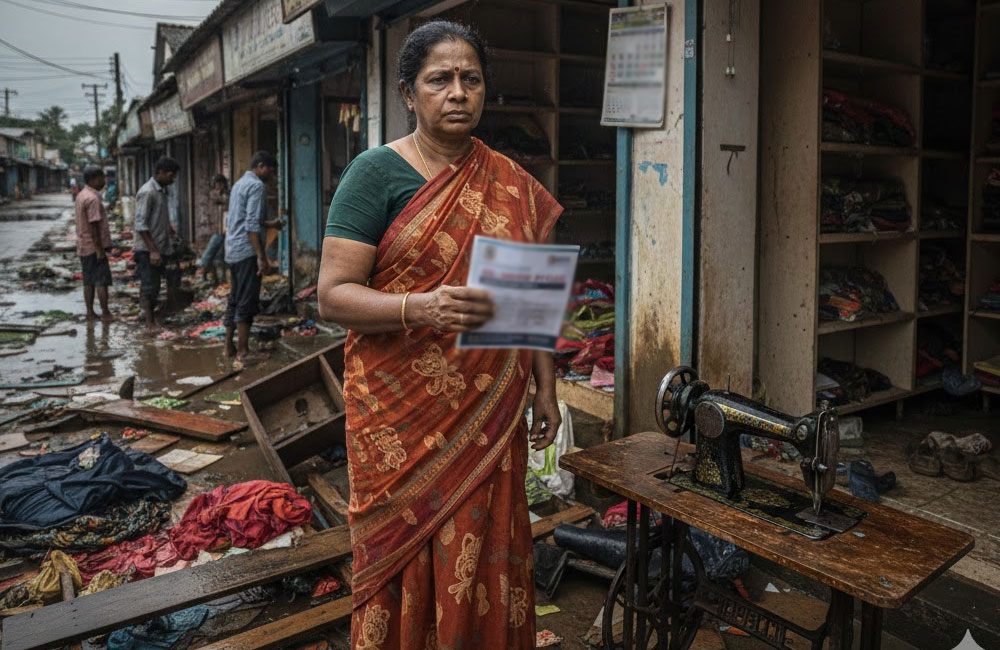
The Government’s announcement of the RE-MSME PLUS loan scheme, aimed at reviving enterprises affected by Cyclone Diwah, has reopened a long-simmering debate over how Sri Lanka responds to economic devastation caused by natural disasters.
While authorities describe the scheme as a lifeline for thousands of struggling businesses, many entrepreneurs and analysts question whether another credit-based solution delayed until 2026 can realistically rescue micro, small and medium enterprises (MSMEs) that are already on the brink of collapse.
Cyclone Diwah and the ensuing floods affected at least 13,698 businesses, according to complaints lodged with a support centre set up by the Ministry of Industries. More than 10,000 of these were micro and small enterprises, including family-run shops, small manufacturers, repair workshops, food processors, and informal service providers.
For many, floodwaters destroyed equipment, stocks, and raw materials within hours, while prolonged power cuts and damaged transport links brought operations to a standstill. Several medium-scale industries reported losses running into millions of rupees due to damaged machinery and disrupted supply chains.
In this context, the RE-MSME PLUS scheme offers three-year loans at a concessional 3 percent interest rate, with a six-month grace period. Micro enterprises will be eligible for loans of up to Rs. 250,000, while small and medium firms can access up to Rs. 1 million.
The Government also plans to consolidate multiple existing schemes such as SMILE Phase III, E-FRIEND II, eco-friendly financing lines, and the earlier RE-MSME loan scheme into a single framework to improve coordination and oversight.
However, critics argue that the core problem is not the number of loan schemes, but the absence of timely and non-debt relief. During previous floods, landslides, and even the height of the economic crisis,
MSME owners repeatedly complained that concessional loans arrived months after the disaster, by which time many businesses had already shut down. Application procedures were often complex, collateral requirements excluded informal operators, and approved loan amounts fell short of actual recovery needs.
For micro enterprises earning daily income, taking on new debt however cheap can be risky. Many are still servicing loans taken during the economic crisis, when interest rates were far higher and demand sharply contracted. Adding fresh borrowing without grants, insurance payouts, or debt moratoriums may simply deepen financial stress rather than restore productive capacity.
Economists also warn that postponing implementation until 2026 weakens the scheme’s impact. Disaster recovery, they argue, requires rapid liquidity, asset replacement, and working capital within weeks not years. Without immediate intervention, affected areas risk permanent loss of businesses, jobs, and local supply networks.
Cyclone Diwah has therefore become a test case for whether Sri Lanka will move beyond a loan-centric disaster response. Unless RE-MSME PLUS is complemented by fast-track grants, simplified access, and a long-term MSME disaster insurance mechanism, many fear the scheme could become yet another well-intentioned policy that arrives too late for those it is meant to save.
Leave your comments
Login to post a comment
Post comment as a guest