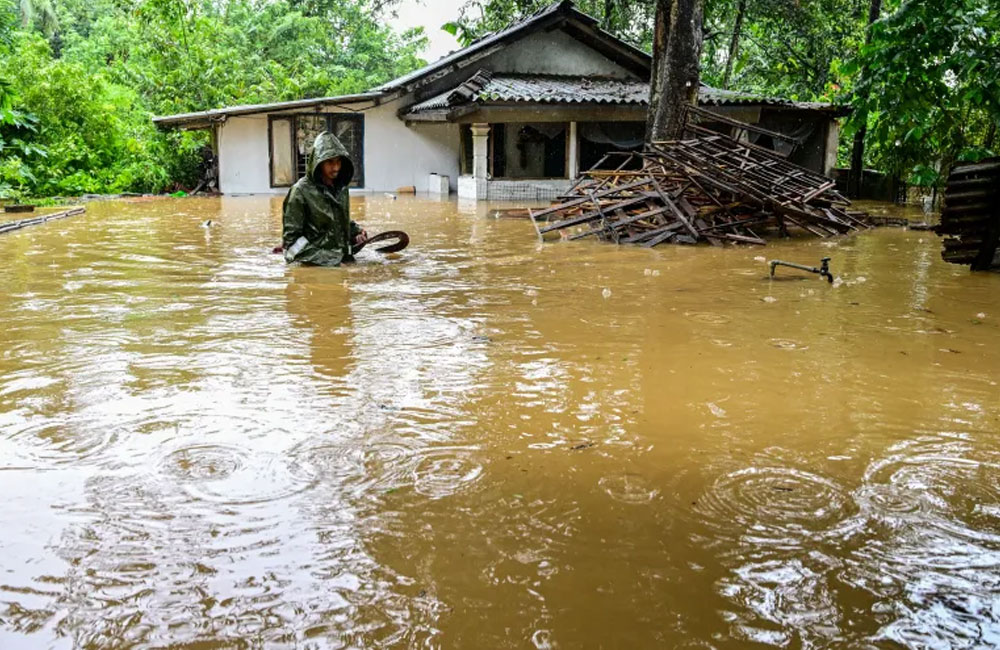
Sri Lanka’s worsening climate disasters have exposed a critical weakness in the country’s early-warning system: the absence of a functioning Doppler radar, a tool regarded globally as essential for accurate real-time weather forecasting.
A Japan International Cooperation Agency (JICA)–funded radar, promised years ago, is now expected only by 2027, raising questions about government accountability after a series of devastating cyclones and floods.
A Doppler radar detects precipitation levels and wind movements, enabling meteorologists to track storm formation, direction and intensity with high precision.
For an island increasingly battered by extreme weather, the absence of such technology has had deadly consequences. Communities hit by recent cyclonic systems say warnings came too late or were too vague to prepare.
Officials privately admit that the Met Department’s limited forecasting capacity without a Doppler system severely restricts the accuracy of localised alerts.
Sri Lanka was supposed to receive two Doppler radars through a JICA grant agreed in 2017. That number was later cut to one. Even that single unit faced repeated delays due to the pandemic, the economic collapse, procurement bottlenecks and administrative mismanagement.
Construction at the Puttalam meteorological station began only after contracts with Japan Radio and Hazama Ando Corporation were signed in June 2024. Suppliers were finalised four months later, restarting a project that had been dormant for years.
This is not the first time the Met Department mishandled Doppler technology. An earlier attemptundertaken with the World Meteorological Organisation (WMO) collapsed in what auditors described as a costly “disaster.”
The National Audit Office revealed that Rs 400 million allocated in 2006–2007 for a Doppler system was effectively wasted. The radar, purchased on Sri Lanka’s instructions from the US-based Enterprise Electronics Corporation, was installed on a 20-metre tower atop the Gonagala peak in Deniyaya.
After installation, the supplier informed the WMO that the required electronic connectivity was impossible to provide.
Eighteen years later, no one knows where that radar is or why technical feasibility was never verified before purchase.
Amid the current crisis, the Met Department’s Director General was barred from speaking to media following public anger over missed warnings during the latest cyclone. The information freeze has further fuelled suspicion about systemic failures and internal accountability gaps.
Scientists warn that without Doppler radar coverage, Sri Lanka will continue to rely on outdated systems incapable of capturing rapid storm intensification now common due to climate change.
As people struggle to rebuild homes destroyed by floods, the question remains unanswered: how many more disasters will strike before Sri Lanka finally installs the technology it has been promised for nearly two decades?
Leave your comments
Login to post a comment
Post comment as a guest