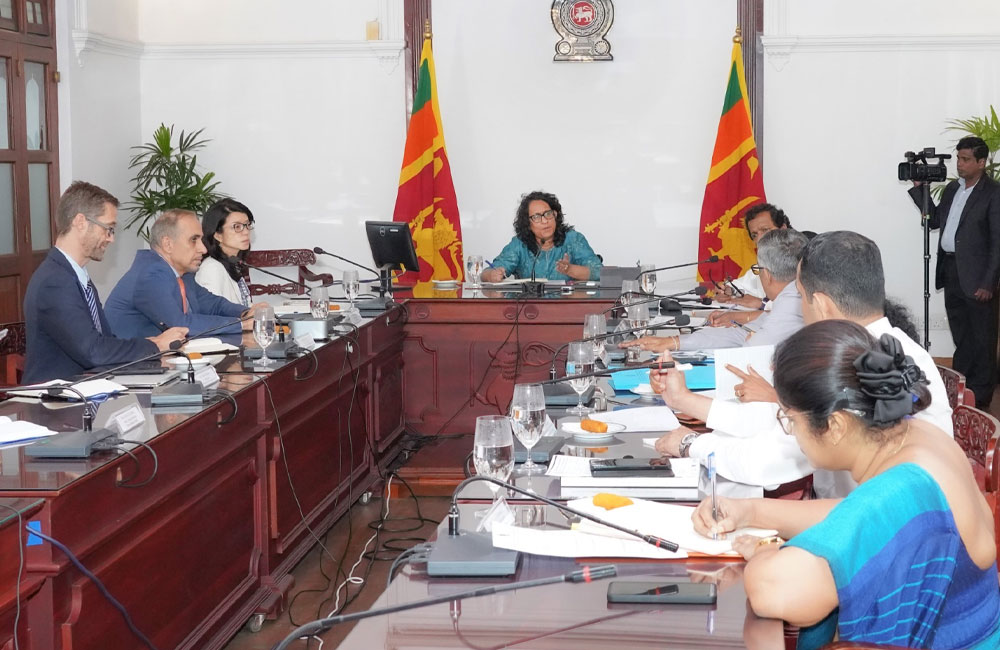
Prime Minister Dr. Harini Amarasuriya underscored the essential role of accurate and timely data in enabling effective decision-making during post-disaster recovery, at a meeting held on December 8 at the Prime Minister’s Office. The discussion centered on reconstruction planning, with particular attention to regions repeatedly affected by flooding.
Representatives from the United Nations Development Programme (UNDP), the World Bank, and the United Nations Office for Project Services (UNOPS) took part in the meeting, which was convened under the Prime Minister’s patronage.
Addressing the gathering, the Prime Minister noted that reliable, systematically gathered information is vital for day-to-day decision-making after a disaster. She emphasized that strong data flows guide both immediate response efforts and long-term recovery strategies.
During the briefing, officials outlined the post-disaster needs assessment tools currently in use, including RAPIDA and the Global Rapid Post-Disaster Damage Estimation (GRADE) system. These UNDP-led assessments integrate GIS technology, satellite imagery, and on-ground data collection to generate real-time, actionable insights. The tools help identify affected communities, infrastructure damage, debris levels, and land-use changes, thereby providing essential information for planning.
UNDP representatives reaffirmed their commitment to continued collaboration with the Government of Sri Lanka, expressing readiness to enhance partnerships aimed at improving the efficiency and impact of post-disaster response and reconstruction initiatives.
The meeting was attended by World Bank Country Manager Dr. Gevorg Sargsyan; UNDP Resident Representative Ms. Azusa Kubota; the South Asia Director for UNOPS; Secretary to the Prime Minister Mr. Pradeep Saputhanthri; Additional Secretary (Development) Ms. Sagarika Bogahawaththa; and officials from the Department of National Planning.
Prime Minister’s Media Division
2025.12.09
Leave your comments
Login to post a comment
Post comment as a guest