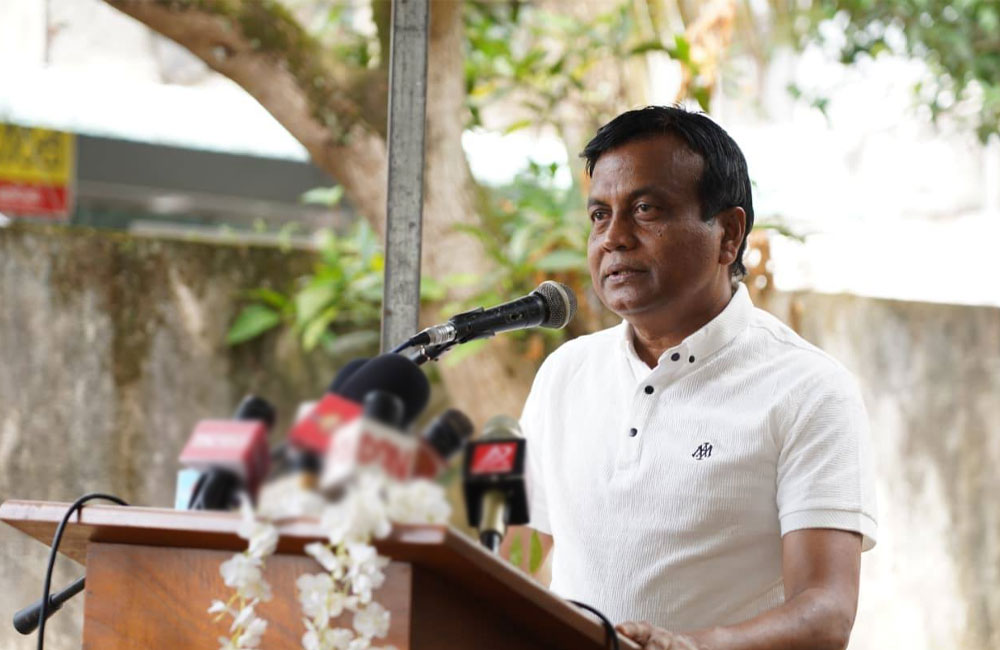
Deputy Minister of Public Security and Parliamentary Affairs Sunil Watagala has come under sharp public and institutional criticism after urging police to invoke emergency regulations against individuals posting what he termed “defamatory” content about the President and senior ministers on social media.
His remarks, made in the middle of a national disaster response, have ignited a storm of concern over political overreach, abuse of emergency powers, and the chilling effect on citizens and journalists at a moment when transparent communication is vital.
The Sri Lanka Working Journalists Association (SLWJA) condemned the Deputy Minister’s comments in an unusually forceful statement, warning that his directive represented a direct assault on freedom of expression.
At a time when the government is working often under harsh scrutiny to provide relief and restore essential services, the SLWJA argued that such rhetoric only undermines public trust and creates the impression that the state is more interested in policing criticism than addressing urgent humanitarian needs.
Watagala made his remarks on 2 December during a meeting at the Malabe Divisional Secretariat, attended by several officials including Deputy Media Minister Dr. Kaushalya Ariyarathna.
Claiming that a coordinated campaign was underway to disseminate misleading information about the disaster, he alleged that false narratives were being spread through “physical means, social media, and even AI-generated content,” including by individuals based overseas.
However, what alarmed media organisations was not the acknowledgement of misinformation—which is a legitimate concern during emergencies but the Deputy Minister’s instruction to police officers to treat those posting such content “not merely as suspects but as offenders” under emergency regulations.
According to the SLWJA, this directive crosses a dangerous threshold by equating criticism and commentary with criminal activity.
The association accused the government of backtracking on democratic values it once promised to uphold. It added that this was part of a pattern of escalating pressure on journalists, editors, and digital platforms over the past year pressure that has intensified alongside political discomfort over disaster management shortcomings now under public scrutiny.
The SLWJA warned that weaponising disaster-related emergency powers to silence dissent poses a severe threat to constitutional rights.
Such actions, it said, weaken the credibility of the government’s relief efforts by creating suspicion that officials are attempting to suppress independent reporting rather than improve accountability.
A separate statement from Internet Media Action (IMA) echoed these concerns, calling the remarks a “serious threat to freedom of expression” and an “abuse of power.
” The IMA criticised Watagala’s claim that “malicious character assassination attacks” warranted harsh punishment under emergency law, noting that the distinction between scrutiny and defamation cannot be defined arbitrarily by political actors.
The organisation stressed that using emergency regulations designed for disaster management to suppress criticism amounts to “theft of fundamental rights.” Such rhetoric, it warned, could foster fear, discourage citizens from reporting lapses in relief operations, and ultimately hinder the government’s ability to correct errors on the ground.
“Criticism is not a crime,” the IMA insisted, demanding that Watagala withdraw his comments. Civil society groups have also urged the government to clarify its commitment to fundamental freedoms as it navigates the challenging task of rebuilding communities devastated by the disaster
Leave your comments
Login to post a comment
Post comment as a guest