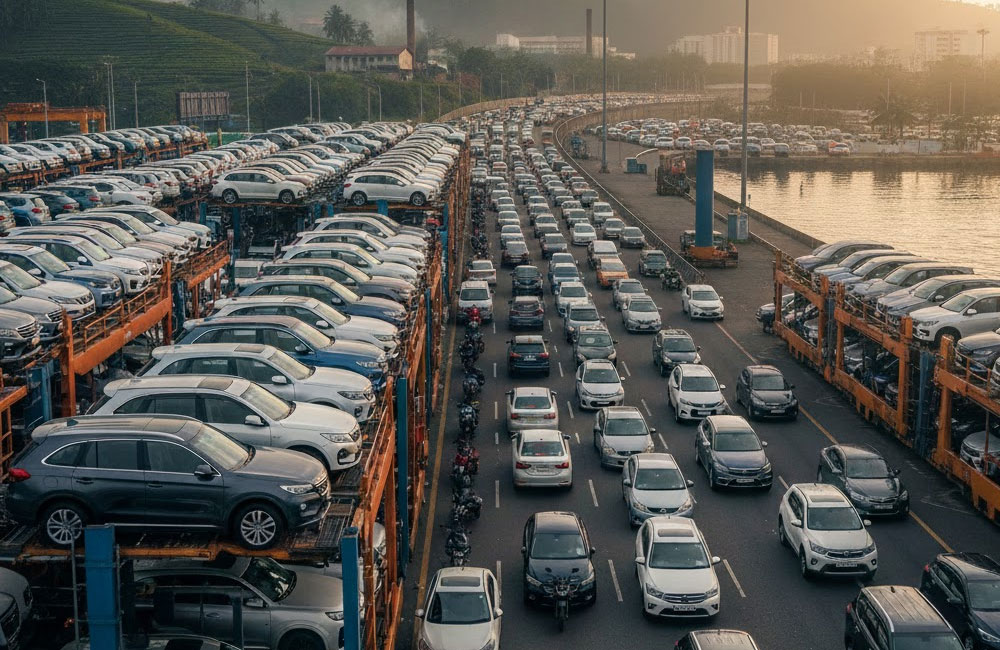
Sri Lanka’s import bill surged to US$ 2,156.8 million in October, with vehicles alone absorbing US$ 261 million, creating renewed concerns over the economy’s growing external vulnerabilities. The sharp spike comes just months after the Central Bank attempted to slow the foreign exchange drain by restricting bank and finance company lending for vehicle purchases—a move now proving insufficient against pent-up demand and looser post-restriction import conditions.
While the economy continues to expand mirroring 2024’s 5% GDP growth the revival in consumption has created an import-heavy recovery. Fuel imports rose to US$ 357.8 million in October, with refined petroleum accounting for the bulk of the expenditure. Over the first ten months of 2025, Sri Lanka spent US$ 3.3 billion on fuel and US$ 1.46 billion on vehicles, reflecting the scale of the country’s dependence on international markets.
With total merchandise imports reaching US$ 17.55 billion (a 13.8% rise), the country’s trade deficit widened sharply, hitting US$ 1,007.4 million in October alone—the highest monthly deficit recorded this year. Exports, meanwhile, stagnated at US$ 1.15 billion, failing to keep pace with the import surge. The ten-month trade deficit now stands at US$ 6.2 billion, up from US$ 4.7 billion last year, placing renewed pressure on the fragile recovery in external balances.
The impact is already visible in Sri Lanka’s current account, which slipped into a US$ 199.5 million deficit in October the second consecutive month in the red—raising red flags about sustainability. Although the current account still shows a US$ 1.65 billion surplus for the first ten months, the momentum is clearly weakening.
Beyond the headline numbers, the resurgence in vehicle imports is creating serious structural risks. According to the Ceylon Motor Traders Association (CMTA), the post-February 2025 relaxation of restrictions has triggered a wave of indirect imports, many entering without proper safety inspections, verified histories, or manufacturer warranties. CMTA warns that these vehicles—often under-invoiced or routed through grey channels—pose long-term risks to both consumers and the economy.
Hidden defects, tampered odometers, and lack of after-sales support mean buyers may save at the point of purchase but face steep costs down the line. More critically, such imports undermine government revenue through loss of customs duties, distort market competition, and create recurring pressure on foreign exchange as spare parts must be sourced externally without manufacturer backing.
Authorized agents, CMTA stresses, offer vehicles built for Sri Lankan conditions, backed by warranties, proper recalls, trained technicians, and ethical foreign currency transactions. In contrast, grey imports bypass key regulatory checks, leaving buyers exposed and depriving the state of millions in revenue.
As vehicle imports accelerateand as consumers increasingly turn to unregulated channels—the economic consequences are mounting: widening deficits, rising FX pressure, reduced revenue collection, and heightened consumer risk. Without stronger regulatory enforcement and tighter oversight of import channels, Sri Lanka risks repeating past cycles of unsustainable import-led expansion, further weakening its fragile recovery.
Leave your comments
Login to post a comment
Post comment as a guest