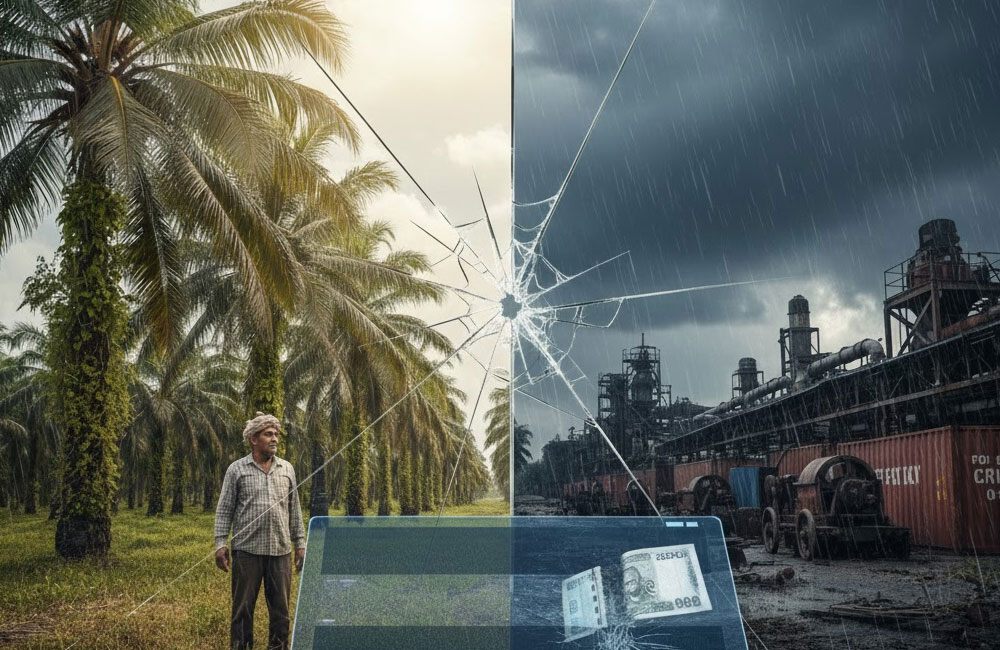
Sri Lanka’s continued ban on new oil-palm cultivation and the import of crude palm oil (CPO) has escalated into a significant economic setback, straining foreign exchange reserves, undermining export sectors, and jeopardising thousands of livelihoods, industry stakeholders warn.
Initially introduced on environmental grounds, the policy has now created far-reaching economic distortions. Since the CPO import ban took effect in April 2021, Sri Lanka has spent more than US$175 million on imported edible oils to meet domestic demandan unsustainable burden for an economy still grappling with balance-of-payments pressures.
Despite once having a productive oil-palm sector that supplied part of the annual requirement of nearly 264,000 metric tonnes, the country now relies almost entirely on imports.
The fallout has been particularly damaging for Board of Investment (BOI) export manufacturers. Companies that previously produced hydrogenated palm-oil products such as vanaspathi ghee, shortening, CBS fats and chocolate fats have incurred losses exceeding US$40 million after losing access to their primary raw material in 2022.
Their export operations collapsed even though they enjoy preferential access to Indian markets under the Indo–Sri Lanka Free Trade Agreement (ISFTA).
Adding to the irony, India-Sri Lanka’s biggest trading partner has recently reopened the very HS codes that Sri Lanka closed, allowing imports of palm-oil-based products while simultaneously raising tariffs on edible oils.
This shift has created fresh demand in India for Sri Lankan processed exports, but domestic manufacturers remain unable to capitalise due to the rigid CPO import ban.
In a detailed appeal to President Anura Kumara Dissanayake, industry leaders have urged the government to rethink its position and introduce a controlled licensing mechanism allowing BOI-registered firms to import CPO (HS Code 1511.10).
They argue that restoring access to raw materials would revive export production, stabilise domestic edible-oil supply chains, and bring in an estimated US$75 million annually in export earnings.
Their concerns extend beyond immediate manufacturing losses. Plantation companies are pressing for the removal of the nationwide ban on new oil-palm cultivation, imposed in 2022, which abruptly halted a long-term industry intended to reduce dependence on imported oils.
They propose an annual replanting programme covering 10,000 acres, predicting that Sri Lanka could achieve self-sufficiency and potentially produce a surplus for export within six years.
Industry arguments mirror regional trends. India, which imports nearly eight million tonnes of palm oil each year, has launched a major plan to cultivate oil palm over five million hectares, signalling the strategic value of the crop for food security when properly regulated.
As Sri Lanka prepares to transition from the Special Commodity Levy to a more transparent ad valorem tax on imported oils in 2026, the pressing question remains: will policy change arrive in time?
For manufacturers, plantation workers, and rural communities dependent on the sector, the answer could determine whether the industry survives or collapses entirely.
Leave your comments
Login to post a comment
Post comment as a guest