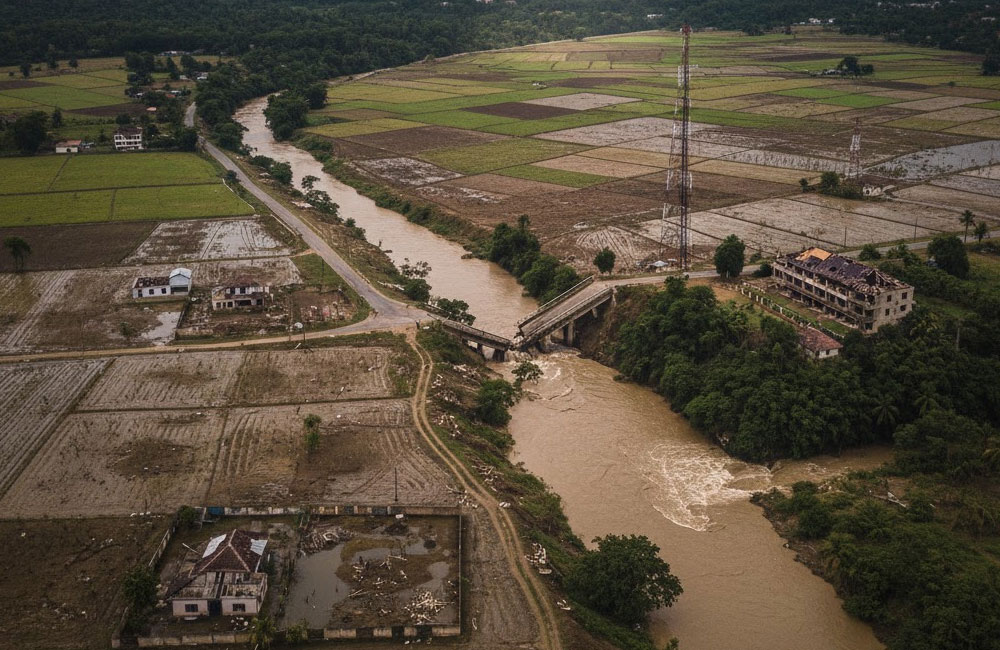
As Sri Lanka continues to grapple with the aftermath of Cyclone Ditwah, UNP President Vajira Abeywardena has issued a public warning that the country’s economy could suffer one of its largest disaster-related losses in decades, urging the government to release transparent assessments and launch immediate relief interventions.
While official figures remain unavailable, informed sources within the Disaster Management, and provincial administrations estimate the economic cost to fall between LKR 120–300 billion, depending on the accuracy of district-level assessments now under way. These internal estimates, shared in confidence with UNP officials, were referred to indirectly by Abeywardena, who said the impact could “push the economy back by years if mishandled.”
Early briefings indicate severe damage to agriculture particularly vegetables, paddy, and smallholder cash crops with over 35,000 hectares affected across Sabaragamuwa, Central, and Southern provinces. This alone could translate to LKR 20-40 billion in direct output losses and higher food inflation in the coming months.
The fisheries sector has also been hit, with hundreds of boats damaged or lost, disrupted landing sites, and destroyed cold-chain facilities. Industry representatives estimate losses exceeding LKR 10-15 billion.
Tourism, already fragile, faces fresh setbacks as over 70 hotels, guesthouses and homestays across river valleys and hill regions report structural damage, cancellations and supply disruptions.
Housing, Infrastructure and the Wider Economic Bill
Rough field reports suggest 14,000-18,000 houses damaged or destroyed, in addition to thousands more requiring partial repair. Public infrastructure - especially rural bridges, culverts, feeder roads and irrigation canals - has sustained substantial damage, with internal engineering notes pointing to a LKR 40–60 billion reconstruction requirement.
The cumulative hit to livelihoods, reconstruction spending, supply chain disruptions and service-sector losses could push the total economic shock toward the upper range of LKR 300 billion, analysts say.
Abeywardena’s Critique of the Government Response
Abeywardena criticised what he described as the slow and opaque response of state institutions in releasing accurate loss assessments. He argued that without transparent figures, both Parliament and the public cannot evaluate the scale of required relief, nor how much financial support must be redirected from the Budget.
He also warned that delays in emergency relief will deepen rural vulnerability, especially in areas
The UNP has recommended:
- A rapid national damage audit, using satellite and district data.
- Immediate cash grants and housing repair assistance for affected families.
- A temporary debt moratorium for small farmers and micro-businesses.
- Fast-tracked restoration of feeder roads, bridges and irrigation networks.
- Publication of district-level damage estimates within days, not weeks.
Abeywardena cautioned that the disaster “demands urgency, transparency and accountability,” stressing that failure to act swiftly could turn a natural catastrophe into an economic crisis.
Leave your comments
Login to post a comment
Post comment as a guest