Cyclone Ditwah has rapidly transformed into the most severe political and administrative crisis facing President Anura Kumara Dissanayake’s JVP-led NPP Government, as public anger rises sharply over mounting deaths and what many describe as glaring failures in disaster preparedness.With 153 confirmed dead and 191 missing, the storm’s aftermath has touched almost every district, leaving the Government scrambling to defend itself against accusations of ignoring expert warnings and allowing systemic lapses that worsened the tragedy.
The most politically damaging revelation concerns early alerts. The Department of Meteorology had reportedly flagged Ditwah’s escalation as early as 12 November, urging immediate activation of a coordinated disaster-response mechanism.
Instead of mobilising state machinery, authorities assumed the cyclone would follow the trajectory of previous storms an assumption now castigated as fatal. Critics have compared this lapse to the 2019 Easter Sunday intelligence failure, where warnings were available but insufficiently acted upon.
When rains intensified by 27 November, the situation further deteriorated. The Government’s sudden decision to declare a nationwide public-sector holiday on 28 November, without clearly defining essential services, created administrative paralysis at the worst possible moment.
Thousands of distressed residents rushed to divisional secretariats and grama niladhari offices seeking emergency assistance, only to discover shuttered offices or absent officials.
Some Divisional Secretaries even refused emergency procurements fearful of corruption allegations while being technically “on leave”resulting in delayed evacuations in several heavily affected localities.
Initial internal estimates compiled by the Treasury and provincial administrations suggest an economic blow in the range of LKR 120–300 billion, depending on the accuracy of district-level assessments now underway.
These figures were alluded to indirectly by senior UNP figure Vajira Abeywardena, who warned that mismanaging the crisis could “set the economy back by years.”
The agricultural sector is among the hardest hit. More than 35,000 hectares of vegetables, paddy, and smallholder cash crops across Sabaragamuwa, Central, and Southern provinces have been severely damaged translating into LKR 20–40 billion in direct losses. Economists caution that this could trigger renewed pressure on food inflation in the coming months. The fisheries sector reports losses exceeding LKR 10–15 billion, with damaged boats, disrupted landing sites, and destroyed cold-chain infrastructure crippling coastal livelihoods.
Tourism already fragile is now absorbing further shocks, with over 70 hotels, guesthouses, and homestays in river-valley and hill-country corridors reporting structural damage, cancellations, and supply chain disruptions.
Housing and public infrastructure have sustained heavy destruction. Rough field assessments indicate 14,000-18,000 homes fully or partially damaged. Rural bridges, culverts, feeder roads, and irrigation canals have taken a severe hit, with engineering units estimating a LKR 40–60 billion reconstruction requirement.
Analysts project the cumulative economic toll-including agricultural losses, reconstruction costs, supply disruptions, and service-sector shocks-could reach LKR 300 billion at the upper range.
In the vacuum created by slow official action, ordinary citizens stepped up. Community kitchens emerged overnight, doctors provided free online consultations, and volunteers used private vehicles to rescue stranded families. Yet the conspicuous absence of the JVP’s traditionally active Red Star volunteer force drew public criticism and discomfort within the NPP leadership.
Communication missteps worsened tensions. Tamil-language disaster alerts were issued far too late, leaving affected communities feeling neglected by a government that had pledged equality and modernised state communication.
Only by midday on 29 November, under intense pressure, did the President declare a state of emergency and restore essential services via Gazette.
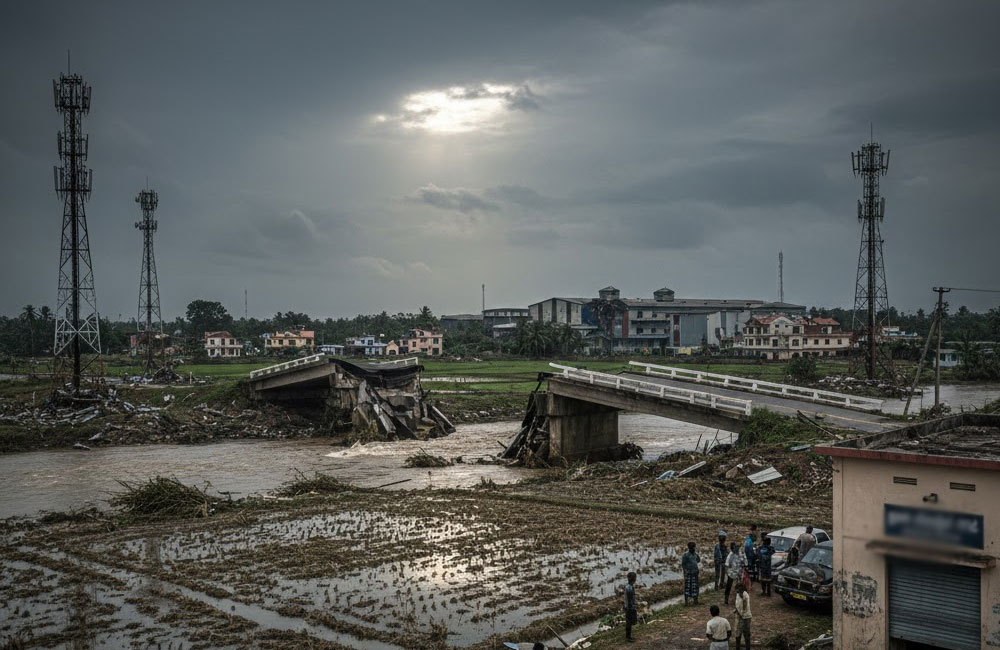
Beyond the politics, the material damage is staggering: devastated paddy fields, ruined agricultural land, damaged telecom towers, severed road networks, collapsed bridges, affected hotels, and even industrial losses including a major apparel facility in Thulhiriya.
With Sri Lanka already carrying Rs. 30.93 trillion in public debt, the reconstruction burden could force the Government to seek urgent external assistance.
Opposition parties have moved quickly. The UNP highlights its own past disaster-management record, while SJB leader Sajith Premadasa has appealed to the IMF to relax certain programme conditions in light of the “national calamity.”
As waters recede, the Government faces its most difficult task: rebuilding public trust. Cyclone Ditwah has exposed serious weaknesses in institutional coordination and crisis governance. To recover politically and economically the NPP Government will require transparency, rapid action, and a willingness to acknowledge mistakes, qualities the public now demands more strongly than ever.
Leave your comments
Login to post a comment
Post comment as a guest