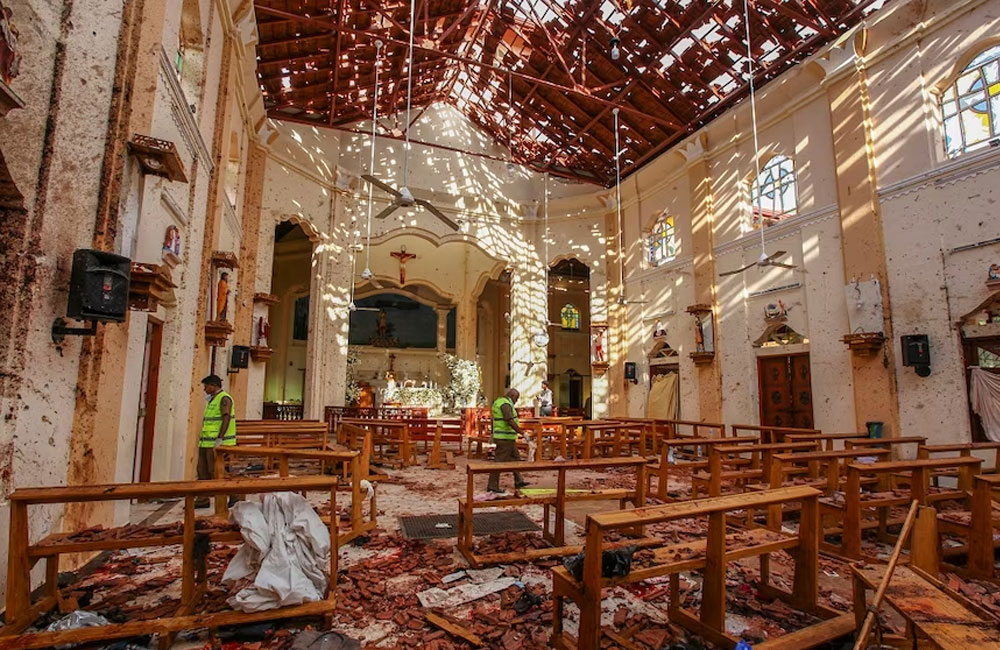
A High Court Trial-at-Bar has convicted 15 accused in the case concerning the 2019 Easter Sunday terror attacks, imposing lengthy prison sentences ranging from 200 to 260 years.
The verdict was delivered by a three-member Trial-at-Bar comprising High Court Justices Navaratne Marasinghe, Ramanathan Kannan and Sujeewa Nishshanka.
The first accused was sentenced to 220 years of rigorous imprisonment, while the second, third, fourth and fifth accused were each sentenced to 240 years.
The sixth and seventh accused received 200 years each, while the eighth accused was sentenced to 260 years. The ninth and tenth accused were each given 220 years.
The eleventh and fifteenth accused were sentenced to 200 years each, while the sixteenth, eighteenth and nineteenth accused received 220, 220 and 200 years respectively.
The court also ordered the confiscation of the properties belonging to all 15 convicted accused.
At the same time, nine other individuals who had been indicted in connection with the attacks were acquitted and released. They were identified as Husainul Rizvi Khalid Sameer, Mohamed Sawahir Mohamed Hassan alias Abu Dawood, Mohamed Iftikhar Mohamed Insaf alias Abu Mohamed, Zainul Abdeen Mohamed Jaseen, Mohamed Mustafa Mohamed Rizwan, Meera Zaheed Mohamed Nafli alias Abu Sana, Mohamed Ameen Ayantullah, Mohamed Ansardeen Hilmi and Mohamed Akram Ahakkam.
The judgment relates to the Easter Sunday attacks of April 21, 2019, in which suicide bombers targeted three Catholic churches and three major hotels in Colombo. The attacks killed 269 people and injured more than 500 others.
Nine suicide bombers, including National Thawheed Jamaath leader Zahran Hashim, carried out the coordinated attacks, which drew widespread international attention.
Legal proceedings were initiated in 2019 against 24 accused over more than 23,270 charges. The charges included allegedly conspiring to carry out the attacks, providing assistance and abetment, promoting extremist ideologies and creating discord between communities.
The prosecution presented evidence from 2,309 witnesses in the case filed by the Attorney General, which included former National Thawheed Jamaath figure Naufer Moulavi among the accused.
The reading of the judgment began before the Trial-at-Bar at around 12.30 p.m. yesterday. Presiding Judge Navaratne Marasinghe told court that, given the extensive nature of the judgment, only the key matters would be read out in open court.
He noted that the indictment served on the accused consisted of nine volumes and approximately 8,900 pages.
The court considered allegations relating to the conduct of workshops, the maintenance of safe houses and activities involving extremist lectures and weapons training prior to the Easter Sunday attacks.
Explaining the court’s consideration of the alleged conspiracy, Judge Marasinghe said that individuals involved in a conspiracy did not necessarily have to be physically together or participate at the same stage. He noted that an agreement to commit an offence could be formed directly or implicitly and that individuals who became involved at different stages could all become parties to the conspiracy.
The Trial-at-Bar subsequently considered the individual defence submissions made by the accused.
The court rejected the defence pleas of 15 accused, resulting in their convictions, while the defence pleas of the nine acquitted accused were accepted.
Leave your comments
Login to post a comment
Post comment as a guest