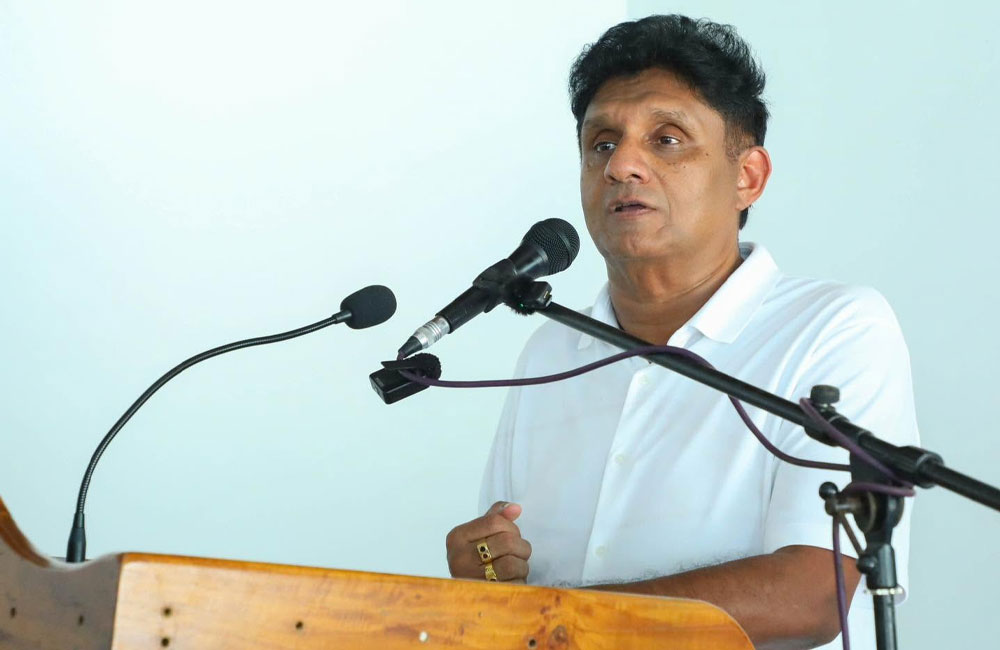
Opposition Leader Sajith Premadasa has accused the government of attempting to dismantle the independence of the judiciary and establish autocratic single-party rule through its proposed changes to judges' retirement ages.
Premadasa made these remarks while addressing a public dialogue on the protection of democracy, the rule of law and judicial independence, organised by the Samagi Lawyers' Association at the Sri Lanka Foundation Institute on Saturday.
The Opposition Leader questioned why the government, led by President Anura Kumara Dissanayake, had proposed raising the retirement age of Supreme Court judges from 65 to 67 and that of Court of Appeal judges from 63 to 65, while making no move to abolish the Executive Presidency through a constitutional amendment, despite having campaigned on such a promise.
He noted that when this inconsistency was raised in Parliament, the government had denied any such commitment existed, a response he characterised as an attempt to erode democracy entirely.
He said that the manoeuvre would not only damage the independence of the judiciary but also undermine public confidence in it.
Premadasa further pointed to the government's failure to fill several outstanding vacancies in the superior courts, describing this as both a violation of fundamental rights and a form of undue pressure exerted upon the judiciary.
He observed that political actors often invoked international principles on judicial independence and the separation of powers while in opposition, only to abandon them once in office and begin consolidating power instead.
Placing these developments in a longer historical context, the Opposition Leader traced the evolution of legal and democratic principles from the Mesopotamian, Egyptian, Greek and Roman civilisations through to the Magna Carta, the development of common law in medieval England, the 1787 American Constitution, the 1948 Universal Declaration of Human Rights, the 1966 covenants on civil and political rights, and the 1985 basic principles on the independence of the judiciary.
He said that governance rooted in this democratic tradition depended on a strong separation of powers between the legislature, the executive and the judiciary, supported by a functioning system of checks and balances, adding that judicial independence and the strength of democracy were directly linked.
Premadasa also warned of potential economic repercussions, cautioning that pressure from institutions such as the IMF could follow the government's course of action, and that facilities such as the European Union's GSP+ trade concession could similarly come under threat.
He said it was necessary to establish the IMF's position on the proposed amendments, and called on the public to unite across class, colour and political lines to resist what he described as an anti-democratic programme, stressing that past periods of judicial interference must not be allowed to recur.
Leave your comments
Login to post a comment
Post comment as a guest