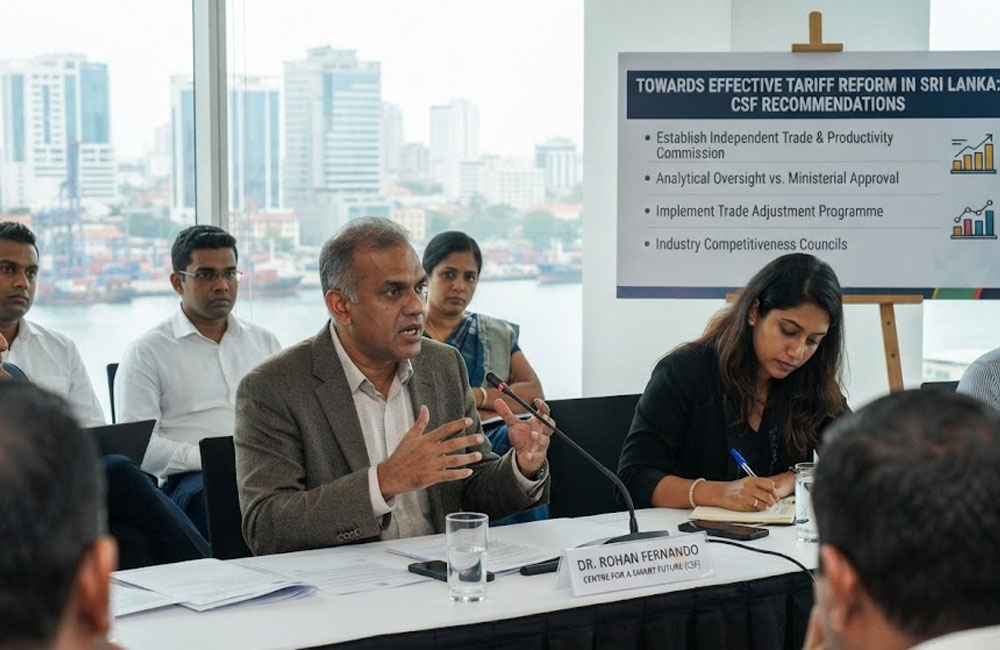
A Colombo-based think tank has said that Sri Lanka's renewed tariff rationalisation drive risks stalling unless it is supported by an independent, analytically-capable institution rather than a body that merely channels industry submissions for ministerial approval.
The Centre for a Smart Future (CSF) said the government should consider reviving free trade agreement negotiations alongside its tariff reform agenda.
The CSF pointed to Sri Lanka's own history with such reforms, noting that a similar tariff rationalisation effort undertaken a decade ago had collapsed under industry pushback and political pressure. The think tank observed that a detailed institutional framework for a trade adjustment programme had in fact been approved by the Cabinet of Ministers in early 2019, but had only ever been nominally put into effect, leaving the reform vulnerable to the same resistance that derailed earlier efforts.
According to the CSF, the technical groundwork for such a mechanism already exists in the form of templates and reference material developed previously, and what is now required is the institutional resolve to implement them with firmness and credibility. To this end, the think tank recommended the establishment of an independent Trade and Productivity Commission, equipped with its own secretariat and dedicated analytical capacity, and tasked with monitoring the follow-through of reform measures. It further suggested that this commission be interlocked with the National Tariff Policy Committee already proposed under the National Tariff Policy of February 2026.
The CSF cautioned that a body limited to convening stakeholder consultations and forwarding submissions for ministerial decision would not function as an effective adjustment mechanism, and stressed that the limited fiscal space available for adjustment support must be allocated judiciously. Among its specific recommendations, the think tank proposed the creation of Industry Competitiveness Councils to address sector-specific regulatory and facilitation constraints, alongside TVET-based worker retraining programmes and time-bound investment promotion initiatives designed to absorb displaced workers and capital.
The CSF urged policymakers to take the political decision to establish the appropriate institutional mechanisms now, rather than waiting to react to the industry pressures that trade liberalisation would predictably generate.