

By a Gazette notification, the Sri Lankan government appointed a Presidential Task Force for Archaeological Heritage Management in the Eastern Province on June 4, 2020. The Task Force has been tasked to identify sites with archaeological importance, identify and implement appropriate programs, identify land that should be allocated for cultural promotion, and preserve the cultural value of identified sites. Of significance is that the force has been established exclusively for the Eastern Province, where Tamil and Muslim communities share the space almost equally.
The appointment of an “all Sinhala” task force has already evoked a sense of fear among my Tamil friends. According to Tamil media, the Tamil National Alliance (TNA) has condemned the move as a step towards Sinhalesization and Buddisization of Sri Lanka. For me, it evoked memories of the end of the war. So, I wrote on my twitter feed, “In the war against LTTE, the government forces took control of the Eastern Province first. Then they focused the energy on the Northern Province, which led to the total military victory.” I guess I am also nervous. I decided to share an excerpt connected to the archeology department from my recent (2019) book, Post-war Dilemmas of Sri Lanka: Democracy and Reconciliation (published in London and New York by the Routledge, pp. 128-9).
The excerpt
‘What could be called the structural adjustment programs, where nationalist groups and institutions of the state collaborate informally, are aimed at limiting the presence and influence of Muslims in areas that are considered “sacred” by the Sinhala-Buddhists. One of the often-leveled arguments was that the Muslim structures including mosques, shops, and other religious symbols in the “sacred” territories are “illegal” (Wickramasinghe 2014, 400). The nationalists, at times, violently applied constant pressure on the state and the relevant institutions of the state to remove these illegal structures from the Buddhist sites. Consequently, many institutions, including ministers of the government, the Archaeology Department, the police, the Central Cultural Fund, and the Urban Development Authority (UDA), and so on, wittingly and/or unwittingly collaborated with nationalist groups to restrict the Muslim expansion and, in some cases, to remove their religious and commercial structures (Seoighe 2017). This pattern could be seen in places such as Dambulla, Balangoda, Anuradhapura, Deepavapi, and Devanagala.
On the premise that the Masjidul Khaira mosque in Dambulla was illegally built on a sacred Buddhist site, a roughly 200 men-strong mob demanded the removal of the structure and attacked it in 2012. In response, Prime Minister D.M. Jayaratne ordered the “relocation” of the mosque and the UDA asked that about 50 houses and 20 shops move out of the “sacred area.” Condemning the moves of the government, the Center for Policy Alternatives (2013) pointed out that the involvement of the UDA in this issue favoring the nationalist position “raises concerns that there is a concerted effort both by radical Sinhalese and the Government to evict Muslim families from the center of specific towns and cities” (59).
Featured
Sri Lanka: Weaponizing Archaeology?
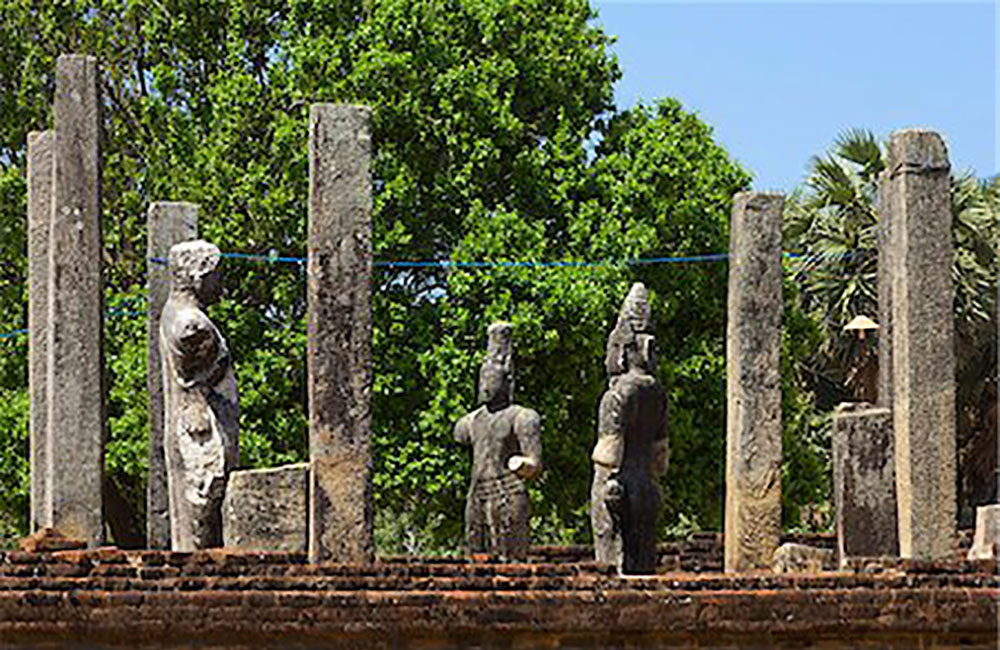
On the other hand, Muslims oppose and constantly protest new Buddhist structures, which the monks claim to have been approved by the Archaeology Department, the Land Commission, and the District Secretaries, in Deegavapi. The Deegavapi issue remains one of the important factors in the now contentious relations between Muslims and Sinhalese. Influenced by organizations such as the BBS, Sinhala Ravaya, and Parakum Sena, an organization in Devanagala, called the Devanagala Surakime Jathika Viyaparaya (National Movement for Defending Devanagala), has been formed to monitor and prevent Muslim expansion in the area (Silva, Niwas and Wickramasinghe 2016). A Muslim person from Devanagala claimed that “we cannot even dig a hole in our land to plant a tree as we may discover some archaeological object that will evoke an intervention by the Archaeology people” (Quoted in Silva, Niwas and Wickramasinghe 2016, 13).’
Dr. S. I. Keethaponcalan is Chair of the Conflict Resolution Department, Salisbury University, Maryland.


