Report: Toronto billionaire and his wife found dead in their home

Toronto billionaire and philanthropist Barry Sherman and his wife were found dead in their mansion Friday afternoon, CNN affiliate CTV reports.

The Toronto Police Service is investigating the deaths as "suspicious."

During a press conference Friday, Constable David Hopkinson would not identify the two bodies. Hopkinson said police, fire units and ambulance responded to a "medical complaint" just before noon on Friday.

Ontario politicians who spoke out on social media said the deceased were generous philanthropists.

Minister of Health Dr. Eric Hoskins tweeted: "I am beyond words right now. My dear friends Barry and Honey Sherman have been found dead. Wonderful human beings, incredible philanthropists, great leaders in health care. A very, very sad day. Barry, Honey, rest in peace."

Minister of Economic Development Brad Duguid also expressed his condolences on Twitter. "Deeply shocked & saddened to hear of the deaths of Barry & Honey Sherman. Philanthropists and entrepreneurs who made our province a better place to live."

Hopkinson said that there are no concerns for the public's safety.

"The circumstances of their death appear suspicious and we are treating it that way," he said.

According to CTV, Sherman was the chairman of generic drugmaker Apotex, which he founded in 1974. Apotex went on to become the largest Canadian-owned pharmaceutical company.

Jordan Berman, global director of corporate communications for Apotex, called the news of the deaths "tragic."

"All of us at Apotex are deeply shocked and saddened by this news and our thoughts and prayers are with the family at this time," Berman said in a statement to CNN.

Constable Hopkinson said that the investigation was still in its early stages and the deaths were not being treated as homicides.

"This is just a suspicious death. We are only investigating that as such right now. If it is determined to be a homicide, then our investigators from homicide will come in."


Report: Toronto billionaire and his wife found dead in their home

India, Australia Hold First Two-Plus-Two Foreign and Defense Secretaries Meeting

In a first, the top diplomatic and defense bureaucrats of the Indian and Australian governments met this week for a so-called two-plus-two meeting.

Indian Foreign Secretary S. Jaishankar and Defense Secretary Sanjay Mitra hosted Australian Secretary of the Department of Foreign Affairs and Trade Frances Adamson and Secretary of the Department of Defense Greg Moriarty in New Delhi for the meetings.

According to a statement released by the Indian Ministry of External Affairs, the meeting covered “All aspects of bilateral relations with a focus on strategic and defence relations between the two countries.”

In November, representatives from both India and Australia participated in a working-level quadrilateral meeting with representatives from Japan and the United States.

This so-called “Quad” had originally met in 2007 and the latest meeting focused on the concept of a “free and open Indo-Pacific,” an idea that all four sides backed in statements released after the working-level meeting.

Unsurprisingly, the India-Australia two-plus-two meeting referenced the idea: “Both sides agreed that a free, open, prosperous and inclusive Indo-Pacific region serves the long-term interests of all countries in the region and of the world at large,” the Indian Ministry of External Affairs noted in its statement.

On regional security matters, India and Australia have seen a fair bit of convergence recently. The two countries conduct bilateral naval exercises in the Indian Ocean, and Australia may potentially participate in the trilateral U.S.-India-Japan Malabar drill in the coming year.

In 2017, Australia, despite its interest, did not participate in the Malabar drills, owing to Indian hesitation. The Indian Navy nevertheless joined its Australian counterpart for the AUSINDEX drill this year.

Earlier this year, Australian Prime Minister Malcolm Turnbull visited New Delhi for a four-day state visit, where he met with his Indian counterpart Narendra Modi.

The joint statement released by the two leaders during that visit, which described them as “partners in the Indo-Pacific,” focused considerably on regional issues.

“The two Prime Ministers reaffirmed their commitment to a peaceful and prosperous Indo-Pacific, based on mutual respect and cooperation. Australia and India share a commitment to democratic values, rule of law, international peace and security, and shared prosperity,” the statement noted.

“The strategic and economic interests of both countries are converging which opens up opportunities for working together in a rapidly changing region.”

 By Ankit Panda

The Diplomat

Pic: MEA India

India, Australia Hold First Two-Plus-Two Foreign and Defense Secretaries Meeting

UN envoy : Korean tensions are world's most serious security issue

Tensions on the Korean Peninsula are the world's most dangerous security issue and must be resolved fast and diplomatically to avoid war, a top United Nations envoy said after a rare visit to North Korea.

Jeffrey Feltman, the UN under-secretary-general for political affairs, visited the reclusive nation between Tuesday and Friday, the first trip there by a top UN official in six years.

During his visit, he met with Ri Yong Ho, the North Korean minister for foreign affairs. Their meeting came at a particularly tense time -- a week after North Korea tested an advanced long-range missile and South Korea conducted military drills with its ally, the United States.

Ri and Feltman "agreed that the current situation was the tensest and dangerous peace and the security issue in the world today," the UN said in a statement.

Feltman stressed the need for relevant Security Council resolutions to be implemented, saying a diplomatic solution could be achieved through sincere dialogue.

In a statement to journalists, he said there's an "urgent need to prevent miscalculations and open channels to reduce the risks of conflict." He emphasized that the international community is alarmed by escalating tensions, and is committed to a peaceful resolution.

"Time is of the essence," he said.

Missiles and drills

North Korea remains technically at war with its neighbour South Korea after the Korean War ended in armistice but not peace in 1953.

Feltman's trip coincided with the annual Vigilante 18 military drill held by the US and South Korea, which the US Air Force says is designed to boost the "combat effectiveness" of the alliance.

North Korea's state media described the drills as "joint air war exercises targeting the DPRK," a reference to North Korea's official name, the Democratic People's Republic of Korea.

The drills came after Pyongyang test-fired a Hwasong-15 missile November 29.

It was North Korea's first ballistic missile test since September. The Hwasong-15 is believed to be its most dangerous and technologically advanced long-range ballistic missile and demonstrated a range of around 13,000 kilometres (8,000 miles), which puts most of the planet in range. North Korean state media purports it can carry a "super-large heavy warhead."

UN in North Korea

Feltman's visit to North Korea was a response to a "long-standing invitation" from Pyongyang authorities for policy dialogue, the UN said ahead of the visit.

The last senior UN official to visit North Korea was emergency relief coordinator Valerie Amos in October 2011, according to the UN. The last time an undersecretary-general for political affairs visited the country was in February 2010.

Six UN agencies are represented in North Korea, staffed by a team of about 50 people from across the globe, the UN said in a statement.

Feltman visited several UN projects in North Korea, including a pediatric hospital and Tuberculosis prevention institute.

The former American diplomat is a key adviser to UN Secretary-General Antonio Guterres on global peace and security issues. He spent nearly 30 years at the US State Department before joining the UN in 2012.

Pic Source: UN

UN envoy : Korean tensions are world's most serious security issue

France bans plastic cups, plates and cutlery

France has passed a new law to ensure all plastic cups, cutlery and plates can be composted and are made of biologically-sourced materials.

The law, which comes into effect in 2020, is part of the Energy Transition for Green Growth – an ambitious plan that aims to allow France to make a more effective contribution to tackling climate change.

Although some ecologists’ organisations are in favour of the ban, others argue that it has violated European Union rules on free movement of goods.

Pack2Go Europe, a Brussels-based organization representing European packaging manufacturers, says it will keep fighting the new law and hopes it doesn't spread to the rest of the continent.

"We are urging the European Commission to do the right thing and to take legal action against France for infringing European law," Pack2go Europe secretary general Eamonn Bates told The Associated Press. "If they don't, we will."

Bates believes there is no proof the biologically-sourced materials are more environmentally beneficial and that the ban might make the situation worse as people may misunderstand the extent of degradability.

"The ban will be understood by consumers to mean that it is OK to leave this packaging behind in the countryside after use because it's easily bio-degradable in nature. That's nonsense! It may even make the litter problem worse," he said.

Source : The Independant, UK

France bans plastic cups, plates and cutlery

New York Port Authority attack: Man held after Manhattan blast

A man is being held after an attempted terror attack at New York City's main bus terminal, officials say.

"Terrorists won't win," Mayor Bill de Blasio said after a blast at the Port Authority terminal in Manhattan during the morning rush hour on Monday.

The suspect, named as Akayed Ullah, 27, was wounded when a "low-tech explosive device" strapped to his body blew up in an underpass, officials say.

They say four other people suffered minor injuries. A photo circulating on social media shows a man, said to be the suspect, lying on the ground with his clothes ripped and lacerations on his upper body. Mayor De Blasio said he was believed to have acted alone.

The explosion occurred at about 07:30 (12:30 GMT). Andre Rodriguez, 62, told the New York Times: "I was going through the turnstile. It sounded like an explosion, and everybody started running."

Another eyewitness, Alicja Wlodkowski, told Reuters news agency that she had seen a group of about 60 people running. "A woman fell. And nobody even went to stop and help her because the panic was so scary," she said.

Nearby subway stations were evacuated, and the Port Authority Bus Terminal temporarily shut.It is the biggest and busiest bus terminal in the world, serving more than 65 million people a year.

Source: BBC

New York Port Authority attack: Man held after Manhattan blast

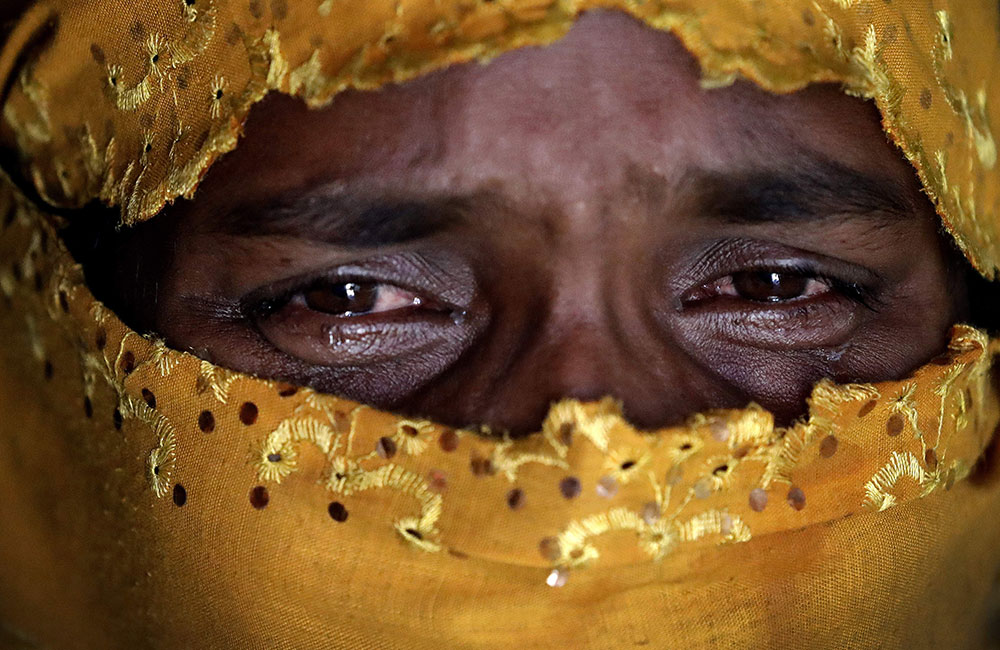
21 Rohingya women recount rape by Myanmar armed forces

UKHIA, BANGLADESH (AP): The newlyweds were asleep in their home in western Myanmar in June when seven soldiers charged in.

The woman, a Rohingya Muslim who agreed to be identified by her first initial, F, knew enough to be terrified. She knew the military had been attacking Rohingya villages, as part of what the United Nations has called ethnic cleansing in the mostly Buddhist nation. She heard just days before that soldiers had killed her parents and that her brother was missing.

Now they had come for her. The men bound her husband with rope, and tied her scarf around his mouth. They yanked off her jewelry and tore off her clothes. They threw her to the floor.

And then, she says, the first soldier began to rape her.

She struggled against him, but four men held her down and beat her with sticks. Her husband finally wriggled the gag out of his mouth and screamed.

And then she watched as a soldier fired a bullet into the chest of the man she had married only one month before. Another soldier slit his throat.

Her mind grew fuzzy. When the soldiers were finished, they dragged her outside and set her bamboo house ablaze.

It would be two months before she realized her misery was far from over: She was pregnant.

The Associated Press reported this story with a grant from the Pulitzer Center on Crisis Reporting.

The rape of Rohingya women by Myanmar's security forces has been sweeping and methodical, the Associated Press found in interviews with 29 women and girls who fled to neighbouring Bangladesh.

These sexual assault survivors from several refugee camps were interviewed separately and extensively. The women gave AP their names, but agreed to be publicly identified only by their first initial, citing fears they or their families would be killed by Myanmar's military.

They ranged in age from 13 to 35, came from a wide swath of villages in Myanmar's Rakhine state and described assaults between October 2016 and mid-September.

Yet there was a sickening sameness to their stories, with distinct patterns in their accounts, their assailants' uniforms and the details of the rapes themselves.

The testimonies bolster the U.N.'s contention that Myanmar's armed forces are systematically employing rape as a "calculated tool of terror" aimed at exterminating the Rohingya people. The Myanmar armed forces did not respond to multiple requests from the AP for comment, but an internal military investigation last month concluded that none of the assaults ever took place.

When journalists asked about rape allegations during a government-organized trip to Rakhine in September, Rakhine's minister for border affairs, Phone Tint, replied: "These women were claiming they were raped, but look at their appearances — do you think they are that attractive to be raped?"

Doctors and aid workers, however, say they are stunned at the sheer volume of rapes, and suspect only a fraction of women have come forward. Medecins Sans Frontieres doctors have treated 113 sexual violence survivors since August, a third of them under 18. The youngest was 9.

Each woman interviewed by the AP described attacks that involved groups of men, often coupled with other forms of extreme violence. Every woman except one said the assailants wore military-style uniforms, generally dark green or camouflage. The lone woman who described her attackers as wearing plain clothes said her neighbors recognized them from the local military outpost.

Many women said the uniforms bore various patches featuring stars or, in a couple cases, arrows. Such patches represent the different units of Myanmar's army.

Though the scale of these attacks is new, the use of sexual violence by Myanmar's security forces is not. Before she became Myanmar's civilian leader, Aung San Suu Kyi herself said Myanmar's armed forces used rape as a weapon to intimidate ethnic nationalities.

Yet Suu Kyi's government has not only failed to condemn the recent accounts of rape, it has dismissed the accounts as lies. In Dec. 2016, the government issued a press release disputing Rohingya women's reports of sexual assaults, accompanied by an image that said "Fake Rape."

 Pic Caption: In this Tuesday, Nov. 21, 2017, photo, K, 25, right, cries as she recounts being gang raped by members of Myanmar's armed forces during an interview with The Associated Press in her tent in Kutupalong refugee camp in Bangladesh (AP File Photo)

21 Rohingya women recount rape by Myanmar armed forces