
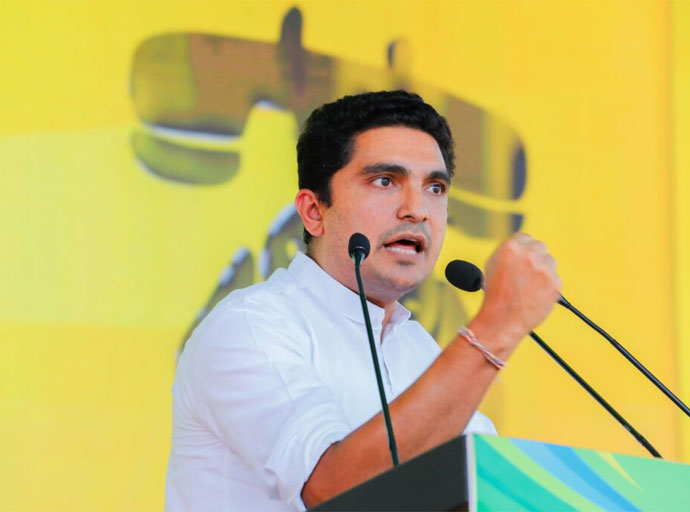
Sri Lanka's government has achieved less than 10 percent efficiency on its justice and rule-of-law pledges over two years while undermining transparency through the 22nd Constitutional Amendment, Samagi Jana Balawegaya (SJB) MP Prasad Siriwardana said.
He made these remarks in Parliament on Thursday (26).
Siriwardana said that the government campaigned on building rule of law, an equal-access court system, transparency, efficiency, and public trust, yet its performance amounts to 90 percent rhetoric and 10 percent action.
He urged the government to reverse that ratio during the current year so that action reaches 90 percent and rhetoric drops to 10 percent.
He said that the 22nd Constitutional Amendment has eroded transparency despite warnings from judges, the Bar Association, and international organizations.
He also pointed out that two years have passed without fulfilling pledges to abolish the executive presidency or introduce a new constitution, noting that legislators who once stepped down from presidential candidacies over abolishing the executive presidency have left those promises unfulfilled.
Turning to the courts and prison congestion, Siriwardana noted that while prosecuting genuine wrongdoing is acceptable, state institutions opposing bail during ongoing trials in cases involving MPs Chamara Sampath and Namal Rajapaksa raises serious concerns.
He emphasised that granting bail is the international norm, whereas opposing bail and jailing ordinary citizens before conviction for minor offenses worsens overcrowding and runs counter to fairness and humanity.
Siriwardana further called for clear statutory definitions and new penalties for contempt of court, saying that sentencing someone unfamiliar with legal procedures to 15 or 20 years in prison merely for speaking loudly in court is unfair.
He also highlighted legal and administrative gaps in executing presidential pardons, citing the controversy surrounding Ven. Gnanasara Thero's pardon in which paperwork issues led to re-imprisonment after a pardon had been granted and acted upon.
Addressing reconciliation and budget priorities, Siriwardana noted that no funds were allocated in the budget for mechanisms under the Ministry of National Integration, including the Office on Missing Persons, the Office for Reparations, and a truth commission.
He also pointed to a Tamil lawmaker's question raised during the debate asking why commemorations are permitted for deceased Janatha Vimukthi Peramuna (JVP) members who fought for Sinhalese people while Tamil people are barred from commemorating LTTE members.
He warned that such unresolved grievances fuel ethnic tension and undermine reconciliation pledges.