
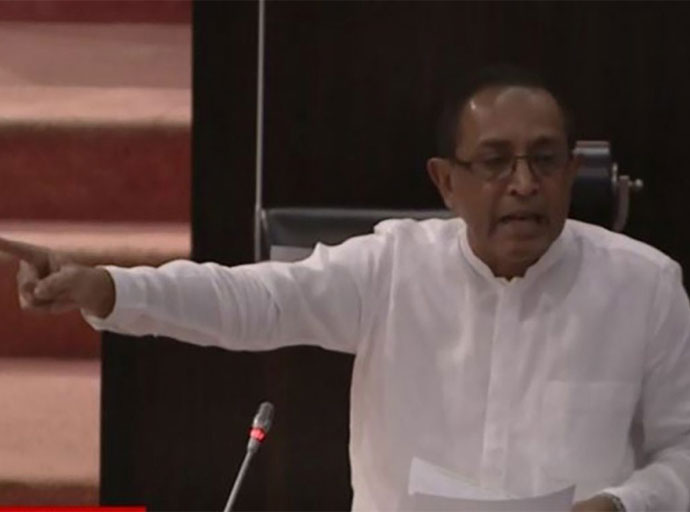
Samagi Jana Balawegaya (SJB) Member of Parliament Kabir Hashim told Parliament that the government inherited a stabilising economy rather than a collapsed one in November 2024 following the March 2023 International Monetary Fund (IMF) programme, noting that its real test lies in delivering practical policies that improve people’s lives.
Opening the opposition’s remarks in the budget debate, Hashim said that while the government pointed to higher economic growth as well as rising tax and VAT revenues, those figures masked everyday economic hardship and structural weaknesses.
Citing the principle that development is about transforming people's lives rather than economic metrics alone, he argued that household welfare must come first.
*Poverty and tax burden*
Pointing to Household Income and Expenditure Survey (HIES) findings, varying poverty figures cited by institutions and officials, and rising gold-backed pawning loans, Hashim said many families were relying on savings or borrowing to bridge monthly living expenses.
He said that revenue growth had come largely through indirect taxes affecting ordinary consumers rather than through expanding the tax base or generating new jobs.
Contrasting tax concessions for luxury apartment developments and ultra-luxury vehicle imports with taxes on building materials for ordinary families and levies on mobile reloads and internet data, he said everyday living costs remained heavy.
*Capital spending*
Hashim argued that the budget lacked a clear strategy to create jobs for young people entering the labour market, warning of job losses amid business and facility closures, pressure on small and medium enterprises, and slow capital expenditure execution.
While acknowledging external shocks such as Middle East tensions, he said the administration should pursue concrete results despite challenges, contrasting its approach with programmes launched during former president Ranasinghe Premadasa’s era amid domestic and international conflict.
Welcoming the President’s call in the budget address for a civil political culture and room for differing views, Hashim said the SJB had its own policy approach and urged cooperation grounded in the "Saptha Aparihaniya Dharma" principles to advance the country.