
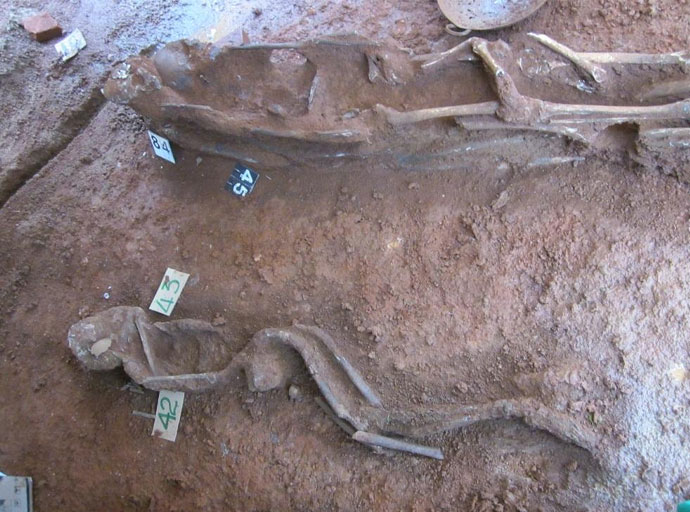
A High Court in Sri Lanka has commenced considering a request to reopen the investigation into the third largest mass grave discovered in Sri Lanka. The probe had been put on hold for eleven years.
A silent vigil was held by relatives of the disappeared in Matale town early Wednesday (11) before the commencement of court proceedings.
The vigil preceded by a march was led by human rights activist and Chairman of the Families of the Disappeared (FoD), Brito Fernando.
On 16 July 2026, Matale Magistrate Harshana Dhanushka Ratnayake dismissed a request made by victims of enforced disappearances in 88-89 to reopen the case concerning the mass grave discovered in late 2012 on the premises of the Matale General Hospital as the case had been closed since 2015.
He had stated that the matter should be taken before a higher court in line with the advice of the Attorney General because a verdict delivered by a predecessor could not be reviewed by the same court.
Accordingly, Attorney Himali Kularatne, who appeared before the High Court on behalf of the petitioners, informed Matale High Court Judge Nalin Hewawasam on 11 November that more names may be added to the list of the 18 affected relatives of missing persons in the future.
According to provincial reporters, a large number of relatives of the disappeared were present at the silent vigil as well as the court.
They have been searching for their loved ones who have gone missing following arrest or abduction during the southern youth armed insurrection in the late 80s.
The uprising was launched by Janatha Vimukthi Peramuna (JVP), the leading party in the current National People’s Power (NPP) government.
Attorney Kularatne, representing petitioners, told journalists that she drew the High Court's attention to the fact that although three reports had been submitted regarding the human remains found in the Matale mass grave, the case was closed in 2015 based solely on the third report.
“The Sri Lankan judicial medical officer submitted certain concerns that had drawn his attention. Archaeologist Raj Somadeva then submitted a report, while Beta Analytic conducted a carbon dating test. Based on the third observation, the case has been closed on the grounds that the remains were the result of an epidemic that had occurred around 1950. That opinion was accepted. Therefore, my argument was that although there were three different sets of concerns, only the third was taken into consideration. I mainly pointed out that the first and second concerns were not considered.”
After 155 human skeletons were exhumed from a site near Matale Hospital in 2013, reports submitted by Judicial Medical Officer Dr. Ajith Jayasena and archaeology professor Raj Somadeva concluded that the skeletal remains dated back to the 1986-1990 insurrection in the south.
However, a report submitted to the court by the police, claiming to have been issued by Beta Analytic based in Miami, Florida, concluded that the human skeletal remains found at the site dated back to a period before 1950.
Attorney Kularatne further told reporters that she had requested the Matale High Court to conduct DNA tests on the human skeletons exhumed from the mass grave, a request that had previously been made before the Magistrate's Court.
“I had informed the Magistrate's Court that if these DNA tests were not conducted promptly, the results could be compromised.”
Granting attorney Kularatne time to make further oral submissions on behalf of the petitioners on 13 January 2027, Matale High Court Judge Nalin Hewawasam questioned her as to why the relevant parties had remained silent for so long before requesting the reopening of the case.
“I said that multiple changes could happen depending on the circumstances. These include their financial situations, economic hardships, and the disappointment and loss of confidence resulting from repeatedly filing complaints without success. Their family members had died, and they had to take care of those who remained,” she added.
Judge Nalin Hewawasam further stated in open court as the Matale mass grave court case was largely document-based, he wanted to study original copies of the documents.
Hundreds of people went missing in the Matale district during the JVP insurgency, and Gotabaya Rajapaksa was the District military coordinating officer in overall charge of the district at the time.
He was secretary of defence in his sibling Mahinda Rajapaksa’s administration and had a two year stint as president until ousted by the 2022 ‘Aragalaya’ popular uprising.
An investigative report published in 2022 by Journalists for Democracy in Sri Lanka (JDS) and the International Truth and Justice Project (ITJP) revealed that more than 700 people had disappeared while in the custody of officers under his command in 1989.
In a letter addressed to the Sri Lankan government in 2023 based on the report, a UN panel of experts sought information on investigations conducted by the government to hold Gotabaya Rajapaksa and his associates, who are accused of committing crimes, accountable.
“The allegations received also refer to a complete lack of accountability and judicial action against the State authorities identified as the main perpetrators of the violations committed,” said the experts.
However, no response has been provided to date