
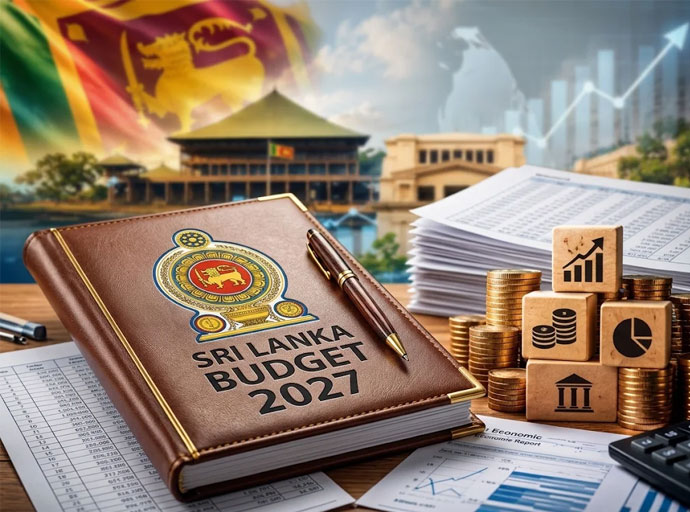
Sri Lanka's 2027 National Budget presents President Anura Kumara Dissanayake's National People's Power (NPP) Government with a defining opportunity to move the country beyond economic stabilisation towards sustainable growth, employment generation and improved living standards.
Presented against the backdrop of an economic crisis that devastated household incomes, weakened businesses and pushed millions into financial insecurity, the Budget must demonstrate how the Government intends to translate improved macroeconomic indicators into tangible economic benefits for the population.
The challenge is particularly significant because the country is attempting to maintain fiscal discipline under the International Monetary Fund's Extended Fund Facility while responding to growing demands for public investment, salary increases, welfare assistance and relief from the escalating cost of living.
With proposed expenditure of approximately Rs. 4,992.77 billion and a borrowing ceiling of Rs. 3.8 trillion, the Government has limited fiscal space to accommodate competing demands.
Nevertheless, the success of the Budget should not be measured exclusively by its ability to meet revenue targets, maintain a primary surplus or satisfy international financial commitments. Its broader responsibility is to establish an economic environment in which households, entrepreneurs and investors can regain confidence.
One of the most pressing issues is the widening gap between income growth and the cost of maintaining an ordinary standard of living. Middle-income families, public and private-sector employees, pensioners and self-employed people continue to face substantial pressure from food, electricity, transport, education, healthcare and housing expenses.
The proposed allocation of approximately Rs. 330 billion for the final phase of public-sector salary restructuring is significant. However, the Government must also recognise the difficulties confronting private-sector employees, whose salary adjustments depend largely on the financial capacity of individual enterprises.
Small and medium-scale enterprises are another critical component of the economic recovery. These businesses generate employment, support domestic production and contribute to government revenue. Yet high operating costs, limited access to affordable credit, taxation and inconsistent market demand continue to restrict their expansion.
The Budget must therefore move beyond providing financial assistance to selected sectors and establish a comprehensive framework for SME development, including accessible financing, technology adoption, export opportunities and reduced regulatory barriers.
Agriculture and manufacturing also require greater attention. Reducing dependence on imported goods while strengthening domestic production would help conserve foreign exchange, create employment and improve the country's resilience against international market disruptions.
Investment promotion must similarly move beyond announcements of proposed projects. Investors require policy consistency, transparent approvals, reliable infrastructure, predictable taxation and confidence that contractual commitments will be honoured.
The Government's revenue strategy is equally important. Expanding the tax base, improving compliance, reducing evasion and strengthening the administration of revenue institutions are preferable to placing an increasingly disproportionate burden on existing taxpayers.
The challenge is to achieve these objectives without compromising the fiscal commitments essential to maintaining economic stability.
Ultimately, Budget 2027 must establish a credible transition from crisis management to economic development. Sri Lanka cannot afford another financial recovery that produces encouraging national statistics while leaving ordinary citizens struggling to meet their monthly expenses.
The Government's real achievement will be determined by whether its economic policies create better employment, stronger businesses, higher productive investment and improved household purchasing power.
The November 12 Budget must therefore be more than an exercise in balancing national accounts. It must become a practical roadmap for restoring public confidence and building an economy that delivers prosperity beyond the boundaries of economic recovery.
A significant last-minute development to incorporate: On November 11, the President reviewed the final Budget proposals. The Government indicated that Rs. 2 trillion would be allocated exclusively for capital expenditure, signalling an emphasis on investment-led expansion.
This deserves particular scrutiny: the effectiveness of that allocation will depend on actual project implementation, employment creation, productivity improvements and returns on public investment not merely the announced expenditure.
The Budget must also be assessed against the IMF's 2.6% primary-surplus target for 2027 and the approaching conclusion of the current IMF programme in March 2027.