
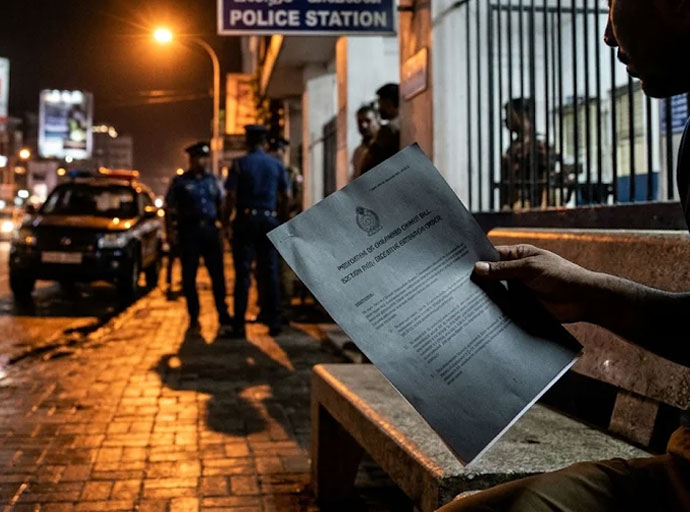
The government has presented key Committee Stage amendments to the proposed Prevention of Organised Crimes Bill following 26 petitions filed in the Supreme Court, though critics warn that extensive executive detention powers remain largely intact.
Solicitor General Viraj Dayaratne informed the Supreme Court that the state would revise controversial elements of the draft legislation, following constitutional challenges brought by the Bar Association of Sri Lanka and other civil society groups.
Under the revised text, the permitted period for initial police custody before presenting a suspect to a Magistrate has been reduced from 72 hours to 48 hours.
However, Section 21(3) continues to empower the Secretary to the Ministry responsible for the Police to issue executive detention orders for two-month intervals, extending up to a maximum of one year.
Legal oversight at the initial production stage remains restricted, as Magistrates are still required to give effect to executive detention orders presented by the authorities.
The government has completely removed Section 14(3), which had previously criminalised the reporting of judicial proceedings without prior court approval under threat of a two-year prison sentence.
Despite this removal, legal experts maintain concerns over Section 56, which penalises the disclosure of information that could prejudice an investigation with up to 10 years imprisonment.
The Bar Association of Sri Lanka warned that the broad scope of Section 56 could expose journalists, whistleblowers, and public-interest reporting on police misconduct to criminal prosecution.
The amended draft also removes provisions that allowed courts to consider physical features such as tattoos, clothing styles, and hand signals to determine criminal gang membership.
Courts may still evaluate suspicious associations with known gang figures, provided the individual knowingly attended meetings or received benefits from an organised group.
Procedural changes to Section 17 establish a general requirement for search warrants, though officers may conduct warrantless searches under emergency conditions if written justifications are recorded.
Rules allowing police confessions taken by an officer of Assistant Superintendent rank or above to be admitted as evidence have been retained under Sections 46 and 47, alongside powers allowing senior officers to access telecommunications records without prior court orders.
The retention of executive detention orders, police confession admissibility, and broad surveillance powers demonstrates that fundamental constitutional concerns persist despite public-interest amendments.