
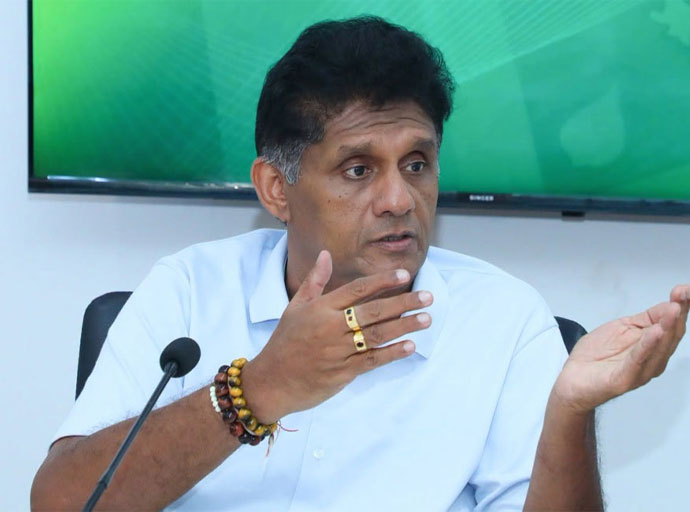
Opposition Leader Sajith Premadasa has condemned the government's handling of the recent Colombo floods, accusing the administration of failing to perform basic infrastructure maintenance despite promises of rapid reform.
Issuing a special statement yesterday (08), Premadasa highlighted how severe urban inundation had devastated local communities following heavy rainfall across the Western Province.
A lack of development in Colombo's drainage infrastructure alongside an inability to clear waste from existing channels had directly caused the recent crisis, according to the Opposition Leader.
He noted that the NPP government had been elected on a mandate to deliver widespread progress within six months, yet it had failed even to clean the municipal drainage channels.
Addressing local municipal claims that the capital's network could only handle between 30mm and 50mm of rain, Premadasa pointed out that historical weather records demonstrated the city had weathered far higher precipitation levels in previous decades.
Meteorological data recorded peak rainfalls of 493.7mm in 1992 and 440.2mm in 2010 without causing comparable structural disasters, he explained.
Experts had consistently identified poor water drainage as the primary factor behind urban flooding, making the repair, upgrading, and routine maintenance of the network an urgent necessity.
Premadasa claimed that had his party held power, it would have installed an advanced storm water drainage network modeled on Singaporean infrastructure.
Such a system would feature integrated collection facilities, underground storage tanks, high-capacity pumping operations, and green urban infrastructure.
Sri Lanka must also study flood management strategies from the Netherlands, including large-scale flood barriers, underground storage, and river expansion projects to adapt modern technologies for local conditions.
The Samagi Jana Balawegaya (SJB) leader urged the government to move past political blame games and leverage its parliamentary majority to collaborate with the opposition on long-term preventive solutions.