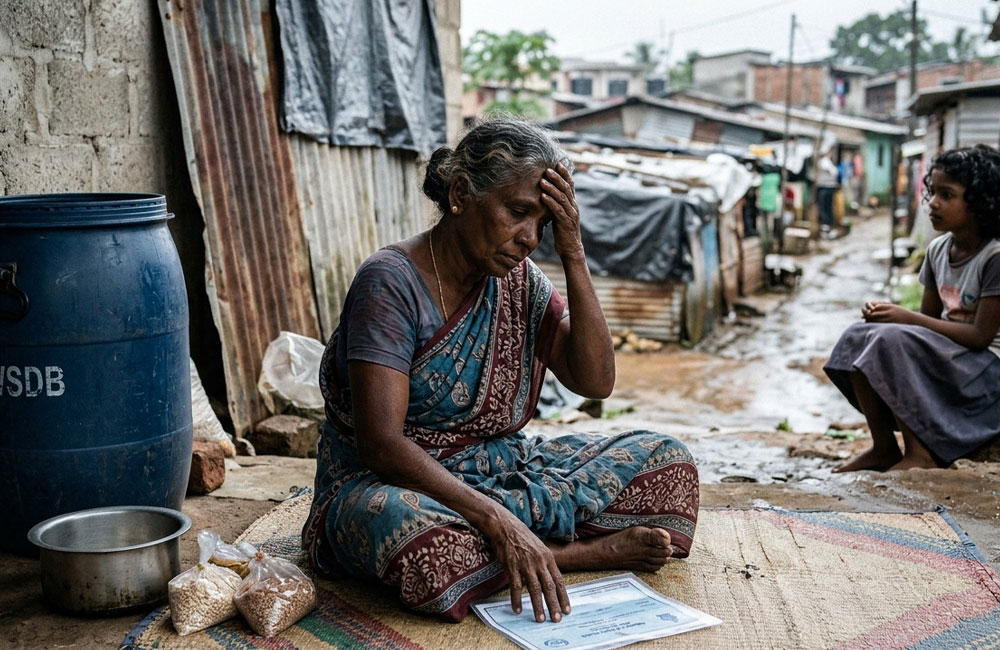
Sri Lanka's flagship social safety programs are failing to prioritize the country's most vulnerable households when major economic, health, and climate crises strike.
A study released by the Institute of Policy Studies in Colombo revealed that state welfare benefits are distributed uniformly without accounting for a family's vulnerability to external shocks.
Research fellow Dr Ganga Tilakaratna presented the findings, drawing from the think tank's annual flagship report.
The analysis evaluated cumulative family exposure across thirteen categories of crises, including the coronavirus pandemic, recent economic volatility, and recurring natural disasters.
Data compiled from thousands of surveyed homes revealed that over eleven percent of local households face severe cumulative shock exposure, while more than half endure moderate risks.
Although primary welfare schemes like Aswesuma cover nearly thirty percent of all households, the study found no direct link between crisis vulnerability and actual welfare distribution.
Within the lowest income bracket, overall assistance dropped significantly for families enduring high crisis exposure compared to less vulnerable peers, leaving forty-five percent of highly exposed low-income homes completely unsupported.
The estate sector, while showing improved general coverage compared to previous government initiatives, recorded lower benefit rates for high-exposure households than for low-exposure ones.
To address these systemic flaws, policy analysts outlined actionable reforms centered on digital integration and rapid emergency deployment.
Healthcare adaptations
The research institution advised linking all safety net operations directly into a centralized integrated welfare management platform to capture excluded families.
Experts recommended connecting welfare databases with national disaster registries to instantly identify vulnerable populations in high-risk zones.
The proposed strategy calls for predefined emergency expansion protocols, digital payment architecture, and dedicated financing mechanisms to ensure swift resource mobilization during crises.
Investments in labor market initiatives were also cited as critical for strengthening long-term financial independence across local communities.
Beyond general social protection, the presentation emphasized the urgent need to prepare Sri Lankan institutions for a rapidly aging population.
Assessments of the national healthcare system uncovered structural deficits, including a lack of age-specific health data, supply chain disruptions, and an absence of dedicated financing for long-term care.
Proposed health interventions include reinforcing primary medical services, expanding digital health solutions like telemedicine, and reducing personal medical spending for elderly citizens through targeted subsidies.
Leave your comments
Login to post a comment
Post comment as a guest