The disqualification of one of two bidders for the Bandaranaike International Airport expansion has left the Government negotiating with a single contractor. Now, allegations of an additional US$190 million demand raise urgent questions about competition, procurement delays and the protection of public funds.
Sri Lanka is still recovering from one of the gravest economic crises in its history. Every dollar of public expenditure matters. Every foreign-funded development project must be subjected to rigorous scrutiny, and every government institution entrusted with procurement decisions must be able to demonstrate that it has protected the interests of the people.
Against this background, troubling questions have emerged concerning the long-delayed expansion of Bandaranaike International Airport (BIA), one of the country's most strategically important infrastructure projects.
At the centre of the controversy is a straightforward question:
How did an international tender that attracted two bidders end up with only one eligible contractor, and could that loss of competition now expose Sri Lanka to an additional US$190 million in costs?
The answer deserves immediate public scrutiny.
From competitive tender to single-bidder negotiations
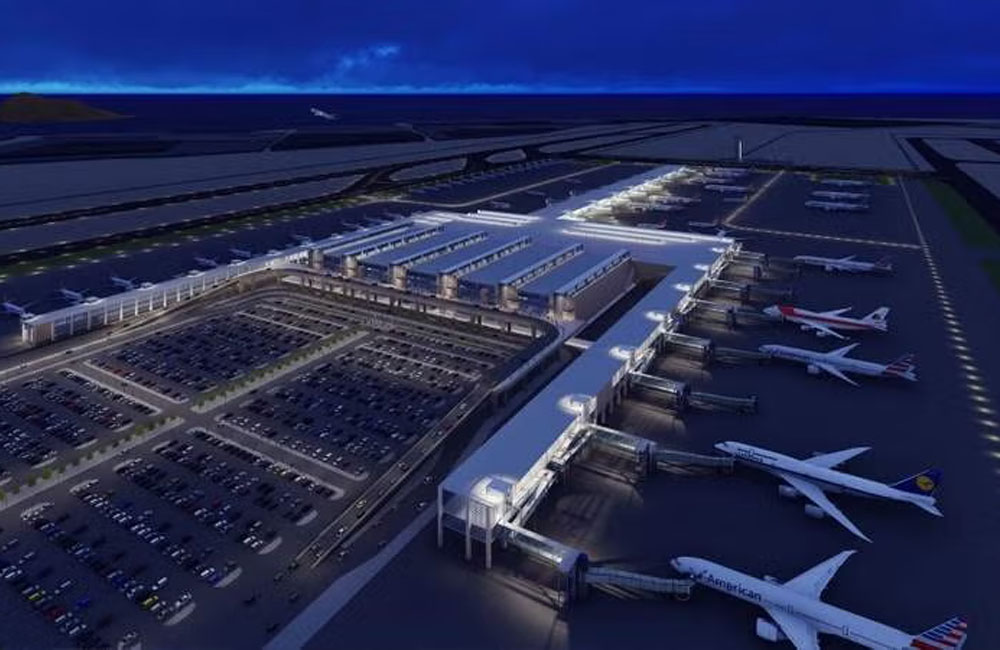
The airport expansion project, financed through Japanese development assistance, was intended to transform Sri Lanka's principal international airport, increase passenger capacity and strengthen the country's position as an aviation and tourism hub.
The Japan International Cooperation Agency (JICA) formally welcomed the renewed tender process in September 2024, identifying the project as an important element of economic cooperation between Japan and Sri Lanka.
Two bidders subsequently participated in the tender: Japan's Taisei Corporation and the Sojitz–Larsen & Toubro consortium.
However, following the technical evaluation, the Sojitz–L&T consortium was declared technically non-responsive, leaving Taisei as the sole responsive bidder. The selection subsequently received JICA's concurrence, according to reporting published in July 2026.
The legal and technical justification for Sojitz's disqualification must be assessed against the actual tender documents. A bid that fails mandatory requirements cannot simply be retained to preserve competition.
Nevertheless, the elimination of the only competing bidder has fundamentally changed the Government's commercial negotiating position.
With no alternative financial bid remaining in contention, the authorities must now demonstrate how they intend to establish that the final contract price represents fair market value.
This is not merely a procedural question. It goes to the heart of protecting public money.
The alleged US$190 million increase: A question that cannot be ignored
Information concerning the ongoing negotiations raises an especially serious concern: that Taisei is seeking approximately US$190 million above its originally quoted tender price.
If substantiated, the proposed increase would represent an extraordinary additional financial commitment.
For perspective, US$190 million is equivalent to approximately Rs. 45 billion at an illustrative exchange rate of Rs. 300 per US dollar.
That is money which could otherwise support essential public infrastructure, healthcare, education, disaster preparedness and other national priorities.
It is also a substantial amount of foreign exchange for an economy still working to strengthen its external financial position.
The authorities must therefore disclose whether such an increase has actually been requested, the contractual basis on which it is being sought and whether the Government has any legal obligation to consider it.
Can a delay justify an additional US$190 million?
One explanation reportedly being advanced is that considerable time has elapsed since the tender process began, exposing the contractor to increases in labour, materials, equipment and other construction costs.
Construction inflation and geopolitical disruptions are legitimate commercial considerations. Major international contracts frequently contain provisions addressing price adjustments, changes in law, force majeure and exceptional cost movements.
But these provisions exist precisely because contractors and employers must allocate foreseeable commercial risks before submitting and accepting bids.
A passage of time does not, by itself, entitle a bidder to disregard its quoted price or demand an unlimited revision.
Questions have also been raised about whether the applicable tender conditions limit permissible price adjustments to approximately US$20 million over the contract period.
That alleged ceiling requires verification against the actual bidding documents. If confirmed, the authorities must explain how any substantially larger adjustment could be justified within the contractual and procurement framework.
If the original tender does not permit the proposed increase, the Government should not treat it as an unavoidable cost merely because negotiations have reached an advanced stage.
The correct response would be to examine the available contractual remedies and procurement alternatives, including the financial and operational consequences of any further delay.
Who bears responsibility for the delay?
The Government cannot assess the proposed contract price without also examining how the project reached its present position.
The renewed tender was announced in September 2024. Bids closed in March 2025, following extensions to the submission deadline.
According to published audit reporting, the Technical Evaluation Committee completed its evaluation in November 2025, while financial proposals were opened only in April 2026.
By July 2026, negotiations over the contract amount were still continuing.
This prolonged process raises an unavoidable question:
If delays in evaluation, approvals or negotiations have materially increased project costs, who is accountable for those delays?
Responsibility cannot automatically be assigned to any one institution without examining the relevant records. Some delays may have been justified by technical complexity, financing requirements or mandatory procurement procedures.
But taxpayers are entitled to know whether every stage was conducted efficiently, whether avoidable delays occurred and whether the additional costs could have been prevented.
An institution entrusted with safeguarding public resources must be able to explain not only why it selected a particular bidder, but also whether its decisions preserved value for money.
The Auditor General's findings make the matter even more serious
The airport project already carries a significant history of financial losses and additional expenditure.
According to the Auditor General's findings reported by the Sunday Times, substantial amounts were paid in connection with the termination of the earlier construction contract.
The report identified termination-related payments of approximately JPY 7.76 billion and Rs. 6.64 billion during 2025.
It also highlighted expenditure on protective works and other activities undertaken while the project remained incomplete.
These findings do not establish misconduct by the current tender participants. They do, however, demonstrate the considerable financial consequences of the project's prolonged interruption.
The public is therefore entitled to ask how much more Sri Lanka may ultimately pay before the new terminal becomes operational.
A comprehensive accounting should identify the original contract value, payments already made, termination-related settlements, preservation costs, consultancy fees, financing charges and any proposed increase under the replacement contract.
Without that information, it is impossible to determine the true cost of completing the airport expansion.
A troubling question about the integrity of public procurement
The most serious concern is not simply whether one contractor is requesting a higher price.
It is whether Sri Lanka's procurement framework is adequately protecting the public interest when a competitive tender effectively becomes a single-bidder negotiation.
A properly conducted technical evaluation may legitimately eliminate a non-compliant bidder. But when that decision leaves only one bidder, it becomes especially important to demonstrate that the evaluation was objective, consistent and supported by documented evidence.
The public should be given confidence that the disqualification was neither arbitrary nor designed to favour any particular participant.
Equally, the remaining bidder must not be permitted to exploit the absence of competition to obtain unjustified commercial concessions.
These concerns establish corruption or wrongdoing and, the combination of a single responsive bidder, prolonged delays, undisclosed financial negotiations and allegations of substantial price escalation creates a compelling case for independent scrutiny.
Transparency is the most effective way to resolve these questions.
Seven questions the Government must answer
The Ministry of Ports and Civil Aviation, AASL and the relevant procurement authorities should urgently clarify:
- What was Taisei's original financial bid, and has an additional US$190 million been requested? If so, what is the precise amount and justification?
- Why was the Sojitz–L&T consortium disqualified? Which mandatory technical requirements were not satisfied, and were the same standards consistently applied to both bidders?
- What do the tender documents permit regarding price escalation? Is there a contractual ceiling, and what legal basis exists for any adjustment beyond it?
- Why did the procurement process take so long? Which stages contributed most to the delay, and were those delays unavoidable?
- What is JICA's position on the final price and financing arrangements? Has any proposed additional cost been reviewed and approved?
- What is the full cumulative cost of the airport expansion to date? This should include prior payments, termination costs, preservation works, consultancy expenses and the proposed replacement contract.
- Has an independent value-for-money assessment been undertaken? If so, will the Government publish its conclusions before any final award?
These are reasonable questions concerning a project financed through public resources and international development assistance.
Development must proceed—but not at any price
Sri Lanka urgently needs the expanded airport.
The existing infrastructure constrains the country's long-term aviation ambitions. A modern terminal would support tourism, international connectivity, investment and future economic growth.
Japan has remained an important development partner, and JICA's continued commitment to the project deserves recognition.
But the importance of completing the airport cannot become a justification for accepting costs that have not been properly examined.
The Government must balance the economic cost of further delays against the financial consequences of accepting any proposed contract increase.
That requires an independent technical and commercial assessment—not an assumption that the sole remaining bidder's revised price must necessarily be accepted.
Public money is not an unlimited contingency fund
Sri Lankans have endured years of economic hardship, higher taxation and pressure on household incomes.
At a time when the public is being asked to exercise financial discipline, the institutions spending public money must be held to the same standard.
An alleged US$190 million increase in a major infrastructure contract is not a minor administrative adjustment. It is a matter of national financial significance.
If the increase is commercially and contractually justified, the Government should publish the evidence.
If it is not justified, the Government should protect the public purse and pursue lawful alternatives.
And if an independent investigation identifies negligence, procedural irregularities, conflicts of interest or corrupt conduct, the responsible parties should be held accountable through the appropriate legal processes.
Sri Lanka cannot afford a procurement culture in which delays accumulate, competition disappears and the final bill grows without a transparent explanation.
The airport must be completed. But it must be completed through a process that is lawful, accountable, commercially defensible and demonstrably in the public interest.
The immediate priority is clear: before any final contract award, disclose the proposed price, explain the escalation, publish the basis of the tender evaluation and establish whether Sri Lanka is receiving genuine value for money.
The public deserves nothing less.
Leave your comments
Login to post a comment
Post comment as a guest